Twelve USDT Calls, Nine Wallets: Tracing the Reported Tronify Impersonation Case

October 06, 2026
 ChainBounty investigation · USDT token shown for context; no endorsement or attribution to the issuer.
What the records show. One address initiated twelve USDT calls that debited nine token-holder addresses. Two collecting addresses later sent 51,000 USDT to a single destination. These are two distinct observations—not two amounts to add together as a loss total.
The movements behind the report
Between 7 and 28 September 2026, twelve USDT calls on TRON debited nine different token-holder addresses for a combined 15,864.609801 USDT. The calls had one feature in common: the same collecting address initiated every transaction. On 30 September, that address and a second collector sent a separate total of 51,000 USDT to one destination, 81 seconds apart.
Public allegations concerning Tronify.rent / tron.store prompted the review. To understand what the ledger supports, this report follows three questions: who initiated the twelve calls, what their amounts measure, and where the collectors subsequently sent funds. It then separates those observations from the unresolved questions of authorization, consent and operator identity. The 51,000 USDT consolidation is not a verified loss total, and its provenance has not been fully reconciled with the earlier calls.
Measure | Result / scope |
|---|---|
Report version | 1.2 · structural and explanatory revision, 6 October 2026; evidence window unchanged |
Network | TRON mainnet; TRC-20 USDT |
Primary period | 1–30 September 2026 UTC |
Follow-up cutoff | 6 October 2026, 02:46:45 UTC, as stated by investigation source |
Verified payment subset | 12 transferFrom calls; 9 distinct token holders; 15,864.609801 USDT |
Verified consolidation | 2 transfer calls; 51,000 USDT received in 81 seconds |
Public allegations | Approximately $69,651 / 80 victims; not reconciled or independently established |
────────────────────────────────
Timeline — the ledger observations came before the public reports
UTC period / time | Event | Evidence level |
|---|---|---|
7–28 September | Twelve transferFrom calls in the verified subset | Independently checked |
30 September 16:24:54–16:26:15 | Two collector sweeps into H | Independently checked |
1–5 October | Nine additional TRX-seeded addresses reported; subsequent payments not established | Investigation source only |
5 October; exact post times not established | Initial public allegations and subsequent infrastructure correction | Public source attribution |
────────────────────────────────
The three addresses followed in this report
C1 and C2 are labels for the two collecting addresses; H labels the destination of their later transfers. C2 has two observed roles: it submitted all twelve calls and received tokens in some of their events. These labels describe activity, not identity or ownership.
Role | Full address | Evidence boundary |
|---|---|---|
C2 · caller / collector | Owner of every payment call; recipient in some events | |
C1 · collector | Recipient in other payment events | |
H · consolidation | Receives the two later sweep transfers |
1. The address that called the contract was not the holder being debited
A token movement has more than one relevant actor. The transaction owner identifies the address that submitted the call; the From field in the token-transfer event identifies the address whose token balance was debited. Those fields need not name the same address. In all twelve inspected calls, the owner is C2, while the token-event From field names another holder. The calls use transferFrom rather than transfer, and all twelve are recorded as successful and confirmed. The USDT contract is TR7NHqjeKQxGTCi8q8ZY4pL8otSzgjLj6t.
The distinction changes how these movements should be described. They were not twelve direct transfers submitted by the holders whose balances decreased: C2 called the contract to move those balances. The transferFrom method is a delegated-transfer mechanism, but the method name does not explain how authorization was obtained. Approval records and wallet interactions are needed to distinguish informed delegation from deceptive authorization; the calls alone do not establish which website, if any, induced it.
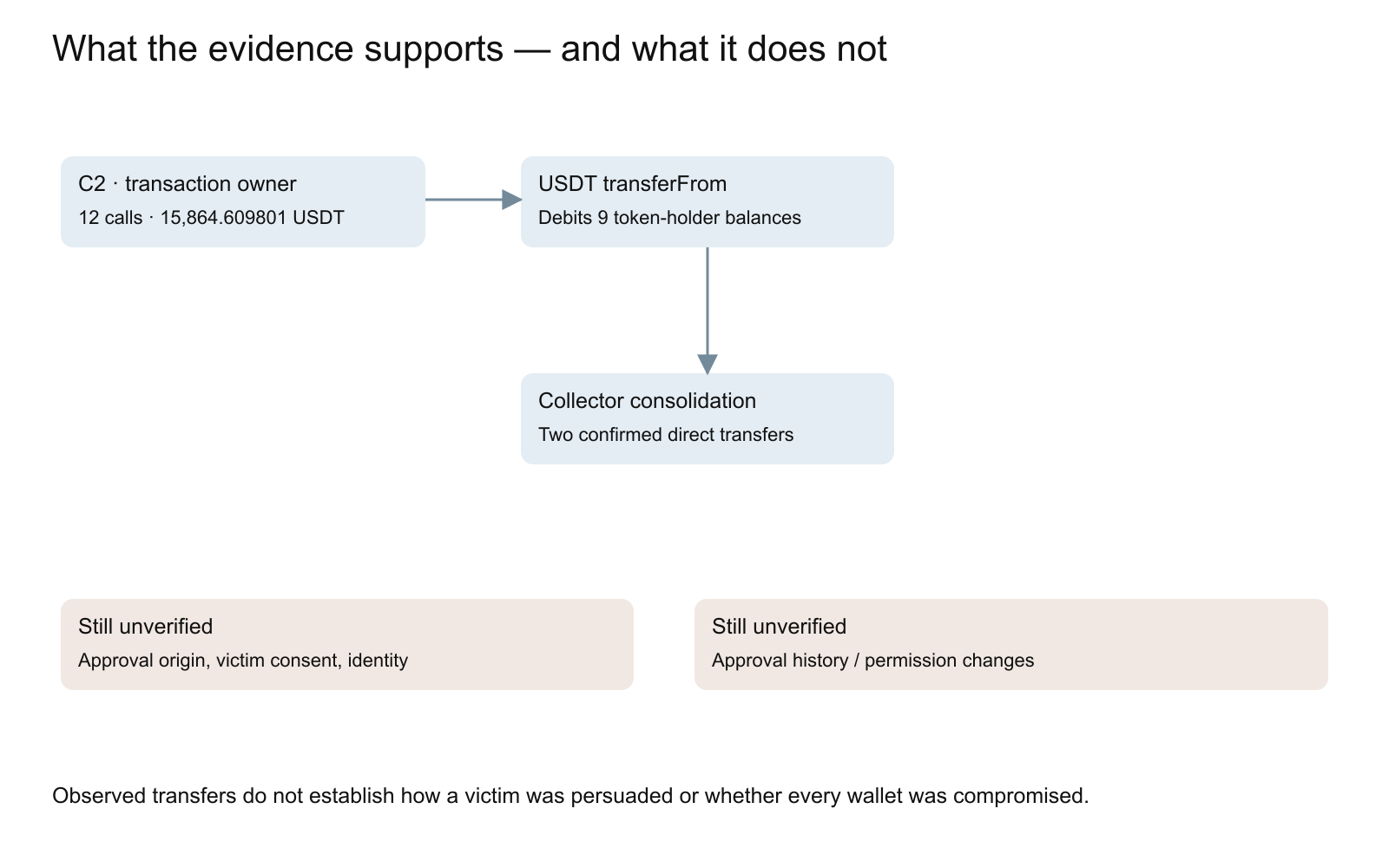 Figure 1 — Delegated-transfer mechanism. Evidence P1–P12: C2 is the transaction owner; the token-event From field names the debited holder. Approval creation and consent remain unverified.
────────────────────────────────
2. What the 15,864.609801 USDT total measures
Once the caller and the debited holders are separated, the next question is how much moved in this examined set. Adding each of the twelve transaction-event amounts once, using the transaction hash to avoid duplicates, gives 15,864.609801 USDT. Nine distinct holder addresses appear because some addresses were debited more than once. Twelve events therefore do not mean twelve victims—and the ownership and victim status of those nine addresses are not established by the count.
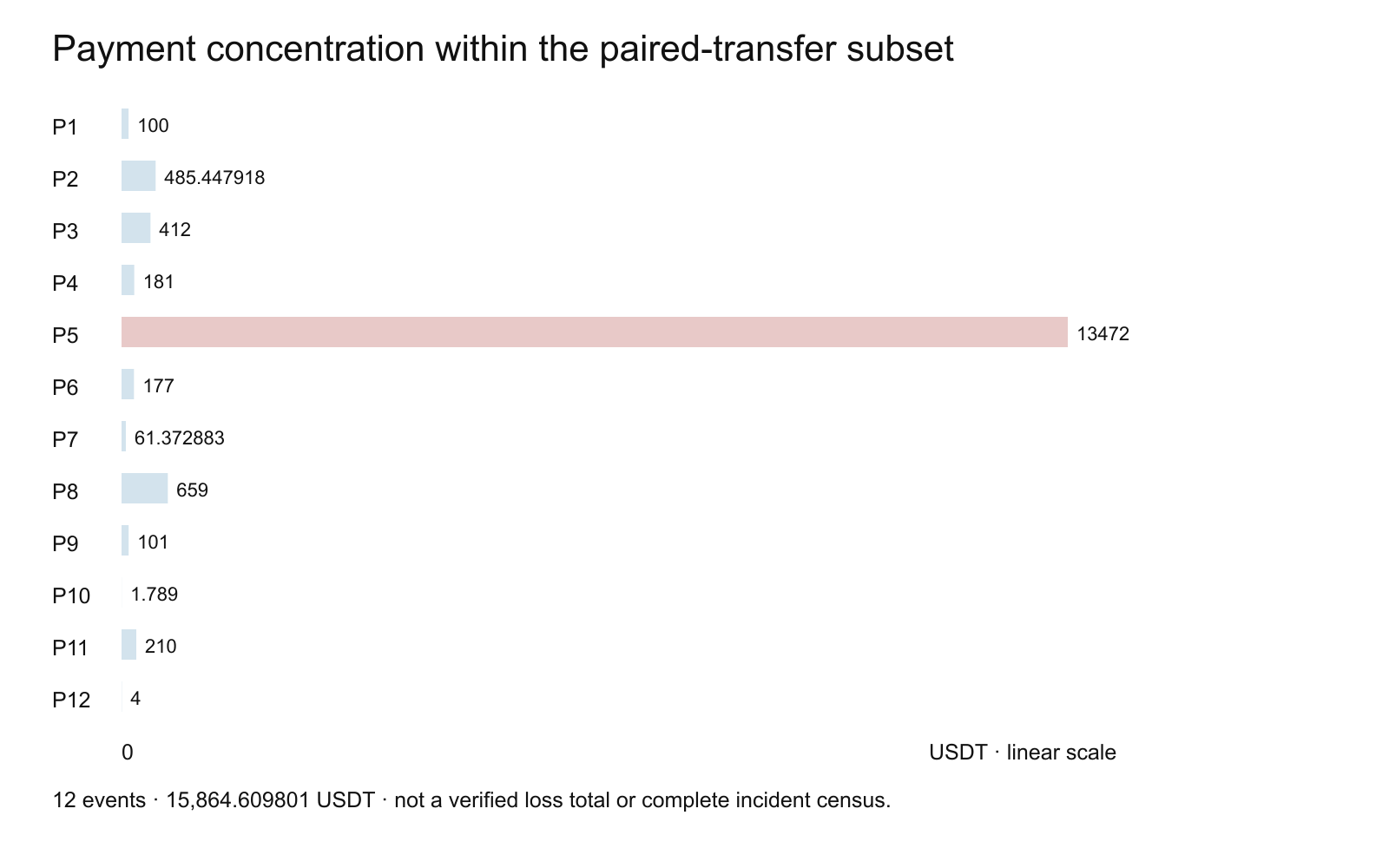 Figure 2 — Full payment distribution. All twelve amounts use one linear, zero-based USDT scale. P5 dominates the inspected subset; the chart does not estimate total incident loss.
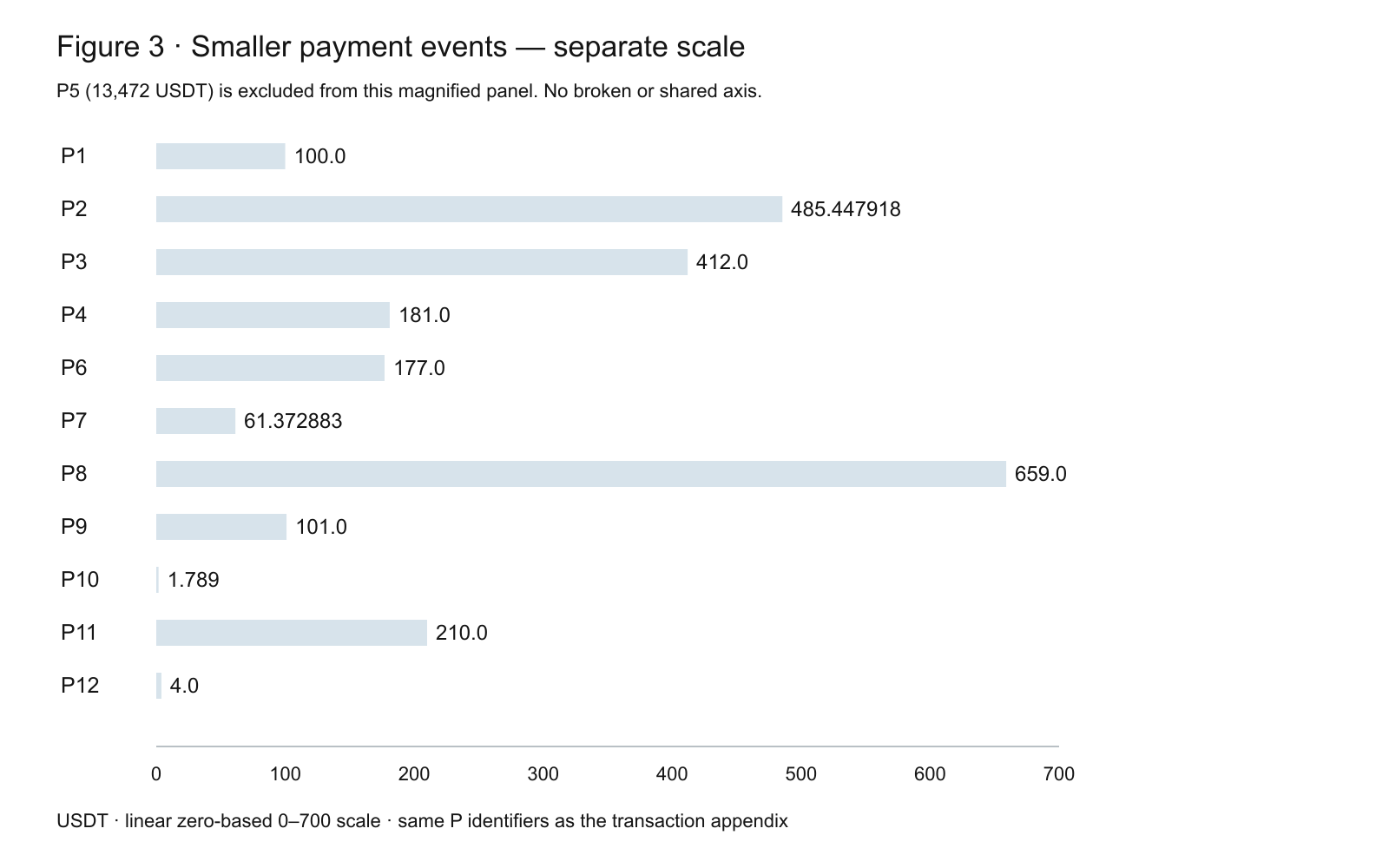 Figure 3 — Magnified smaller events. A separate 0–700 USDT axis makes the eleven smaller events readable. P5 is excluded only from this panel, not the aggregate. Do not compare bar lengths between Figures 2 and 3.
The largest event, P5, is 13,472 USDT: approximately 84.92% of this subset. Figure 2 shows that concentration on a single zero-based scale. Figure 3 uses a separate 0–700 USDT scale to make the other eleven events readable; it does not remove P5 from the total. No conversion to a contemporaneous USD price is applied. Unpaired inflows, recycled funding and later hops are excluded from the sum. The publicly reported approximately $69,651 and 80 victims describe a different, unreconciled population—not a larger total that this subset independently proves.
────────────────────────────────
3. Two collectors sent 51,000 USDT to one destination
The next observed stage is a pair of direct transfers on 30 September. At 16:24:54 UTC, C1 sent 36,000 USDT to H. At 16:26:15 UTC—81 seconds later—C2 sent another 15,000 USDT to the same address. Unlike the earlier delegated calls, both transactions use transfer and are confirmed in the explorer. Together they establish that H received 51,000 USDT from these two collectors. They do not establish that all of those tokens came from the twelve earlier events, or that C1, C2 and H share an owner.
UTC / block | Movement | Full transaction |
|---|---|---|
2026-09-30 16:24:54 · 86704310 | E1 · C1 → H · 36,000 USDT | 501b95a1bd13510e495601f2b19e619763a5a73debc85619be2662301b5f48a9 |
2026-09-30 16:26:15 · 86704337 | E2 · C2 → H · 15,000 USDT | 63e05ce6c8739cdaf6357d3784e4d23d8d51947b6d9d7c0197990e696aee9bc3 |
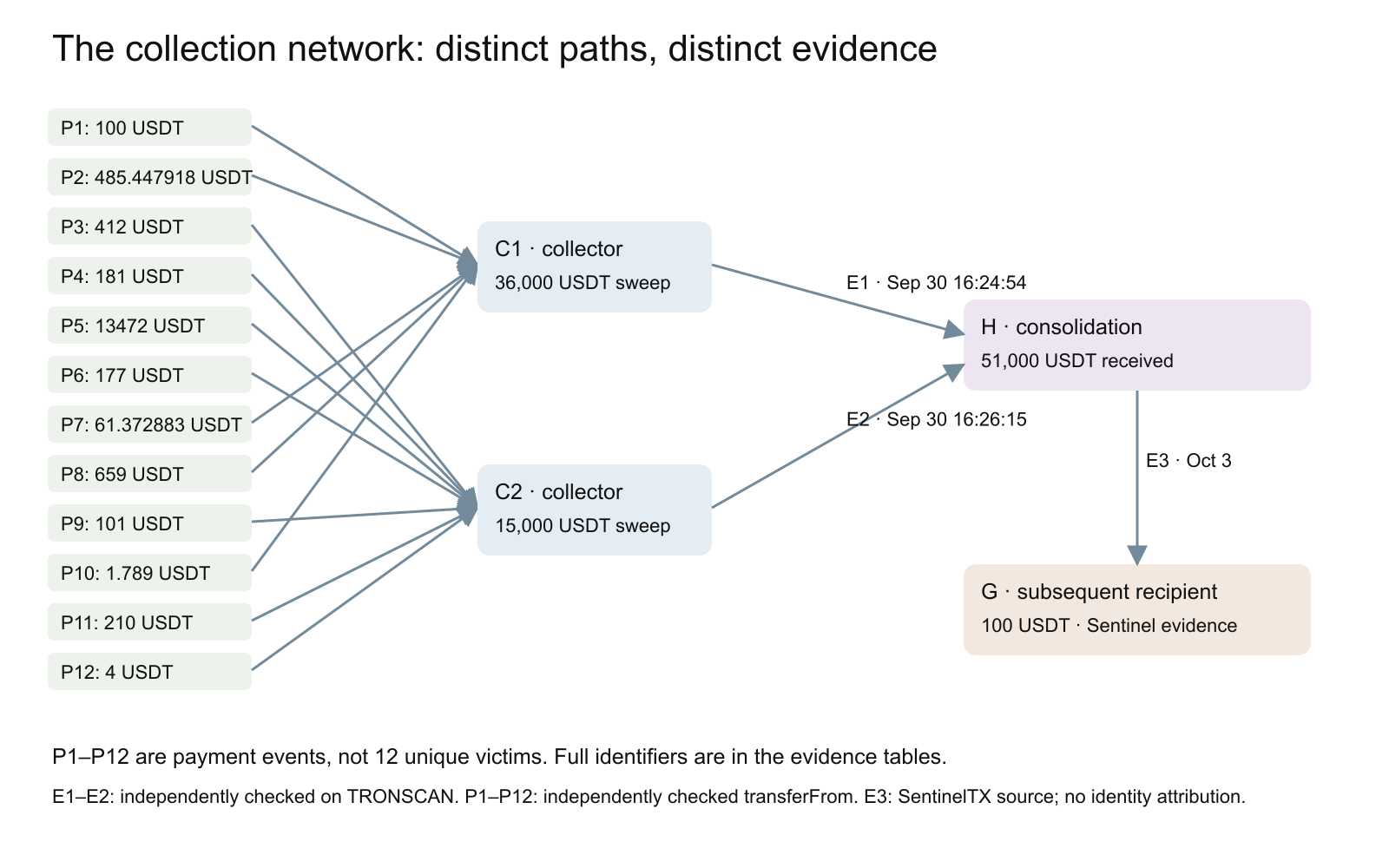 Figure 4 — Collection and consolidation network. P1–P12 are payment events, not twelve victims. E1 and E2 identify the two verified consolidation transactions below; E3 is a source-only lead. Arrow direction indicates token movement, not ownership.
A later 100 USDT movement from H appears in the investigation output at e783e0a7579b27cd49f87c284b22fac22fea1f65e2fe7f415ec2fbe2fb20667d. Subtracting it from 51,000 does not establish a current balance of 50,900: a current balance snapshot and intervening activity are needed.
────────────────────────────────
4. A shared service is not evidence of a shared operator
The public source corrected its inclusion of TDii6vao7xyWg2rKPbCPWVRpSmne8xcqYx and identified it as legitimate Tronify infrastructure. The correction is material: service usage must not be treated as proof of operator control or collusion. Public correction.
Likewise, exchange labels observed on payer-side funding routes do not establish collector cash-out. Shared service use, timing proximity and a visually dense graph are not identity evidence.
────────────────────────────────
5. What is established, and where the evidence stops
Evidence class | What it establishes | What it does not establish |
|---|---|---|
P1–P12 · directly checked | Successful transferFrom calls, amounts and transaction owner | Approval origin, consent or victim status |
E1–E2 · directly checked | Two transfers into H; 51,000 USDT in 81 seconds | Total loss, current balance or common ownership |
E3 · source-only lead | Reported later 100 USDT branch; hash retained | Independent re-verification or remaining balance |
Public reporting | Attributed incident context and correction | On-chain domain or human attribution |
The records connect the twelve calls through a common transaction owner and connect the two collectors through transfers to H. That is an operational connection between transactions, not an identification of the people behind them. Delegated transfers occur in legitimate workflows as well as deceptive ones, so the method alone does not establish fraud, intent or a stolen private key. Claims about Gemini recommendations, AI videos or search manipulation concern off-chain inducement; transaction records alone cannot confirm them.
The reported TRX seeding and short delays are investigative context. The seeding transactions have not all been independently checked in this report, so they are not used to establish a universal causal mechanism. The provider also contains conflicting first-activity dates and broader historical paths; those values are not used to date the operation or aggregate losses.
────────────────────────────────
6. The next investigation: authorization, inducement and destination
The remaining questions require different kinds of evidence. Approval records address how C2 could move tokens; victim and service records address the alleged inducement; a timestamped balance and transaction ledger address what happened after consolidation. None can be replaced by the shape of the graph alone.
Question to resolve | Required evidence | Purpose |
|---|---|---|
How was C2 authorized? | USDT approval events, allowance history and wallet interaction records | Separate informed delegation from deceptive authorization |
Which domains induced transactions? | Victim records, browser history and legitimate service order logs | Connect on-chain movement to off-chain inducement |
Where are consolidated funds now? | Timestamped H balance and subsequent transaction ledger | Determine actual remaining exposure without assuming a balance |
Who owns the affected wallets? | Voluntary victim evidence or lawful records | Validate victim count and loss attribution |
The immediate task is to connect the observed calls to their authorization history, test the alleged off-chain inducement, and reconstruct H’s subsequent activity. The table identifies the evidence needed for each question. Until that evidence is available, the report supports a description of delegated transfers and consolidation—not a complete victim census, a current balance, or a finding that funds were frozen, recovered or cashed out at an exchange.
────────────────────────────────
Evidence appendix — full identifiers
Every payment below was independently checked in the TRONSCAN overview. The method is transferFrom and the transaction owner is C2 in every row. USDT native precision is six decimals. The hash is the deduplication key.
Common fields for P1–P12: TRON mainnet USDT; successful and confirmed transferFrom calls; transaction owner TV6n8cCLmX5mRCMMNvcE1K1i87Yo9Ys5rv. The tables separate movement from transaction anchors so full identifiers remain readable. Each P identifier refers to exactly one transaction hash.
P1–P4 · token movements
Evidence / USDT | Token holder · From | Collector · To |
|---|---|---|
P1 · 100.0 | ||
P2 · 485.447918 | ||
P3 · 412.0 | ||
P4 · 181.0 |
P1–P4 · transaction anchors
Evidence | UTC / block | Full transaction hash |
|---|---|---|
P1 | 2026-09-07 19:51:06Z · 86046294 | 3c3b8a6fe26b69a760134f1bb3b944baa0ec049c89d3002a426bd3137784d035 |
P2 | 2026-09-10 13:25:27Z · 86124903 | 6a93656feb2b32058214bc6e8eaebc697f4312132f30e982f4a66325f2e3f84d |
P3 | 2026-09-11 07:00:33Z · 86145999 | a521b4b148ca8a58b35438981df742a27ee64a988d4c8077384f3e9ceb409304 |
P4 | 2026-09-12 15:18:09Z · 86184741 | b72f7690b7d5d8e92301018de4ac02c516b356b8d7ea9853564d3847b12977e5 |
P5–P8 · token movements
Evidence / USDT | Token holder · From | Collector · To |
|---|---|---|
P5 · 13472.0 | ||
P6 · 177.0 | ||
P7 · 61.372883 | ||
P8 · 659.0 |
P5–P8 · transaction anchors
Evidence | UTC / block | Full transaction hash |
|---|---|---|
P5 | 2026-09-13 08:04:39Z · 86204865 | 8b003bd469b45956b430df31ad67b0c8d668a114808775e9897787b6e20ccbf6 |
P6 | 2026-09-14 02:10:24Z · 86226573 | e1bbcbac8dd49284e9745757f555dc663b66da42555544fdf5b9c7e2a0a0119e |
P7 | 2026-09-14 20:14:42Z · 86248253 | 877c9e0cb7ebccf7fe18ce63b0a9f4206aa32993b30c688679ad2f0a2bb83a65 |
P8 | 2026-09-14 22:44:30Z · 86251249 | e6bc783dc6f2f180b576a044f037afe44f4c688b87cd534460f49b19cf145cb5 |
P9–P12 · token movements
Evidence / USDT | Token holder · From | Collector · To |
|---|---|---|
P9 · 101.0 | ||
P10 · 1.789 | ||
P11 · 210.0 | ||
P12 · 4.0 |
P9–P12 · transaction anchors
Evidence | UTC / block | Full transaction hash |
|---|---|---|
P9 | 2026-09-15 00:21:57Z · 86253196 | d52998a2a9f33af5894d50ab95cfa63a73427038ce4e059ffb5a14cba5b97a34 |
P10 | 2026-09-15 00:22:33Z · 86253208 | 3a9d82c197147bfba3d89fe0a3541fed23bf722e51302d690a5c83a94878e4b6 |
P11 | 2026-09-28 15:20:33Z · 86645460 | c0325bd4daa2c1c88668b8b9fbc7a670d1fec73c53a0ef63eb3c3cdc6b6837be |
P12 | 2026-09-28 15:33:48Z · 86645725 | c4d870bc9b0dc20802324b25641c721bca0a16840284b60d0915476f15f39e33 |
────────────────────────────────
Sources and methodology
Primary public sources: initial disclosure, infrastructure correction, off-chain follow-up. Transaction claims are anchored beside the relevant findings and in the appendix. Public allegations are not independently established totals.
The investigation output supplied candidate identifiers and contextual paths. This report independently compared all twelve payment calls and both consolidation transfers against visible explorer results, checked the aggregate and distinct-holder count, and corrected the direct-transfer interpretation. It does not claim a complete approval-history review, complete wallet balance audit or complete incident census.
Revision note — 6 October 2026. Version 1.2 reorganizes the narrative around the observed sequence, explains address roles before the mechanism, and connects each finding to its limits and next verification step. Existing transaction identifiers, quantities, figures and source links are retained. This is an editorial revision, not a new on-chain verification; the evidence set and investigation cutoff are unchanged.
 0
 0
29 조회

 조사관 신청하기