Anatomy of the Ambient Finance Exploit: How a Stealth Attacker Drained $110K in 12 Seconds

June 15, 2026
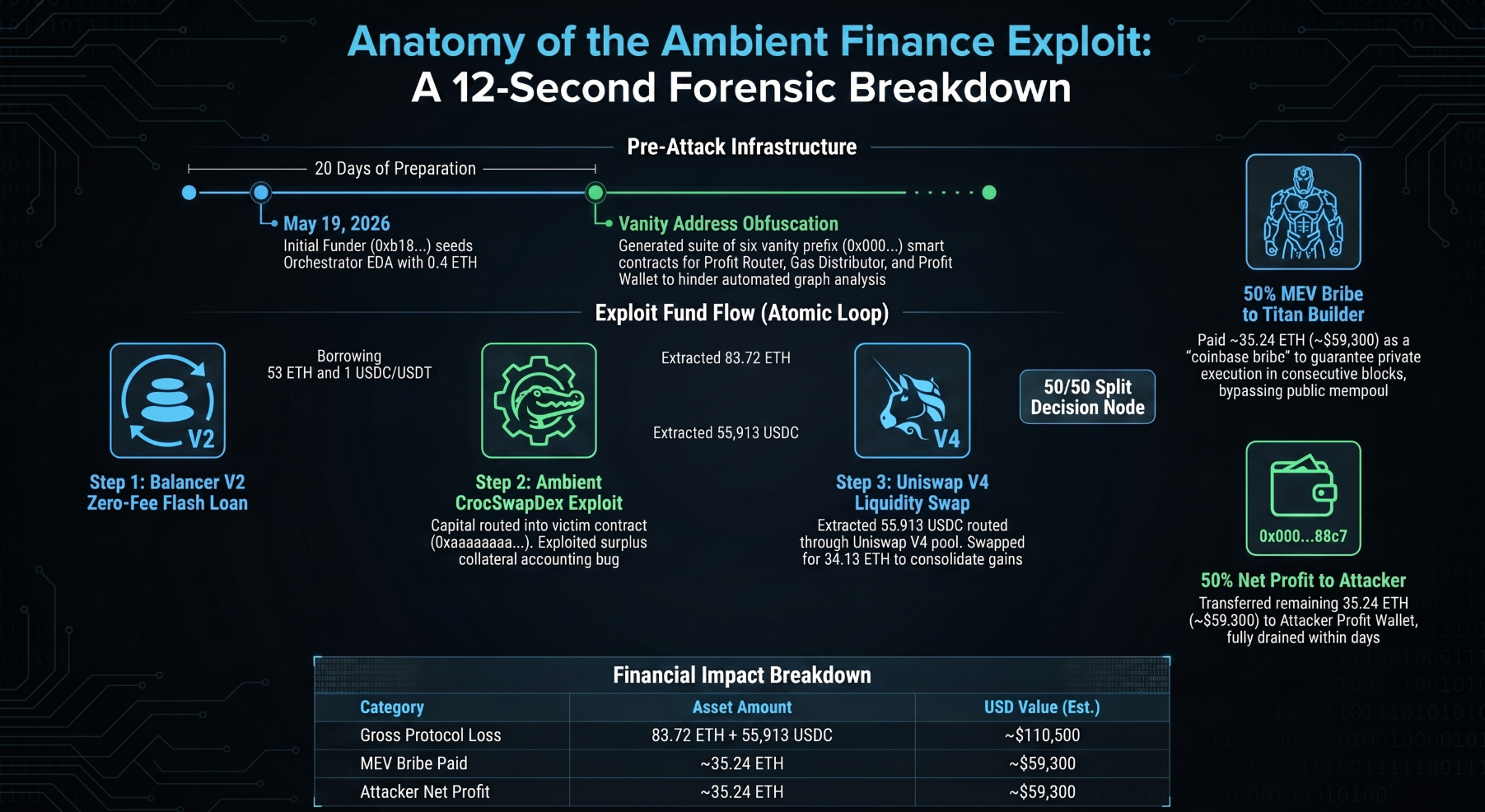
The DeFi space is no stranger to sophisticated attacks, but the recent exploit of Ambient Finance (formerly CrocSwap) stands out for its meticulous preparation and invisible execution. On June 7, 2026, an attacker exploited a surplus collateral accounting vulnerability in Ambient Finance’s CrocSwapDex contract on the Ethereum mainnet.
Within a mere 12 seconds—across consecutive blocks 25266404 and 25266405—approximately $110,600 was drained from the protocol. However, this wasn't your typical smash-and-grab flash loan attack. The orchestrator deployed advanced evasion tactics, making this case a fascinating study for Web3 security professionals.
🛠️ The Exploit Mechanism: Zero-Cost Amplification
The core of the exploit targeted a flaw in the surplus collateral accounting logic of the single-contract DEX architecture. By strategically cycling calls through the HotProxy, WarmPath, and ColdPath execution layers, the attacker manipulated internal surplus balances to withdraw ETH without actually locking up corresponding real collateral.
To fund the exploit, the attacker utilized a classic DeFi weapon: Balancer V2's zero-fee flash loans. In the most devastating of the two sequential attacks (Block 25266405), they borrowed 50 ETH and 1 USDC at absolutely zero cost, executed the accounting manipulation, and extracted 83.72 ETH and 55,913 USDC. The flash loan was repaid within the very same transaction, securing a risk-free profit.
Phase | From (Entity) | To (Entity) | Amount / Action | Block / Date |
Preparation | Initial Funder ( | Orchestrator EOA ( | 0.4 ETH (Seed funding) | May 19, 2026 |
Exploit #1 (USDT) | Balancer V2 ( | Exploit Contract #1 ( | 3 ETH + 1 USDT (Flashloan) | 25266404 |
Exploit Contract #1 | Ambient CrocSwapDex ( | Surplus Accounting Exploit | 25266404 | |
Ambient CrocSwapDex | Exploit Contract #1 | 4.32 ETH (Withdrawal) | 25266404 | |
Exploit #2 (USDC) | Balancer V2 | Exploit Contract #2 ( | 50 ETH + 1 USDC (Flashloan) | 25266405 |
Exploit Contract #2 | Ambient CrocSwapDex | Surplus Accounting Exploit | 25266405 | |
Ambient CrocSwapDex | Exploit Contract #2 | 83.72 ETH (Withdrawal) | 25266405 | |
Laundering & Bribe | Exploit Contracts (#1, #2) | Uniswap V4 Pools | USDC/USDT → ETH Swap | Internal Txs |
Profit Router ( | Titan Builder ( | ~35.24 ETH (MEV Bribe) | 25266404~5 | |
Profit Router | Attacker Profit Wallet ( | ~35.24 ETH (Net Profit) | 25266404~5 | |
Aftermath | Attacker Profit Wallet | Unknown / Bridges / Private Bundles | Full Drain (Current Bal: 0) | Post-Exploit |
🥷 The Ultimate Stealth Play: A 50% MEV Bribe
What makes this exploit truly remarkable is how the attacker managed to bypass public mempool detection. Typically, massive transactions broadcasted to the public mempool can be front-run or blocked by MEV (Maximal Extractable Value) bots or defensive monitoring systems.
To guarantee atomic on-chain execution, the attacker bypassed the public mempool entirely. They submitted the exploit transactions as a private MEV bundle directly to Titan Builder, a dominant Ethereum block builder.
The cost of this invisibility? A staggering 50% of the total profits. The attacker routed 55,913 USDC through Uniswap V4 to swap it into ETH, and then paid approximately 35.24 ETH (worth around $59,300 at the time) as a direct coinbase bribe to Titan Builder. By sacrificing half their loot to secure a 50/50 profit split, the attacker ensured their transaction was included in consecutive blocks without any chance of defensive intervention.
🕵️♂️ A Pre-Planned, Highly Coordinated Operation
Forensic analysis reveals that this was not an opportunistic, spur-of-the-moment hack. The attacker seeded their infrastructure 20 days before the attack (around May 19, 2026) with an initial 0.4 ETH funding.
They deployed at least six "vanity address" smart contracts (all starting with 0x000...) generated deliberately to obfuscate fund flows and create visual clustering on-chain.
As of the latest intelligence, the primary profit wallet (which received the remaining ~35.24 ETH) has been fully drained, likely moved via private bundle transfers or cross-chain bridges. However, the attacker's orchestrator EOA remains operationally active, holding residual balances across **Ethereum (**725),BNBChain(**54), Arbitrum (**41),andBase(20).
🔍 What’s Next?
The Ambient Finance exploit serves as a stark reminder that DeFi attackers are prioritizing execution certainty and stealth over profit maximization. Security communities must look beyond standard re-entrancy bugs and closely audit intra-contract state consistencies.
For investigators and law enforcement, the trail hasn't completely gone cold. The focus now shifts to deeper multi-chain tracing of the active Orchestrator EOA, and potentially submitting a formal cooperation request to Titan Builder to unmask the private bundle submitter's identity.
Stay safe, stay vigilant, and always audit the smart contracts.
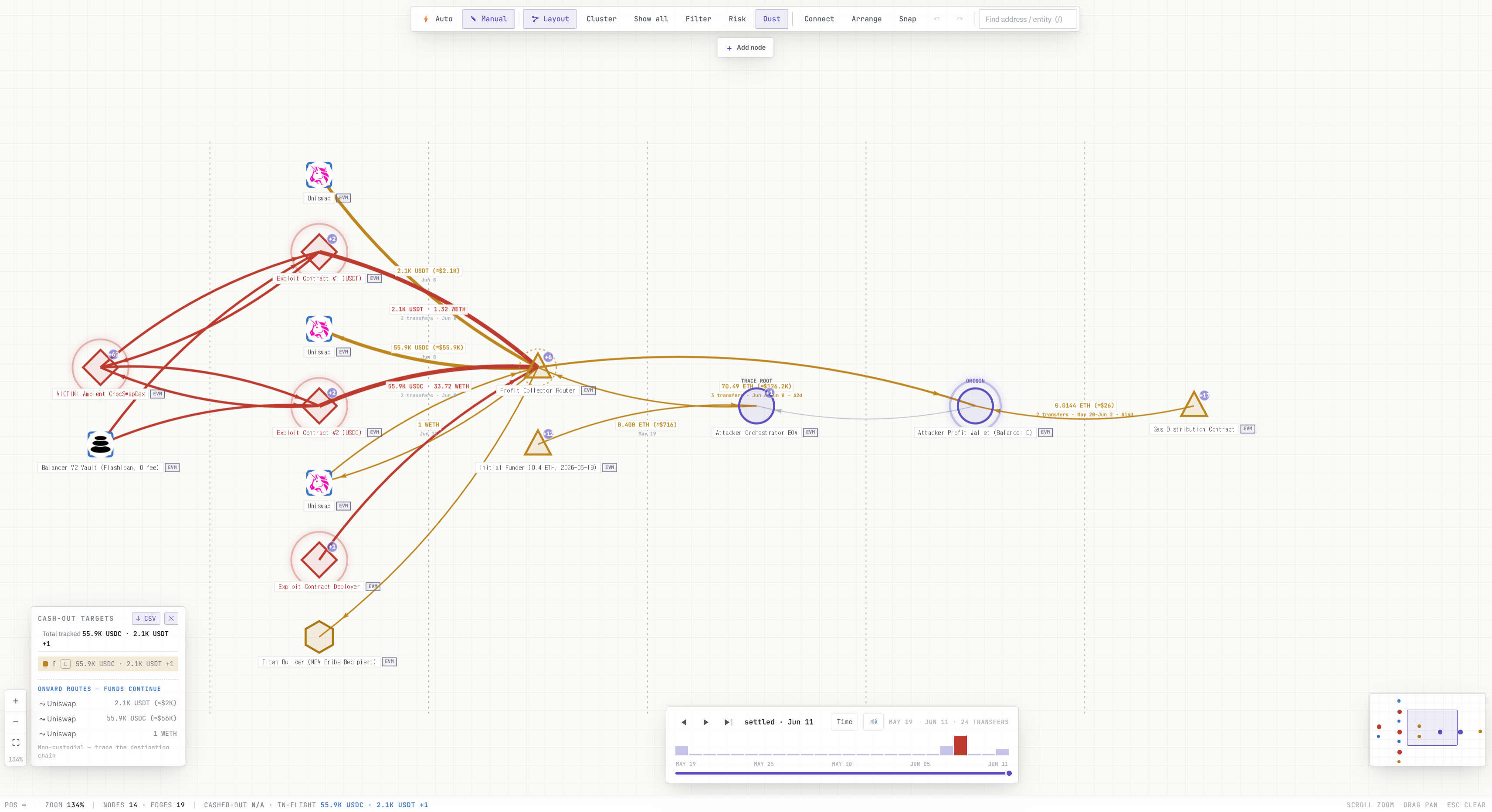
Appendix: Trace graph
 0
0 0
0128 reads

 Become an Investigator