Comprehensive Threat Intelligence Report: Unpacking the $2.1M Thetanuts Finance Legacy Vault Exploit

June 19, 2026
Date: June 19, 2026
Executive Summary
On June 15, 2026, the Web3 ecosystem witnessed a sophisticated attack targeting the Thetanuts Finance Legacy Index Vault on the Ethereum mainnet. ChainBounty’s Threat Intelligence team has conducted a full on-chain forensic investigation into the incident, mapping the attacker's execution methods and subsequent money laundering operations.
While the initial exploit successfully drained approximately $2,100,000 in option tokens, rapid intervention by a whitehat hacker resulted in the recovery of approximately $2,000,000. The attacker managed to successfully bridge and launder the remaining assets, resulting in a realized net loss of approximately $105,000.
Forensic Methodology
To unearth the full scope of this attack, ChainBounty utilized the SentinelTX Blockchain Forensic Intelligence System, analyzing on-chain data up to June 19, 2026.
- Trace Parameters: We tracked outbound fund movements on Ethereum (Chain ID 1) with a maximum query depth of 5 hops, successfully reaching the terminal endpoints within 3 hops.
- Data Enrichment: Our analysis cross-referenced 40+ cross-chain bridge APIs, the Sentinel TRDB, and the June 2026 OFAC SDN Sanctions list.
- OSINT Verification: Intelligence was corroborated using public alerts from Blockaid, PeckShieldAlert, SlowMist, and CryptoTimes.
Anatomy of the Exploit: Integer Division Vulnerability
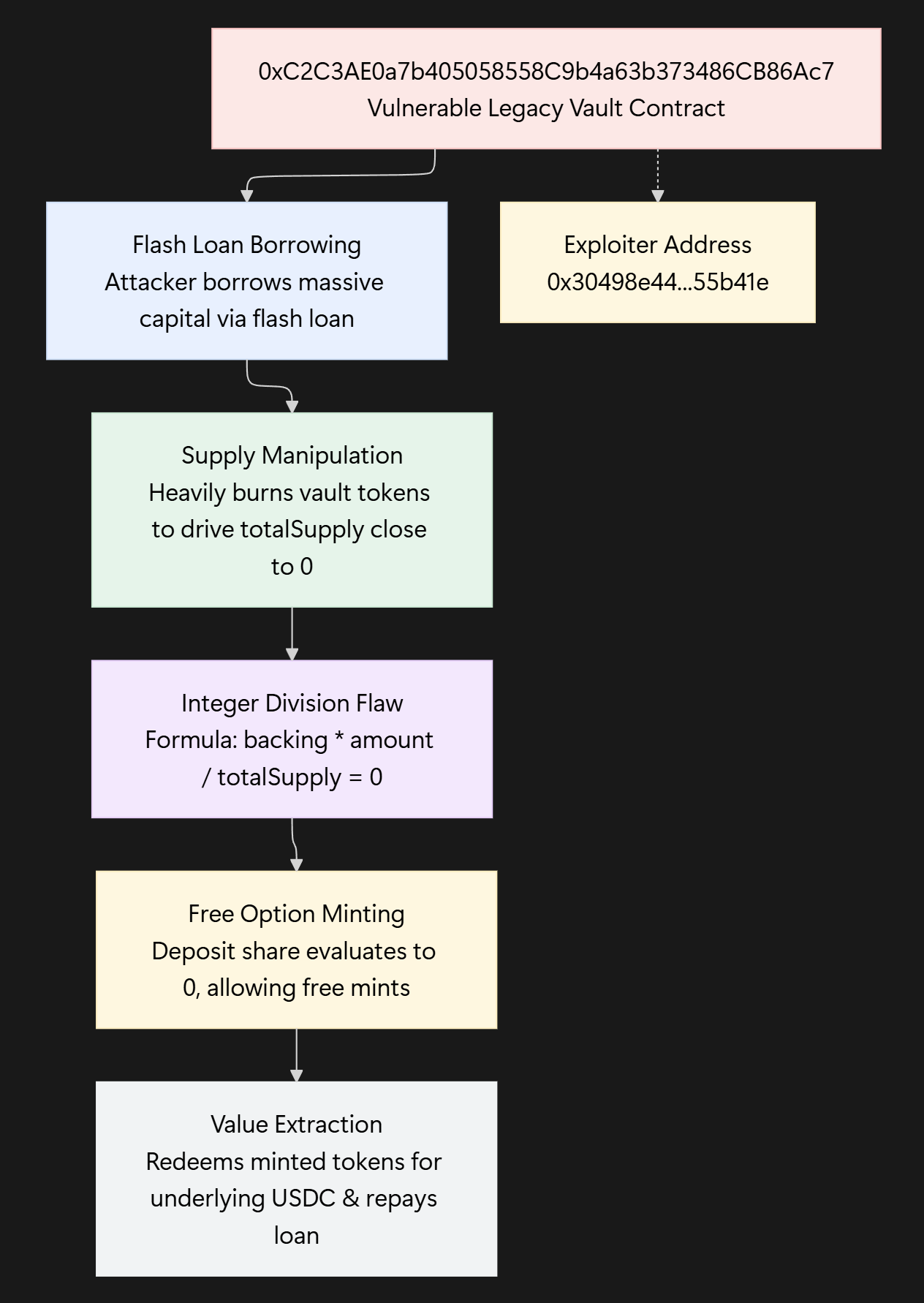
The exploit was directed at the vulnerable legacy contract 0xC2C3AE0a7b405058558C9b4a63b373486CB86Ac7. The attacker (0x30498e4466789E534c72e03B52A16c978655b41e) executed the attack by weaponizing a flash loan against a Solidity integer division flaw.
Here is the step-by-step breakdown of the attack execution:
- Capital Acquisition: The attacker initiated a massive flash loan to borrow capital.
- Supply Manipulation: By heavily burning the vault's tokens, the attacker manipulated the contract's state, driving the
totalSupplyvariable down to a value approaching zero. - Exploiting the Math: The contract utilized a redemption formula calculated as
backing * amount / totalSupply. Due to Solidity's integer division characteristics and inadequate handling of edge cases for near-zero supply, dividing by this manipulatedtotalSupplycaused the function to return a value of 0. - Free Minting: Because the
depositfunction's share calculation evaluated to 0, the attacker was able to repeatedly mint new option tokens entirely for free. - Value Extraction & Repayment: The attacker immediately redeemed these illegitimately minted tokens to extract the vault's actual underlying USDC assets, subsequently repaying the flash loan to secure the profit.
Post-Exploit Money Laundering Tactics
Following the extraction, the attacker initiated a 5-step layering process designed to obfuscate the origin of the funds. On June 15, the stolen assets were consolidated into a dedicated "Loot Wallet" (0xaf3a0fdbfb0e3127247b66a042310e09c32f2299), which was initially funded with 0.027575 ETH to cover gas fees.
From the Loot Wallet, ChainBounty identified three distinct laundering vectors:
Path A: Extreme Fan-Out via DEX Aggregator
- Execution: On June 15, the attacker routed 105,471.499078 USDC into a DEX aggregator/hub address (
0x709de0b97e369661c99ad54f2b858139897d3dba). - Dispersion: Over a 7-day period, this address operated as a massive fan-out hub, executing 419 transactions to disperse the capital across 313 distinct addresses.
- Asset Swapping: To further break the tracking chain, the USDC was swapped into varying amounts of USDT, ETH, and highly volatile meme coins, including DOGEUS, KISHU, and ASTEROID.
Path B: Structuring via OFAC-Sanctioned Mixers
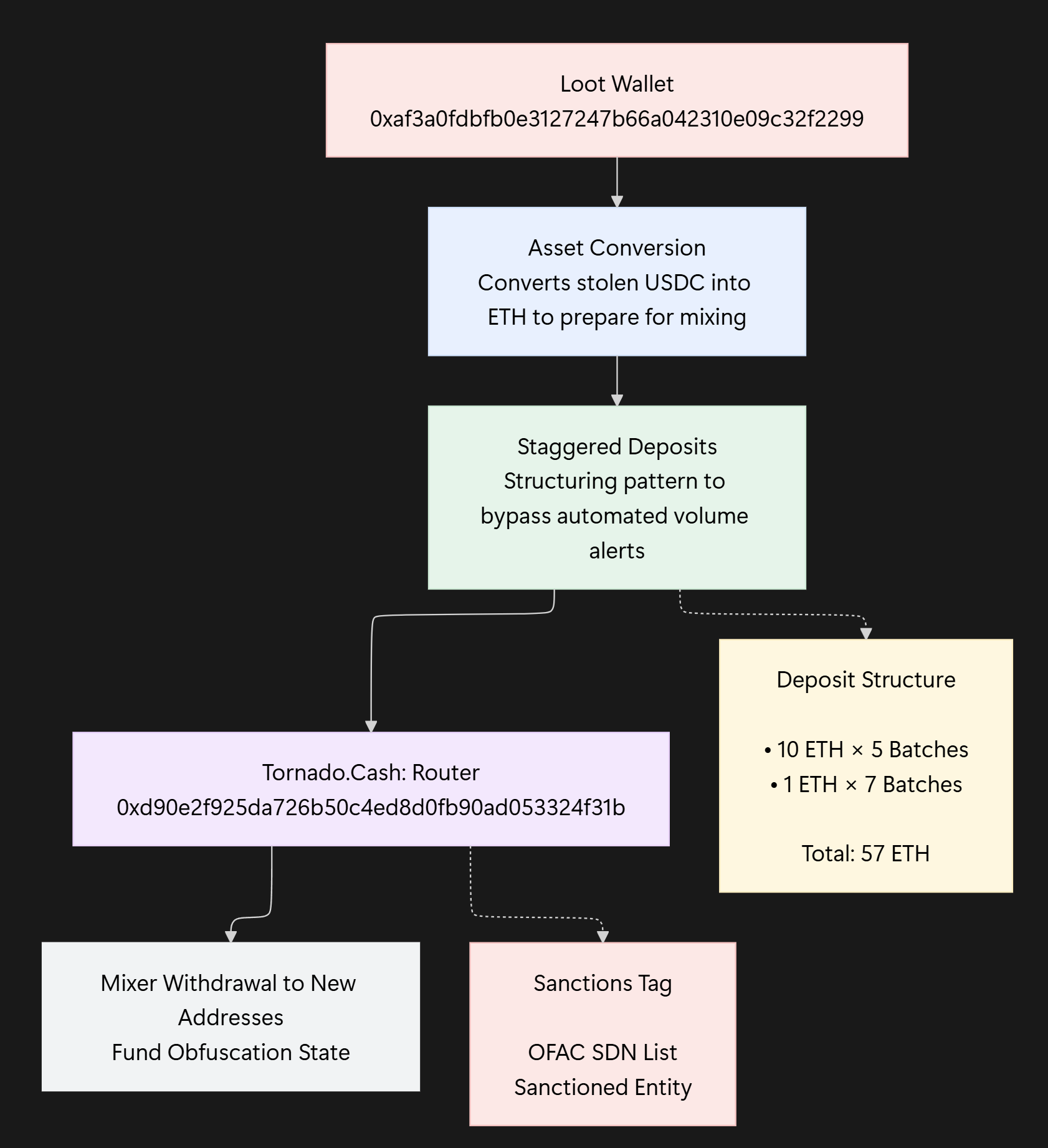
- Execution: To completely sever the on-chain link, the attacker converted a portion of the funds into ETH and utilized the Tornado Cash protocol.
- Structuring Pattern: On June 17, a total of 57 ETH was sent to the Tornado Cash Router (
0xd90e2f925da726b50c4ed8d0fb90ad053324f31b). To avoid triggering volume-based alerts, the attacker used a deliberate "structuring" technique, dividing the deposits into five batches of 10 ETH and seven batches of 1 ETH. - Sanctions Violation: Because the Tornado Cash Router is an OFAC SDN-sanctioned entity, this interaction represents a severe violation of international sanctions.
Path C: Centralized Exchange Liquidation (Binance)
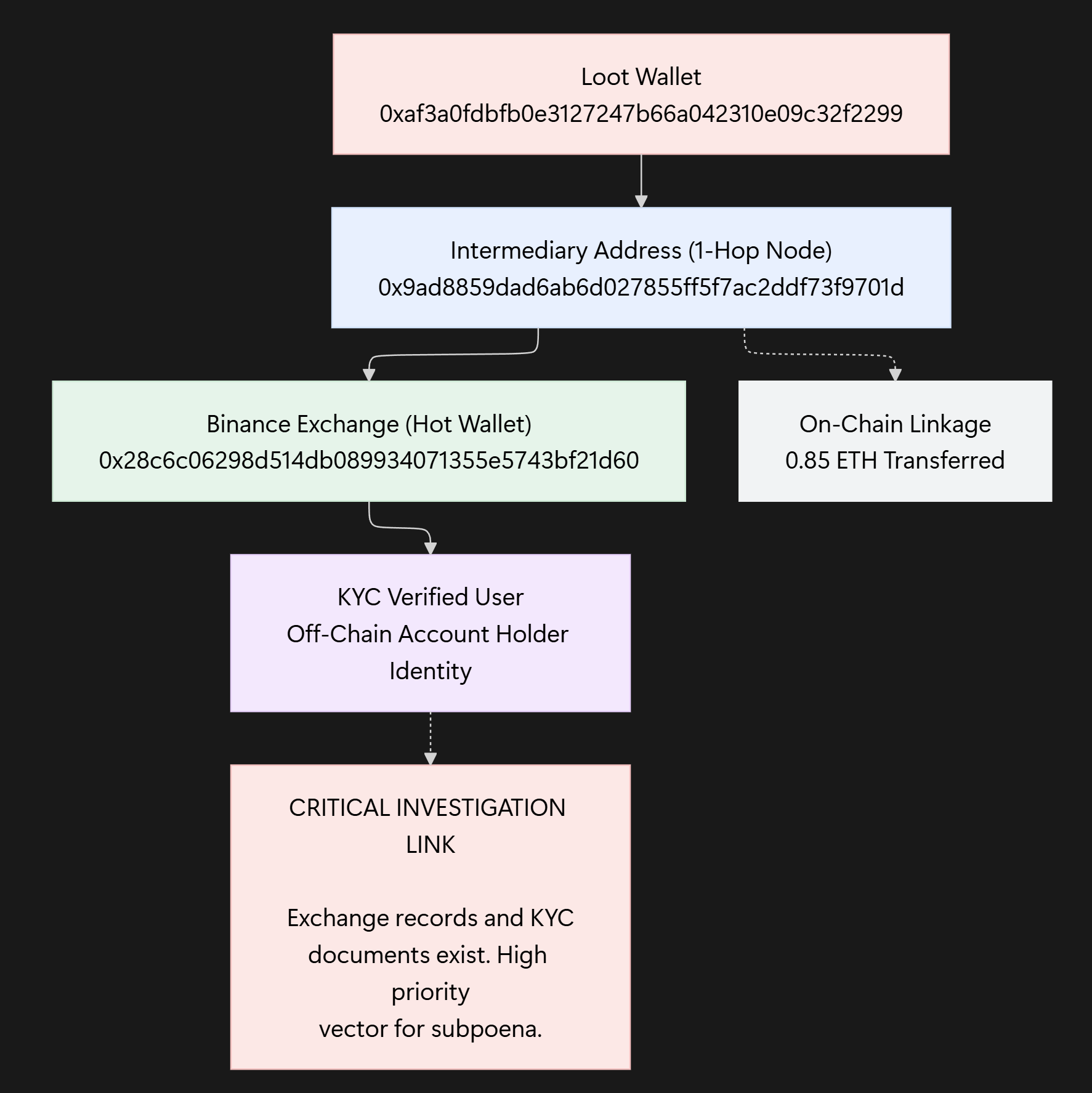
- Execution: ChainBounty analysts discovered a critical operational security failure by the attacker. On June 17, exactly 0.85 ETH was moved from the Loot Wallet.
- Routing: This micro-transaction was routed through a single intermediary address (
0x9ad8859dad6ab6d027855ff5f7ac2ddf73f9701d) and deposited directly into a Binance hot wallet (0x28c6c06298d514db089934071355e5743bf21d60).
ChainBounty Strategic Recommendations
While the funds mixed through Tornado Cash currently possess a recovery probability of less than 5%, other avenues remain actionable. ChainBounty advises the following immediate steps:
- Exploit Centralized Exchange KYC: Because Binance enforces mandatory global KYC, the 0.85 ETH deposit pathway is the strongest lead. Law enforcement agencies should immediately submit a Mutual Legal Assistance Treaty (MLAT) or Letter Rogatory to subpoena the identity associated with the intermediary deposit address (
0x9ad8859dad6ab6d027855ff5f7ac2ddf73f9701d). - Regulatory Reporting: A Suspicious Transaction Report (STR) must be filed with financial intelligence units (such as KoFIU) regarding the deliberate use of the sanctioned Tornado Cash mixer.
- Real-Time Mixer Monitoring: Analysts must deploy real-time monitoring to flag any exchange deposits that mathematically correlate with future Tornado Cash withdrawals originating from this exploit.
Conclusion
The Thetanuts Finance Legacy Vault exploit serves as a stark reminder of the persistent risks associated with legacy smart contracts, specifically regarding floating-point limitations and integer division vulnerabilities. While the prompt action of the whitehat community prevented a devastating $2 million loss, the attacker's sophisticated use of DEX fan-outs and sanctioned mixers allowed them to successfully launder approximately $105,000.
ChainBounty will continue to monitor the dormant assets linked to this exploit. For the latest Web3 forensic analysis and threat alerts, follow the ChainBounty intelligence feed.
 0
0 0
093 reads

 Become an Investigator