Predict.fun smart-account drains: two transactions, an incomplete cross-chain trail

November 04, 2026
Two BNB Smart Chain transactions sit at the center of SentinelTX’s November 4 report on the Predict.fun incident: an 82,000 USDT drain on October 22 and a 5,700 USDT drain on October 27. Both were executed through the accounts’ normal user-operation machinery. Neither decoded transaction called a Predict.fun market or exchange contract.
That pattern is consistent with misuse of an authorized signing credential. It does not, by itself, identify the signer or establish how a key was obtained. The report did not decode the signatures or validator modules. Its cross-chain account also has important limits: Ethereum bridge receipts remain unverified, one proposed onward path runs backward in time and is causally impossible, and a sanctions label asserted for a collector is unsupported.
This article adapts SentinelTX report CASE-CB9FA6EF, dated November 4, 2026. It separates the transactions described in the report from wider public claims and retains the report’s material warnings. The confidential source PDF is not reproduced here.
What the report covers
Public reporting summarized in the PDF describes two waves affecting 29 accounts, with 397,708 USDT taken and 166.8 ETH deposited into Tornado.Cash. SentinelTX used that reporting as a source of leads. The retrieved public article was incomplete, and those incident-wide figures are not the totals established by the two seed transactions examined here.
The distinction matters because the report contains several different kinds of numbers: transfers out of smart accounts, later bridge deposits, ETH receipts, mixer deposits, and allocations assigned to particular tracing paths. Adding them together would recount funds or combine unlike assets.
- Measure: 87,700 USDT — Scope and limitation: The two seed drain quantities: 82,000 USDT and 5,700 USDT. Not a complete incident-loss figure.
- Measure: 397,708 USDT — Scope and limitation: Incident-wide amount reported by the public source, across 29 accounts.
- Measure: 42 ETH — Scope and limitation: The report’s itemized mixer-deposit headline: four 10 ETH legs and two 1 ETH legs. Not a validated attribution of all that ETH to the two BSC seeds.
- Measure: 166.8 ETH — Scope and limitation: Tornado.Cash amount reported by the public source.
- Measure: One further 1 ETH-pool leg — Scope and limitation: The chronology describes its gross amount as not itemized and displays a path-attributed share. The source’s differing presentations are retained in the limitations note.
The investigation retained 36 movement rows, with readable timestamps from October 22 at 15:39:27 UTC through October 27 at 07:25:23 UTC. Its query windows extended from September 22 to November 4. A query window is broader than the transactions actually retained and does not establish complete coverage of every address.
Two drains, five days apart
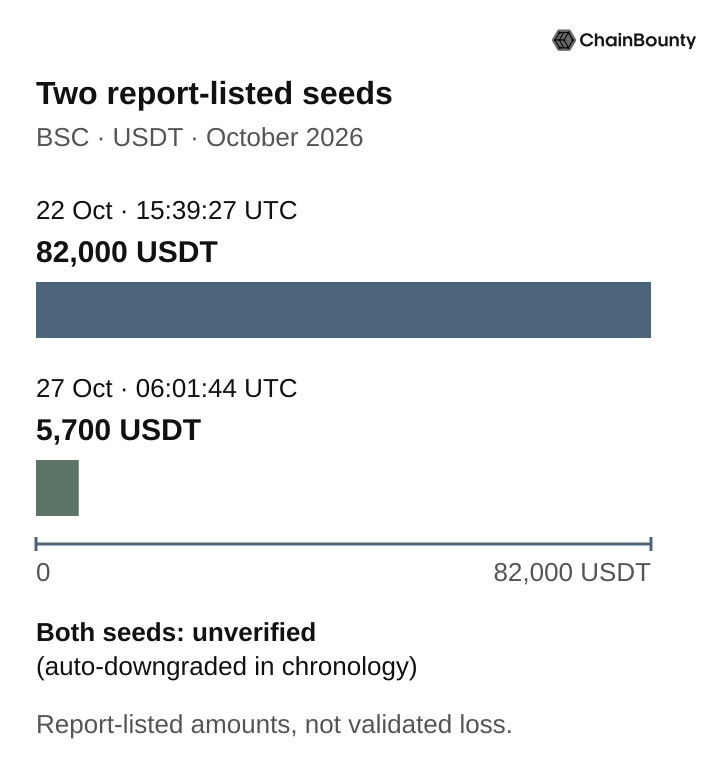
Figure 1. The two seed transfers described in the report total 87,700 USDT. The bars compare the same asset and scope; they do not represent all affected accounts. Color key: Slate, October 22 seed; sage, October 27 seed. Address/role key: S1 and S2 identify the two victim smart accounts in the selected appendix. Source: SentinelTX, CASE-CB9FA6EF, pp. 3–6 and 15. The chronology marks the seed descriptions “unverified (auto-downgraded)”; the corresponding Path Routing Evidence rows are marked “verified.” See the source note.
October 22: the larger seed
At 15:39:27 UTC, S1 transferred 82,000 USDT to a contract ending in de710. Thirteen seconds later, that contract sent 81,999.97 USDT to the BSC address labeled Relay.link in the report’s attribution database. A separate forwarding fee was also recorded.
The Ethereum destination of that bridge leg was not resolved. The bridge explorer returned HTTP 429 on three attempts. The report therefore does not establish a completed Ethereum route for this 82,000 USDT seed, and it cannot be treated as an identified contribution to the later mixer deposits.
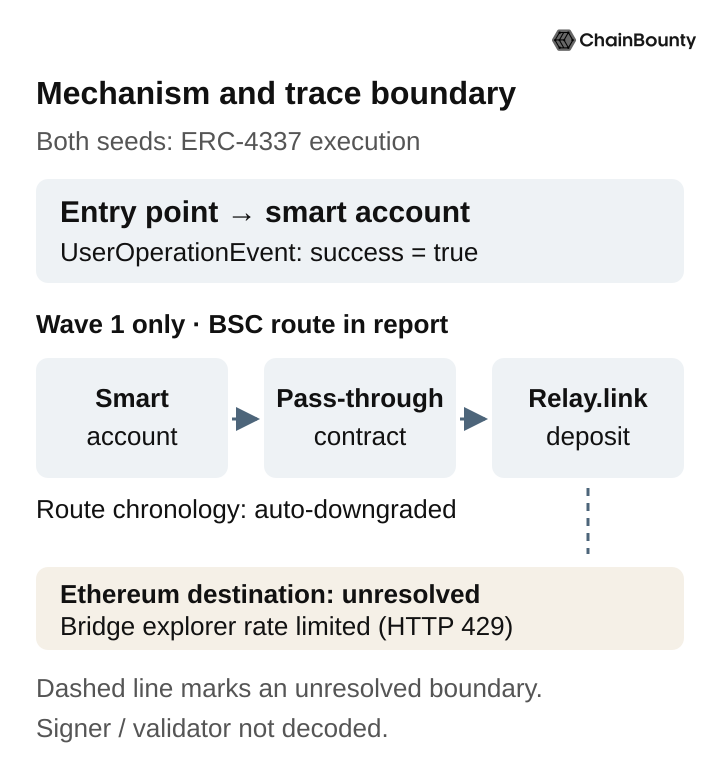
Diagram 2. The common execution pattern and the report’s Wave-1 route, with its unresolved bridge boundary. The report did not decode the signer or validator. Color key: Slate groups the reported execution and BSC route. The amber-tinted box states the unresolved Ethereum boundary. Solid arrows show the report-described Wave-1 route, not independent verification; the dashed line is an unresolved boundary, not a confirmed transfer. Address/role key: Wave-1 smart account 0xd14ca6d1173a710706149a222b7e20324003a660; pass-through contract 0xeda13cffb9b1bb71b948c2b0132f04cf466de710; Relay.link BSC recipient 0x4cd00e387622c35bddb9b4c962c136462338bc31. ERC-4337 entry point 0x0000000071727de22e5e9d8baf0edac6f37da032. Source: SentinelTX, Investigation report CASE-CB9FA6EF, pp. 3–5 and 9, Executive Summary, Transaction Chronology and Transaction Typology. Wave-1 onward chronology is auto-downgraded; Ethereum destination unresolved after HTTP 429.
October 27: a smaller seed and a shared pass-through
At 06:01:44 UTC, S2 transferred 5,700 USDT to a different contract, ending in 82fba. That recipient made seven Relay deposits between 06:01:27 and 06:06:14 UTC. The executive summary presents their total as about 24,654.90 USDT; the fund-flow section records 24,654.894172 BSC-USD across seven transfers.
Those seven deposits are activity of the recipient, not seven onward transfers that can all have been funded by S2. The first deposit, 2,544.97 USDT at 06:01:27, occurred before S2’s 5,700 USDT arrived at 06:01:44. The PDF explicitly flags a route that connects the later inflow to that earlier outflow as causally impossible. This is not an unresolved receipt that might eventually validate that ordering: the earlier transfer cannot be proceeds of the later one.
The source identifies two bridge correlations involving this pass-through and collector C3 on Ethereum. It records 5,699.98424088292384761 USDT associated with 2.456393911612693978 ETH, and 4,844.988528623471693008 USDT associated with 2.088280124827178002 ETH. These are transaction-hash correlations, with Ethereum payout transactions not separately retrieved and receipts explicitly unverified. They should not be presented as verified cross-chain settlement.
What the account operations show
Both BSC seeds were ERC-4337 bundle executions sent to the same entry point. The victim smart account was the sender of the user operation, and the decoded UserOperationEvent reported success. Each operation followed the same sequence: approve a USDT paymaster, pay its fee, then transfer USDT to the recipient contract.
The paymaster fees were 0.185195505742016089 USDT for S1 and 0.174759053954175911 USDT for S2. The report says the approvals left near-unlimited allowances after the fees were taken. The same submitting address sent both bundles, while both pass-through contracts used the same forwarding-fee recipient.
These similarities explain why the report favors a credential-misuse interpretation over an exploit of a Predict.fun contract. But tooling overlap is not proof of common control: the report expressly notes that public account-abstraction services can be shared. Its attribution database returned no label for the submitter or paymaster, and it established no value-bearing flow linking the two waves.
Public claims about compromised API documentation and exported Privy keys supply a possible explanation for how credentials were obtained. SentinelTX did not verify that explanation. The careful conclusion is that the decoded behavior is consistent with an authorized-signer drain, while the signer’s identity and the route of key compromise remain unconfirmed.
Ethereum deposits do not close every BSC link
The Ethereum records show collectors receiving ETH and making fixed-denomination deposits into addresses labeled Tornado.Cash pools. They do not establish that every receipt came from the two BSC seeds.
Collector C1 received three Relay.link payouts and deposited 10 ETH at 05:41:59 UTC on October 27. That mixer deposit preceded the 06:01:44 BSC seed by about 20 minutes. It cannot have been funded by that seed. The chronology says the BSC sources of C1’s funding payouts were not correlated, even though the executive narrative associates them with earlier Wave-2 drains.
Collector C2 made two 10 ETH deposits at 05:53:59 and 05:54:35 UTC, then two 1 ETH deposits at 06:26:35 and 06:27:11. C1 also forwarded 0.277599 ETH, as displayed in the chronology, to C2 before those smaller deposits. C3 deposited a further 10 ETH at 06:07:11. Together, those six mixer legs make up the report’s 42 ETH itemized headline.
C3’s own “Sanctioned” classification is unsupported: the report says no label lookup for that address was on record. That is distinct from the database labels returned for the 10 ETH and 1 ETH Tornado.Cash pool addresses. A pool’s service label does not identify the person controlling a depositor.
No exchange-deposit leg was identified in the traces. The report also did not observe the LI.FI, Across or Railgun routes described by the public source. These are limits of the examined material, not proof that no other movement occurred.
The conclusion and the remaining investigative work
The useful finding is specific: the report describes two smart-account drains using normal account-operation execution, followed by deposits to a Relay-labeled BSC address. The decoded seeds contain no Predict.fun contract call. Separately, it itemizes Ethereum mixer deposits, while leaving critical bridges between source funds and destination receipts incomplete.
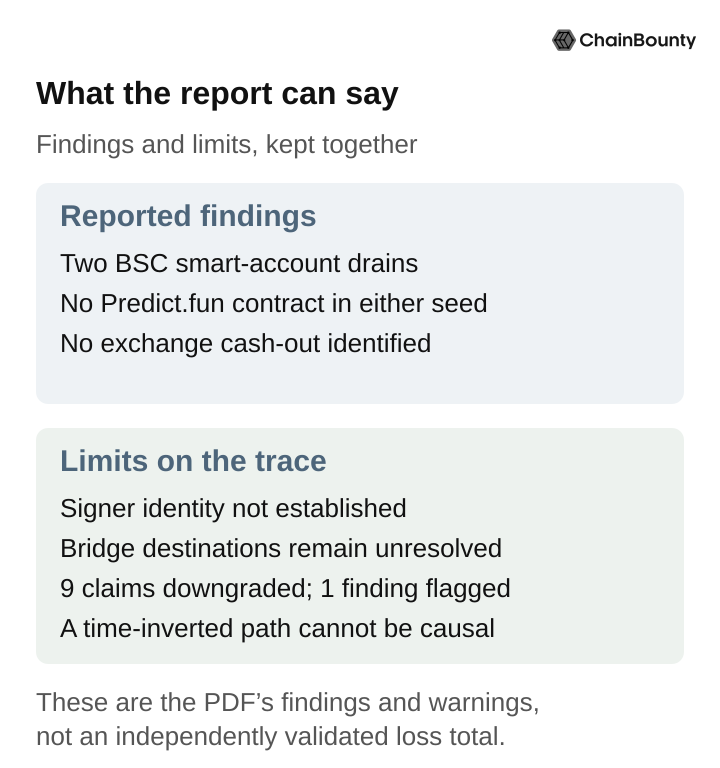
Figure 3. What the report supports, and where its conclusions stop. The USDT seed quantities and ETH mixer deposits have separate scopes and must not be added or treated as a completely attributed route. Source: SentinelTX, CASE-CB9FA6EF, pp. 3–4, 10–14 and 22.
The report prioritizes obtaining Relay settlement and request records, preserving bundler and paymaster logs, and preserving key-export, documentation-server and authentication records. It recommends owner-key rotation for exposed accounts and revocation of the residual paymaster allowances. These are the report’s proposed responses, not actions completed in this article.
Before freeze or KYC action, the report calls for closing the Wave-1 Ethereum route, itemizing C3’s other inbound transfers, resolving the additional mixer leg’s amount presentation, and examining the publicly claimed routes that were not observed. Its assessment of limited freezing prospects rests on the mixer deposits and absence of an identified custodial off-ramp in the traced set. Neither an operator identity nor a recovery outcome is established.
Source and limitations note
This is an adaptation of the actual SentinelTX-generated PDF, not an independent audit or a re-investigation. The source is classified confidential.
The PDF contains the following material warnings, reproduced here with their original wording:
Page 3: “INTEGRITY GATE — the integrity gate downgraded 9 claims in the text and flagged 1 finding for review. See the appendix at the end of this document for the full list.”
Page 3, Label Evidence Gate: “The label claims below do not match the labels the tools actually returned in this session. The lookup result is the single source of truth and the narrative cannot exceed it. Re-verify before investigative use or external submission.”
Page 3: “[unverified] 0x294dc89990f70ddb3067b0a8c917413a3e8d7c13 — narrative claim 'Sanctioned' / labels actually returned: none — the classification was asserted without any label lookup for the address on record — unverified assertion”
Page 22: “[INV-5] (report-wide) — Hop 0 (block 130,037,922) → Hop 1 (block 130,037,883) is time-inverted — the later hop (funds out) settles in an EARLIER block than the hop that feeds it (funds in) → a causally impossible path (the cash-out tx precedes the deposit tx). Likely a destination's commingled total deposits counted as traced taint.”
In plain terms, the C3 label is not supported, and the flagged Wave-2 route cannot establish that the later seed funded the earlier deposit. These warnings are not removed by successful report generation or the presence of a signed evidence manifest.
The PDF also presents differing statuses and amount descriptions that this article does not silently reconcile. The chronology marks the two BSC seeds and the Ethereum seed “unverified (auto-downgraded),” while their corresponding Path Routing Evidence rows on page 15 say “verified.” Two bridge receipts remain unverified in the narrative. For chronology row 26, pages 7 and 11 describe the gross amount as not itemized and distinguish a 0.626278 ETH attributed share; page 19 separately prints a Transfer amount of 1.000000000000000000 ETH. The article retains the report’s 42 ETH headline rather than inventing a revised total.
The source’s aggregate movement figures are not incident-loss figures. Its residuals are tracer-record calculations, not verified current balances. Retained transfers, a graph connection, shared service infrastructure or a label alone do not establish common control or incident attribution.
Selected transaction and address appendix
The short IDs below are reading aids, not verification grades. The PDF provides full transaction hashes and addresses but no embedded public URLs. No explorer link or public-source URL has been reconstructed.
Seed transactions
- E1, October 22 BSC seed: 2026-10-22 15:39:27 UTC; block 129155430; 82,000 USDT. Hash: 0xe3ceb8ca8d391e33e6538f51ce8fbc4533ed08d38b07b2a4380bc22f072ecf0a. Source: pp. 3, 5 and 15; status distinction described above.
- E2, October 27 BSC seed: 2026-10-27 06:01:44 UTC; block 130037922; 5,700 USDT. Hash: 0x1dcc6393610d2158fa20fa436f7fbb6fd8f741b0580d627498d5673aebca9c72. Source: pp. 3, 6 and 15; status distinction described above.
- E3, Ethereum mixer seed: 2026-10-27 05:41:59 UTC; block 26282017; 10 ETH. Hash: 0x02f860b956253fe802fcd09d7dbb5c6bc55d9210977ee49098c96e3e556aad7b. Source: pp. 3, 5 and 15; status distinction described above.
Address roles
- S1, October 22 victim smart account: 0xd14ca6d1173a710706149a222b7e20324003a660.
- S2, October 27 victim smart account: 0xdd2be6e0d6db2212060ee3c691b13ff30777e79b.
- R1, October 22 recipient contract: 0xeda13cffb9b1bb71b948c2b0132f04cf466de710.
- R2, October 27 recipient contract: 0x8b001d7378dbc19c1c62e39c0fc9ffad84182fba.
- B, BSC address labeled Relay.link: 0x4cd00e387622c35bddb9b4c962c136462338bc31.
- E, ERC-4337 entry point: 0x0000000071727de22e5e9d8baf0edac6f37da032.
- P, USDT paymaster, no database label: 0x8b1f6cb5d062aa2ce8d581942bbb960420d875ba.
- Bundle submitter, no database label: 0x3cfdc212769c890907bce93d3d8c2c53de6a7a89.
- C1, Ethereum seed depositor: 0x3c9f6411cd1fbefaf33397145514ed2bf662eef9.
- C2, Ethereum collector: 0x85cd3ee47307bcaf9e1ada4230cc7646e603d429.
- C3, Ethereum collector with unsupported “Sanctioned” claim: 0x294dc89990f70ddb3067b0a8c917413a3e8d7c13.
- M10, database-labeled Tornado.Cash 10 ETH pool: 0x910cbd523d972eb0a6f4cae4618ad62622b39dbf.
- M1, database-labeled Tornado.Cash 1 ETH pool: 0x47ce0c6ed5b0ce3d3a51fdb1c52dc66a7c3c2936.
Address-role sources: SentinelTX, CASE-CB9FA6EF, pp. 3–4, 9–11 and 25. The pool labels include “Mixer” and “Sanctioned”; these are reported database labels, not an independently updated legal-status assessment.
 0
 0
7 reads

 Become an Investigator