커뮤니티
커뮤니티를 강화하기 위해 인사이트와 팁을 공유하세요.

카테고리

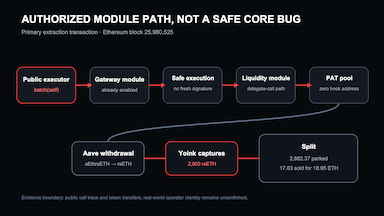
EXECUTIVE SUMMARYAt 04:38:47 UTC on 15 September 2026, an Ethereum transaction removed approximately 2,900 aEthrsETH from Safe wallet 0x40E93a52F6Af9fCD3b476aeDADD7FeABD9f7AbA8, withdrew the underlying rsETH from Aave, and split the proceeds. A generalized MEV searcher known as Yoink executed first, ahead of the party that prepared the exploit path.The largest portion, 2,882.37 rsETH, went to 0xC70f00CD7E461686b04B0E912E309becA8b80ea0. Another 17.63 rsETH was sold for approximately 18.95 ETH. Kelp publicly described a temporary 24-hour address-level pause and said rsETH remained fully backed and its core contracts were unaffected.The chain evidence supports a narrower technical conclusion than several early headlines. The failure was not a Safe core bug, a stolen owner key, or a bypass of signature verification inside Safe. The Safe had already delegated execution power to modules. A publicly callable batch executor treated a self-target as trusted, allowing an outsider to walk through an enabled gateway and liquidity module into Safe module execution without a fresh owner signature.ATTACK PATH AND EVIDENCE BOUNDARYThe main extraction transaction is 0x0e7680b06cb8a6f86c149d9ba90d98e3d334e7b072dde03909d43fcfd98a8705 in Ethereum block 25,980,525. Bitquery reports 175 successful calls, a maximum call depth of 24, and 39 logs.The caller path was public executor batch(self), gateway module, Safe module execution, delegate-call execution, and the enabled Uniswap v4 liquidity module. The Safe processed those module calls as designed. The authorization weakness sat in the public batch contract's target validation and in the amount of authority reachable behind that check.The extraction used a newly created junk token, PAT, as the other side of an aEthrsETH pool. Public discussions initially described a malicious Uniswap hook. Bitquery's call-level reconstruction says the pool's hook field was the zero address and the flow used a normal Pool Manager unlock and take sequence. Until contract-level evidence establishes otherwise, “malicious hook” should be treated as an early characterization rather than a confirmed mechanism.CONFIRMED TRANSACTION ANCHORSThe primary victim Safe is 0x40E93a52F6Af9fCD3b476aeDADD7FeABD9f7AbA8. The reported attacker EOA is 0x0dC2c5D6b05A317076CF501f7E7be36A5dfe9b66, the helper contract is 0x10605eE48Ff962952C966277A5D2dac0A0705Cb1, and the public keeper multicall is 0x4f0055926c839d1d960a82cbf84e2ee933958ebc.The Yoink EOA, 0xFDe0d1575Ed8E06FBf36256bcdfA1F359281455A, called the Yoink bot contract at 0x80BF7Db69556D9521c03461978B8fC731DBBD4e4. The extraction burned roughly 2,900 aEthrsETH and produced the underlying rsETH. The bot parked 2,882.37 rsETH at 0xC70f00CD7E461686b04B0E912E309becA8b80ea0 and sold the remaining 17.63 rsETH through a real ETH/rsETH market.THE 24-SECOND RACEAt 04:38:23 UTC, the helper deployed PAT and an unlocker and minted a large PAT supply. At 04:38:35, it seeded the Uniswap v4 pool. Twelve seconds later, the Yoink transaction landed at index zero in block 25,980,525. The original attacker's transaction does not appear in that block.Within the capture transaction, the module path moved aEthrsETH from the Safe into Pool Manager, the unlocker took the aToken, and the helper withdrew the underlying rsETH from Aave. Yoink then split the proceeds between the large receiving wallet and an in-block sale.The distinction between “front-running the attacker” and “recovering the victim's funds” matters. Yoink prevented the original exploiter from receiving the primary payout, but public chain data does not establish that the receiving wallet belongs to a white hat or that the funds were returned. Address behavior alone cannot identify the operator or its intent.FOLLOW-ON FLOWS AND CURRENT EXPOSUREBitquery reports no rsETH outflow from the 2,882.37 rsETH receiving wallet at its investigation cutoff. That supports a dormant-balance finding, not an independent proof of Kelp's off-chain restriction mechanism. Kelp's public statement described a temporary pause; Bitquery did not identify an on-chain admin pause transaction.The same morning produced several additional flows. At 05:24:47, a copycat extraction moved 50 aEthrsETH through the same PAT pattern; 40 rsETH entered CoW in four transfers and 10 rsETH moved to another address. At 05:47:59, the same reported attacker path hit a second Safe, 0x6a1fac6b3466e29421f70d6eaa91a0de0f627ea2, moving 86,632 DUSD and 38,248 USDC and producing approximately 23.69 ETH for the attacker EOA.At 05:53:59, Yoink used a Morpho Blue WETH flash loan and Aave's liquidation function against the first Safe. Aave events recorded about 168.83 WETH of debt covered and 157.71 rsETH seized. The seized rsETH was sold on Fluid before the flash loan was repaid.At 06:00, the owner disabled the gateway and liquidity modules used by the drain. At 06:37, the same sender repaid 248 WETH of Aave debt. At 07:20, an owner transaction disabled nine additional modules. The containment sequence therefore followed the exploit and several copycat attempts rather than preventing the first extraction.WHAT REMAINED ON THE SAFEThe wallet was not emptied. Bitquery's post-incident snapshot reported approximately 50,279 aEthrsETH, 51,344 variable-debt WETH tokens, 7.18 native rsETH, and 18 Uniswap v4 position NFTs, including the empty PAT position. These balances are a point-in-time public-chain observation and can change.WHAT THE CHAIN PROVES — AND WHAT IT DOES NOTConfirmed by transaction-level public-chain analysis:• The primary extraction occurred in block 25,980,525 through an enabled module path without a fresh Safe owner signature.• Roughly 2,900 aEthrsETH was converted to rsETH; 2,882.37 rsETH was parked at one receiver and 17.63 rsETH was sold.• The pool used for PAT had a zero hook address in Bitquery's reconstruction.• Later activity included copycat drains, a second Safe loss, an Aave liquidation funded through Morpho, and module disable transactions.• The largest rsETH balance had no observed rsETH outflow at the published cutoff.Not established by the available evidence:• The real-world identity or intent of the attacker, Yoink operator, or receiving wallet controller.• Whether the 2,882.37 rsETH will be returned, retained as a bounty, or released after the reported pause.• Whether an off-chain restriction can be mapped to a specific on-chain admin transaction.• A complete victim-loss figure that reconciles the initial drain, copycats, the second Safe, debt repayment, and later liquidations.CONCLUSIONThis incident is a warning about delegated authority rather than multisig cryptography. Safe's owner threshold was never asked to approve the transfer because the relevant modules already possessed a route to execute for the wallet. The control that failed was the caller boundary in front of those modules.The MEV outcome reduced the original attacker's take but did not automatically restore the victim. Investigators should keep the 2,882.37 rsETH receiver, the ETH skim wallets, the CoW route, the Fluid sale, and the second-Safe proceeds under observation. The next material update will be a return transaction, a release from the reported restriction, or a transfer into a labeled service.METHODOLOGY AND SOURCESThis report uses Bitquery's published call-level reconstruction and public Ethereum transaction references, cross-checked against Blockaid's initial alert, Kelp's incident statement, and contemporary reporting. A new SentinelTX investigation was not executed because the account had no remaining monthly investigation slot; this report therefore does not claim SentinelTX verification.Bitquery, “How a Safe module drained 2,900 rsETH in one block”: https://bitquery.io/investigations/rseth-safe-module-drainBlockaid incident alert: https://x.com/blockaid_/status/2099732957803999342Kelp incident response: https://x.com/KelpDAO/status/2099740756865159562Primary transaction: https://etherscan.io/tx/0x0e7680b06cb8a6f86c149d9ba90d98e3d334e7b072dde03909d43fcfd98a8705Unchained, “A Bot Robbed the Hacker Who Drained $7.8 Million in rsETH From a Safe Wallet”: https://unchainedcrypto.com/a-bot-robbed-the-hacker-who-drained-7-8-million-in-rseth-from-a-safe-wallet/
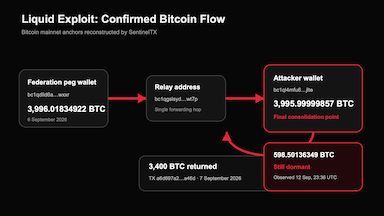
EXECUTIVE SUMMARYOn 6 September 2026, the Liquid Network suffered a validation failure that allowed unbacked L-BTC to be created and exchanged for Bitcoin held by the federation. Blockstream's incident status said approximately 4,000 BTC was withdrawn through SideSwap's Peg-out Authorization Key path while the key itself was not compromised. Public reporting later described a software validation and caching flaw rather than a signer compromise.SentinelTX reconstructed the Bitcoin mainnet leg. It confirmed 3,996.01834922 BTC leaving the federation peg wallet, passing through one relay address, and consolidating as 3,995.99999857 BTC in the attacker wallet. On 7 September, that wallet returned 3,400 BTC. At the investigation cutoff of 12 September 2026 at 23:36 UTC, 598.50136349 BTC remained in the same attacker address.The most important result is a null result: five-hop outbound tracing found no confirmed exchange deposit, mixer exposure, CoinJoin pattern, bridge route, or other cash-out leg for the remaining balance. The retained Bitcoin was visible and dormant rather than dispersed. This leaves a live recovery and enforcement window, but it does not identify the operator.INCIDENT MECHANICS AND EVIDENCE BOUNDARYLiquid's normal peg is intended to keep L-BTC backed one-for-one by Bitcoin held by the federation. The incident broke that backing invariant. The exploit did not require movement of federation signing keys; instead, an invalid asset state was accepted by the peg-out path and released real BTC.The diagram below shows only the Bitcoin mainnet path independently anchored by SentinelTX. Liquid-side issuance details, the precise vulnerable code path, and the disclosure timeline remain dependent on public technical reporting until a complete postmortem is published.CONFIRMED TRANSACTION ANCHORSThe first anchor is transaction 8db751a650ae2f12006b7e8c69a75e4df360e8afd6b9e05ae0b9fa6458a7b140. It moved 3,996.01834922 BTC from federation peg wallet bc1qdlld6antmv4xug242ed83q7k4rqw50cwfns38szx4qu2f4jwaxxsuhwxxr to relay address bc1qgslsydz56d0ed6827hdemfmk5w2f6ldyc6wt7p.Transaction 85d2ca15bea33a592e73ed40c6a5da887feecf1e77f58ec7f580e00841645043 then moved 3,995.99999857 BTC from that relay to attacker wallet bc1ql4mfu6aundtkksxklfajs2h3t9nzcd6gyqjlte. On 7 September, transaction a6d697a25266ce3c78774fd1d75f896b7af522ada209b0f6228ea497bc49a46d returned 3,400 BTC to the federation peg wallet.The evidence ledger below separates confirmed transfers from one unresolved accounting gap. The attacker wallet's observed balance exceeds the simple anchored inflow-minus-return calculation by approximately 1.96304 BTC. That difference may reflect additional inflows, but it must not be assigned to the exploit without transaction-level reconciliation.CURRENT STATUS OF THE REMAINING 598.5 BTCSentinelTX traced outbound activity from the attacker wallet across a 60-day window and up to five hops. The only material outbound transaction was the 3,400 BTC return. The remaining 598.50136349 BTC showed no confirmed split, peel chain, CoinJoin, mixer deposit, bridge transfer, or centralized-exchange deposit.The attacker address and federation peg address were both unlabeled in SentinelTX's internal entity database. Calling the latter the federation wallet relies on public incident materials and transaction context, not an independent database label. This distinction matters because address behavior can confirm a flow without proving real-world ownership.WHAT THE CHAIN PROVES — AND WHAT IT DOES NOTThe chain proves the withdrawal path, the relay hop, the final consolidation address, the 3,400 BTC return, and the retained balance at the stated cutoff. It also shows that the remaining balance had not entered a known off-ramp or obfuscation service during the observed window.The chain does not prove that the operator was a good-faith security researcher. Public messages reportedly used white-hat language, but retaining user backing as leverage after partial return fits a coercive, self-appointed bounty pattern. That is an analytical classification, not a legal finding or identity attribution.Likewise, public claims that a security warning was ignored remain disputed. Bitcoin Red Team co-lead Calle said the parties had agreed to an embargo and accused Blockstream of publishing an incomplete account early. Blockstream-linked voices denied that warnings were ignored. SentinelTX did not independently obtain a complete disclosure record, acknowledgement timestamps, severity triage, patch history, or embargo terms. Until those artifacts are published, the ignored-warning narrative should be treated as an allegation.INVESTIGATOR PRIORITIESThe clearest intervention opportunity is the first movement from bc1ql4mfu6aundtkksxklfajs2h3t9nzcd6gyqjlte. Exchanges and major service providers can prepare alerts against the confirmed address before a deposit appears. No freeze target exists yet because no exchange deposit leg was observed.The strongest attribution lead on the public chain is the relay address bc1qgslsydz56d0ed6827hdemfmk5w2f6ldyc6wt7p and its pre-incident history, co-spend relationships, and counterparties. Two shared outputs in the initial federation transaction—bc1qk3cvk5599nydy8zwavlxaduke54pgf4vl0ckru and bc1qkxwva32eh7mgezq5kladncd3n5wtcjmslh98my—also warrant service-attribution review.The unresolved 1.96304 BTC balance gap should be reconciled before the accounting chain is called complete. Off-chain evidence is equally important: SideSwap request records, account details, IP logs, authentication traces, and federation communications should be preserved.CONCLUSIONThe Liquid exploit is unusual not because the proceeds disappeared quickly, but because most were returned and the remainder stayed visible. At the cutoff, 598.50136349 BTC remained concentrated in one public address with no confirmed laundering or cash-out leg. That creates leverage for recovery negotiations, real-time monitoring, and coordinated exchange response.The restraint visible on-chain should not be mistaken for authorization or attribution. The defensible conclusion is narrower: a software validation failure released federation BTC; a single attacker cluster returned 3,400 BTC; the remaining balance was dormant; and the next transaction may be the first actionable off-ramp signal.SOURCESBlockstream Service Status, "Liquid Security Incident," 7 September 2026: https://status.blockstream.com/Chainalysis, "How The $320M Exploit of Liquid Network Went Down," 9 September 2026: https://www.chainalysis.com/blog/320m-exploit-liquid-network/SideSwap, "Statement on the Liquid Network incident of 6 September 2026": https://testnet.sideswap.io/news/statement-on-the-liquid-network-incident-of-6-september-2026/The Block, "Return the bitcoin: Blockstream refuses ransom demand for remaining 600 BTC from Liquid exploit," 11 September 2026: https://www.theblock.co/news/ecosystems/2026-09-11-return-the-bitcoin-blockstream-refuses-ransom-demand-for-remaining-600-btc-from-liquid-exploit-414247SentinelTX on-chain investigation completed 13 September 2026. All balances and endpoint observations are time-bound. Wallet association does not by itself identify a person or organization.
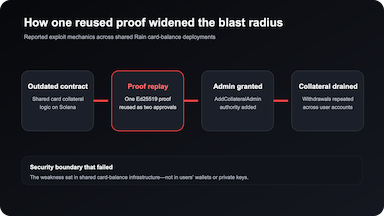
EXECUTIVE SUMMARYOn 28 August 2026, an outdated Solana collateral program used by Rain-powered stablecoin card products was reportedly exploited through a reused Ed25519 verification proof. Blockaid reports roughly $1.1 million drained across multiple programs, followed by swaps into SOL, a bridge to Ethereum, and approximately 455.9 ETH deposited into Tornado Cash.Our SentinelTX investigation reached a narrower, transaction-anchored conclusion. It independently confirmed two USDC inflows totaling 1,780.973441 USDC into the reported Solana collection wallet on the incident date and confirmed the published Ethereum router as a sanctioned Tornado Cash endpoint. It did not reproduce the reported $1.1 million total, the deBridge leg, or the 455.9 ETH deposit from the supplied seeds. Those gaps are central findings, not details to hide.INCIDENT MECHANICSAccording to Blockaid, the vulnerable contract accepted one attacker-controlled Ed25519 proof where two independent authorizations were expected. That enabled AddCollateralAdmin, followed by repeated WithdrawCollateralAsset calls across user collateral accounts. The failure was in shared card-balance infrastructure—not in users’ private keys.The diagram below separates the authorization failure from the later asset movement.VERIFICATION MATRIXClaimStatusEvidence~$1.1M lossReportedBlockaid / press2,945 admin + 5,288 withdrawalsReportedBlockaid1,780.973441 USDC on Aug 28Confirmed2 Solana txsdeBridge + 455.9 ETH to mixerUnanchoredNo matching path from seedsTornado router identityConfirmedSentinel labelClaim | Status | EvidenceReported loss of about $1.1M | Reported, not independently reproduced | Blockaid and press reporting2,945 AddCollateralAdmin and 5,288 WithdrawCollateralAsset calls | Reported, not independently reproduced | Blockaid1,780.973441 USDC received by the reported collection wallet on 28 August | Confirmed | Two Solana transaction anchorsdeBridge route and 455.9 ETH into Tornado Cash | Reported, not anchored in this session | No matching bridge or mixer transaction from supplied seedsTornado Cash router identity | Confirmed | Sentinel Protocol labelCONFIRMED SOLANA TRANSACTION ANCHORSThe reported collection wallet is FVNFzqAny8spWdPmYw6RQ9TkYa29ueFFiqCFD1gQnCEj. SentinelTX found two incident-date inflows:• 1,779.973441 USDC from HEgJutJjfCyG7RDtcS9xBc8sbty31TsqK3VCxyh4s7K1 in transaction 2oE6hQ7nFYpx9k1EUZuy93DsPqDUoo6MvSzMG8b8zGMZ7hUbzAzuYubicvRPK7Pcyvsxb1Hk35yB22dsC9jt3M5L.• 1.000000 USDC from 83v8iPyZihDEjDdY8RdZddyZNyUtXngz69Lgo9Kt5d6d in transaction JV6xqGB4Xppfre5rYvSauypAxZGG3quqtR19utqsQTmot4BPSr8KoqPRUZWfhZ6rDC9SkH45Lu4gcU34pyeKudv.No outbound movement from the collection wallet was observed in the 60-day window. Both counterparties were unlabeled. This means the supplied collection wallet explains only a small fraction of the reported loss and does not itself prove the subsequent swap, bridge, or mixer path.REPORTED FUND FLOW AND EVIDENCE BOUNDARYBlockaid describes a route from drained USDC and USDT through Solana DEX swaps into SOL, across deBridge to Ethereum, and finally into Tornado Cash. The diagram below shows that reported path while marking the mixer as the deterministic endpoint boundary.WHAT THE EVM SEEDS DO—AND DO NOT—PROVEThe supplied address 0xa1a15f1b0d4878873f2933573e4385ab1e4df25c had no relevant value-flow connection to the Solana incident in the observed window and retained only about $4.39. The second seed, 0x775028b2ce02844e8947905e4d655940a76cf559, had an active multi-exchange history, but SentinelTX found no taint-traceable path from the Rain exploit. Service contacts visible around that address—including Binance, Bybit, MEXC, FixedFloat, Cryptomus, Bitpanda and CoinEx—must not be presented as destinations of Rain proceeds without that missing link.The Tornado Cash router 0xd90e2f925DA726b50C4Ed8D0Fb90Ad053324F31b is independently labeled as a sanctioned mixer. The identity of the service is confirmed; the claimed 455.9 ETH incident deposit is not confirmed by this investigation.WAS THE ENTIRE WALLET TRAIL TRACED?No. Deterministic tracing stops at the supplied seeds because the collection wallet showed no outbound transaction in the observed window and neither EVM seed could be connected to the verified Solana inflows. The three strongest next steps are: obtain the full AddCollateralAdmin and WithdrawCollateralAsset transaction sets for all four matching deployments; trace upstream from HEgJutJjfCyG7RDtcS9xBc8sbty31TsqK3VCxyh4s7K1; and identify the reported 455.9 ETH Tornado Cash deposit cluster before tracing backward to a bridge arrival.CONCLUSIONThe most defensible conclusion is narrower than the headline. A shared, outdated authorization design reportedly widened one exploit across multiple card programs. SentinelTX confirmed two incident-date inflows and the mixer router’s identity, but it did not close the chain from those Solana inflows to the reported cross-chain laundering path. The gap between $1.1 million reported and 1,780.973441 USDC independently anchored points to missing wallet sets or incomplete public seeds.That distinction matters: a labeled exchange contact is not automatically incident proceeds, and a published mixer address is not proof of a specific deposit. The next investigation should begin from the deployment-level withdrawal transactions, not from assumptions about the supplied EVM wallets.SOURCESBlockaid, “$1.1M Rain Ecosystem Exploit: How Onchain Monitoring Gives Stablecoin Card Issuers Fleet-Level Coverage” (2 September 2026): https://blockaid.io/blog/11m-rain-ecosystem-exploit-how-onchain-monitoring-gives-stablecoin-card-issuers-fleet-level-coverageSentinelTX case CASE-ASYNCBE3, investigated 4 September 2026.APPENDIX — EVIDENCE STATUS TABLE
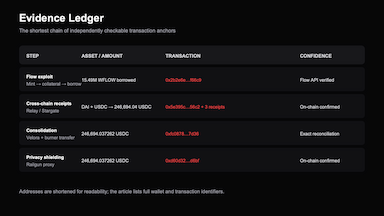
EXECUTIVE SUMMARYOn 31 August 2026, a mint-ratio failure in Ankr’s Flow liquid-staking system allowed an attacker to create economically unbacked ankrFLOW and use it as collateral inside MORE Markets. The exploit was executed through one atomic Flow EVM transaction and removed 15,488,124.15 WFLOW from the lending reserve.The first public alert valued the incident at roughly $9.3 million. That number was a stale detector valuation, not the confirmed loss. Flow later described the reserve loss as approximately $410,000, while on-chain tracing shows that the attacker ultimately consolidated and shielded 246,694.037262 USDC on Ethereum.The most important finding is therefore not simply the amount. MORE Markets’ oracle could price ankrFLOW correctly and still underwrite counterfeit collateral, because the issuer-side mint invariant had already failed. Collateral risk includes the integrity of the asset’s issuance mechanism, not only market price.INCIDENT MECHANICSThe exploit transaction was submitted at 06:18:52 UTC from 0xa1E4B05F9A0425136045D8fC8A4978B25bB6A7Cc to the helper contract 0xA0C2fe72aD9b640994A9c4252F25Fb058DDb3702.Independent transaction reconstruction reports that the helper minted 51,942,364.75 ankrFLOW under an incorrect conversion path. Approximately 8.65 million of that output was economically unbacked. The attacker swapped part of the minted position for WFLOW, deposited 13.3076 million ankrFLOW as collateral, and borrowed 15,488,124.15 WFLOW from MORE Markets.The chain-level call path is consistent with a single atomic strategy: create the mispriced collateral, have the lending market accept it, and remove the reserve before any intervening control can react.WHAT THE FLOW EVM TRANSACTION PROVESThe public Flow EVM transaction record directly confirms the sender, helper contract, block 76986328, timestamp, and the WFLOW and ankrFLOW transfer logs. It also identifies the ankrFLOW/WFLOW pool at 0xbB577ac54E4641a7e2b38Ce39e794096CD11A639, the ankrFLOW token at 0x1b97100eA1D7126C4d60027e231EA4CB25314bdb, and the bond token at 0xd6Fd021662B83bb1aAbC2006583A62Ad2Efb8d4A.Exploit transaction:0x2b2e6ea6cc7dabeec83941abfdc22dd7fa53a58f327af0fccb73a0ed8a3f66c9Attacker EOA:0xa1E4B05F9A0425136045D8fC8A4978B25bB6A7CcHelper contract:0xA0C2fe72aD9b640994A9c4252F25Fb058DDb3702The $9.3M, $410K and $246.7K figures measure different layers. The first was an automated gross valuation of the reserve movement. The second is the corrected protocol-level reserve loss. The third is the amount that can be followed into a completed Ethereum laundering path. They should not be added together or presented as competing estimates of the same quantity.EVIDENCE LEDGERThe following ledger keeps the incident mechanics separate from the later proceeds trail. Full identifiers are listed in the article so each anchor can be checked independently.THE REALIZED-PROCEEDS TRAILSentinelTX traced the attacker’s realized proceeds across Flow EVM and Ethereum. The same attacker address was used as the destination on Ethereum.A Relay/LiFi route converted 89,125.770791 PYUSD0 on Flow EVM into 88,373.568536 DAI on Ethereum. Additional receipts delivered 96,647.730149 USDC through Relay.link and 37,851.215317 plus 23,821.523260 USDC through StargatePoolUSDC.The attacker then used the Velora smart contract at 0x6a000f20005980200259b80c5102003040001068 to convert the 88,373.568536 DAI into USDC. The four Ethereum receipts consequently reconciled to exactly 246,694.037262 USDC.That entire amount moved in transaction 0xfc0878bf80cd9353ddda9974364582086f4a5558ea9638b960ea8882313b7d36 to the previously unfunded relay wallet 0x28ed3280d0689456e349b68a62cf00eaa0715b4d. The attacker also supplied that wallet with 0.002933 ETH for gas.The relay wallet then sent 616.735093 USDC and 246,077.302169 USDC—again totaling exactly 246,694.037262 USDC—to the Railgun proxy at 0xfa7093cdd9ee6932b4eb2c9e1cde7ce00b1fa4b9 in transaction 0xd60d3264e07add714933cdb004f090f4559f64297fda64a7978fb35fcb7dd6bf.No centralized-exchange deposit was observed. The trace ends at Railgun shielding. Any recipient or withdrawal after that point is unknown and should not be inferred.WHAT THE MECHANICS DIAGRAM MEANSThe diagram above shows why the lending market could fail even if its oracle feed was functioning as designed. Once the issuer produced unbacked ankrFLOW, a correct market price became the wrong economic value for that specific collateral. E-mode then magnified the amount that could be borrowed against it.ATTRIBUTION BOUNDARYSentinelTX found no reliable identity label for the attacker EOA, the helper contract, the relay wallet, or 0xac9f360ae85469b27aeddeafc579ef2d052ad405, which received 0.002194 ETH left over from the relay wallet. The EOA and relay wallet are operationally linked because the attacker supplied both the full USDC amount and gas, but this does not identify a person or organization.The current observed balances are effectively empty: the attacker EOA retains only 0.000346 USDC on Ethereum, and the relay wallet retains approximately 0.000521 ETH. A later 1 CAT transfer was classified as spam and excluded from the proceeds graph.RESPONSE AND RECOVERYThe most useful investigative leads are off-chain bridge records and future privacy-pool exits. Relay, LiFi and Stargate may retain routing, solver, API or session records tied to the bridge transactions. Investigators should also preserve the Flow EVM deployer and initial gas-funding history for the attacker and helper contract. A future Railgun unshield event with correlated size, timing and gas behavior could provide a new cluster lead.No CEX deposit means there is no presently identified custodial account to freeze. Recovery prospects are therefore low unless bridge metadata or a later unshield creates an attributable endpoint.EVIDENCE LIMITSConfirmed on-chain facts in this report are anchored to the Flow EVM exploit record and the Ethereum receipts, swap, relay-wallet transfer and Railgun deposit. The exact composition of the difference between the ~$410K reserve loss and the $246,694 realized proceeds remains unresolved. No natural person, company or country has been attributed to the attacker.CONCLUSIONThis was a compact, pre-planned laundering path: atomic collateral creation and borrowing on Flow EVM, multiple bridge routes into Ethereum, immediate asset consolidation, one burner wallet and full privacy shielding. The protocol lesson is equally compact. A lending market must validate the issuance integrity of accepted collateral, because a healthy oracle cannot repair a broken mint invariant.SOURCESFlow EVM transaction record:https://evm.flow.com/api/v2/transactions/0x2b2e6ea6cc7dabeec83941abfdc22dd7fa53a58f327af0fccb73a0ed8a3f66c9Technical reconstruction:https://sigintzero.com/blog/more-markets-15-5m-wflow-ankrflow-mint-ratio-flawReporting cross-check:https://beincrypto.com/more-markets-exploit-flow-evm-wflow/SentinelTX case: CASE-20260902-0001, investigated 3 September 2026.
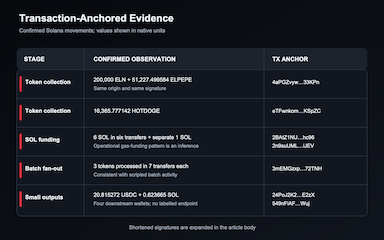
Malwarebytes reported a fake “GTA 6 leaked copy” site that placed a 1 SOL checkout in front of a download and loaded a remote multi-chain drainer script. The page exposed a Solana recipient address: 21iWU6FJWJ9FKKz4Jek2CyTh2x1fqs5jawjrNgE3nHjN.ChainBounty traced that address with SentinelTX. The result is useful precisely because it separates a public campaign indicator from proof of stolen funds. The address has real, transaction-anchored activity, but this investigation did not establish a victim-to-address transfer, an exchange cash-out, or an operator identity.WHAT THE SOURCE ESTABLISHESThe Malwarebytes analysis establishes the off-chain threat context: the fraudulent site presented a fake game purchase, calculated a near-total Solana balance transfer, and loaded code capable of targeting wallets on several EVM networks. It also published the Solana recipient and two infrastructure domains.Those findings do not automatically make every historical transaction involving the published address a theft transaction. That link must be proved separately on-chain.WHAT SENTINELTX OBSERVED ON-CHAINSentinelTX reconstructed a nine-address Solana cluster around the published seed. Four origin wallets supplied tokens or SOL to the seed, which then performed a batch token fan-out and several small USDC and SOL transfers.TRANSACTION ANCHORSToken collection:• 200,000 ELN and 51,227.499584 ELPEPE — 4aPGZvywmCZMeDqpKTfUiQjeHZYEDXJHRRLk4Vmq6YCBAwkWde7U3DimT6SamroZdwM4HKcgNWSceFgkoXY33KPn• 16,365.777142 HOTDOGE — eTFwnkombV3AvMmd9ucWeZ6LMbN9KuWnoSB8nQbJm9JsFAYAoUFAHxzy87R33JurAnAFFBrSWJF8awpyWcKSpZCSOL funding:• 6 SOL in six transfers — 2BAtZ1NUPqQnxM4vrvLDdN9fg5hy1Fh255nytZiUsG2Mhy61Y2YiVBc1UhiP2UrzydofBpCbzTHFpZkW62huhc96• A separate 1 SOL transfer — 2n9suUMLocSKpEvprh2g5EPecxKpZgEvCsiSFnn2DW5BJAAr6BJQcbm1EarFFZFyGq2Aj43efNTGiGYJZXCniJEVBatch fan-out:• Three tokens processed in seven transfers each — 3mEMGzxpcv3hvitz2N59TkiQesuYT4RVuNAbTrXteHdssZpCavaM8JN1z8fupRNwaiLTxmG52WK61fucduq72TNHSmall outputs:• 20.815272 USDC total and 0.623665 SOL total to four downstream wallets — 24PoJ2K27zjSrko4GkP49fP67XTC25xHYgX2aaSKcKcF3AwnNifrWXrqUGR12zEaMuqiP7BeVQ4JMCjkWME4E2zX; 549nFiAFvKU4sA9zUcTYKeZhS1SsJLpWeVfZ5X7XAa26RNm2DhYARTijor6sW9zqAupWfaCHEkDxK6SA3wz1mWuj; 4BXrF2MFbt7U6BshdLY12qQAK5kBV7VGEroaPLZZnVgBAZ2S1qX2qxMZq21fMapHsCAPZ4C41ZxLAKFCsJHQg9AJThe equal seven-way treatment of three tokens is consistent with scripted batch activity. The split SOL funding may be operational gas funding. Those are analytical interpretations, not proof that the cluster belongs to the drainer operator.THE KEY FORENSIC BOUNDARYNone of the nine addresses returned a reliable exchange, mixer, bridge, or named-service attribution. The four observed downstream wallets had no further movement within the traced scope. No confirmed cash-out leg was found.This means the investigation cannot defensibly claim:• that the observed tokens or SOL came from victims of the fake GTA 6 site;• that the batch fan-out was laundering rather than token distribution or spam;• that any specific person or organization controls the cluster;• a campaign-wide loss amount; or• a recovery target at a centralized exchange.The low-value outputs—about 20.8 USDC and 0.62 SOL—could represent settlement or account costs, but that remains inference. The on-chain evidence does not yet support calling them stolen proceeds.ADDRESSES WORTH MONITORING• 21iWU6FJWJ9FKKz4Jek2CyTh2x1fqs5jawjrNgE3nHjN — published seed; collection and redistribution; unattributed.• HMiD3578xUqodjNfLrFFTUwZww6aou6AKiX2NU33JXrM — six-part SOL supplier; unattributed.• 3TwWg4vVnVLBnwpJa8ZK3FrAbNucX8L3BtWtuwt7uVoC — ELN and ELPEPE supplier; unattributed.• 8ekCy2jHHUbW2yeNGFWYJT9Hm9FW7SvZcZK66dSZCDiF — largest USDC output and bidirectional counterparty; unattributed.The strongest next step is backward tracing of the four origin wallets and instruction-level decomposition of the seven fan-out recipients. Downstream monitoring should prioritize 8ekCy2jH…, because it is both the largest USDC recipient and a bidirectional counterparty.CONCLUSIONThe fake GTA 6 site is a credible wallet-drainer threat. The published Solana address is a valid indicator of compromise and has a structured on-chain history. But an indicator is not the same as an attribution.The defensible conclusion today is narrower: SentinelTX confirmed a nine-address collection-and-redistribution cluster, but did not prove that the observed funds were victim proceeds or identify a cash-out endpoint. That boundary should guide monitoring, exchange notices, and any future public claims.Source: Malwarebytes, “Fake GTA 6 ‘leaked copy’ drains your crypto wallet” (1 September 2026)https://www.malwarebytes.com/blog/scams/2026/09/fake-gta-6-leaked-copy-drains-your-crypto-wallet
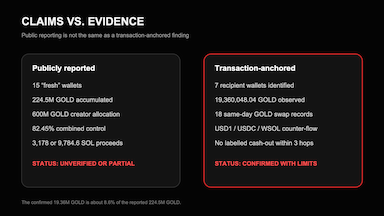
Executive summaryTrump Digital GOLD (GOLD) was promoted through an account styled as @realtrumpcoins1, briefly reached a reported market capitalization above $50 million, and then collapsed by roughly 98–99%. The branding implied political proximity, but no Trump family member publicly confirmed the token.SentinelTX did not validate the most dramatic public claims in full. It did confirm a narrower, transaction-anchored pattern: on 29 August 2026, a single Solana hub distributed 19,360,048.04 GOLD to seven wallets while USD1, USDC, and WSOL moved in the opposite direction in the same trading pattern. That is consistent with DEX swaps or pool interaction, but it does not by itself prove beneficial ownership, creator control, or the final cash-out amount.The evidence boundaryThe token mint is EMWtbpHaNqMbjUMZguuazhuZUVLWG3z4C5oZnGJPSqxS. The pair address examined was Hw5DkpbhbUd7QXj5syiShyPsYCpRCzbz2Vu433mdWEnU. SentinelTX case CASE-20260829-GOLD was explicitly marked partial because the unattended time cap prevented a complete trace. This report therefore separates verified on-chain observations from public reporting and inference.Confirmed fund flowThe central hub HLnpSz9h2S4hiLQ43rnSD9XkcUThA7B8hQMKmDaiTLcC sent GOLD to seven identified wallets on the incident date. The largest recipient received 16.73 million GOLD; the next two received approximately 1.09 million each. Four smaller recipients brought the observed total to 19,360,048.04 GOLD.At the same time, three counterparties sent USD1, USDC, or WSOL toward those recipients. This supports a DEX-swap or liquidity-interaction interpretation. It does not conclusively establish who controlled the wallets or whether every GOLD transfer was a sale.Public claims versus observed evidence15 newly created wallets: partial — seven recipients identified; “new” status not proved.224.5M GOLD accumulated: unverified — 19.36M GOLD observed.600M GOLD held by creator: unverified — creator wallet not identified.82.45% combined supply control: unverified — holder query incomplete.3,178 SOL (~$330K) or 9,784.6 SOL (~$1.01M) proceeds: both unverified; the figures conflict.$8.2M profit: not supported by transaction anchors in this investigation.The confirmed 19.36 million GOLD represents about 8.6% of the publicly claimed 224.5 million GOLD. The remaining 205.14 million GOLD was not traced in this session.Coordination indicators, not identity proofThe same date, the same sending hub, and the same swap pattern across seven wallets are indicators of coordination. They are not proof that a single person controlled every wallet. Several recipient wallets also had older activity, which weakens the blanket description of all participants as newly created wallets.The hub itself had activity before this incident and traded multiple meme tokens. It therefore should not be described as an incident-only attacker wallet without additional attribution evidence.Cash-out statusNo labelled centralized-exchange deposit, bridge, mixer, or exchange hot/cold wallet was identified within three hops of the seven recipients. The endpoint remains unresolved. This does not mean no cash-out occurred; it means the available investigation did not reach a labelled endpoint.What investigators should preserve nextThe highest-value next step is a deeper trace from the seven recipients, especially BNahnx13..., which received 16.73 million GOLD. Investigators should also resolve the token deployer from the mint creation transaction, reconstruct liquidity additions and removals for the pair, and seek exchange compliance matches for the identified wallets. Those steps are necessary before any defensible loss or profit number can be assigned.ConclusionThe chain supports a coordinated-looking GOLD distribution and swap pattern involving at least seven wallets and 19.36 million tokens. It does not yet support the full 15-wallet, 224.5-million-token, 82.45%-control, or $8.2-million-profit narrative. The strongest conclusion is therefore narrower: a concentrated, same-day market operation is visible on-chain, but identity, total proceeds, and final off-ramp remain unconfirmed.Sources: SentinelTX case CASE-20260829-GOLD; Cointelegraph; KuCoin News; CryptoRank. Public claims are attributed as reporting and are not presented as independently verified facts.
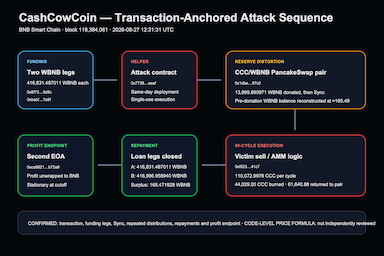
Executive SummaryOn 27 August 2026, a single BNB Smart Chain transaction used two large WBNB funding legs to manipulate the CCC/WBNB pool and extract 165.47192825151242 WBNB in profit. SentinelTX reconstructed the transaction flow and identified an important attribution distinction: the transaction signer paid the gas, but the profit was routed through a second contract to a different externally owned account.The evidence supports a reserve-manipulation exploit. It does not, by itself, identify the human operator.Evidence BoundaryThe primary evidence is the successful attack transaction 0x89d8050641019a5a75fa3dafb4f64fb153e4dd30c0f1f51d06a6cc206d3ead43, confirmed at block 118,384,061 on 27 August 2026 at 12:31:31 UTC. Public reporting describes a roughly $117,000 loss. Dollar values are therefore contextual; token amounts and transaction relationships below come from the on-chain reconstruction.Transaction-Level Attack SequenceThe attack signer 0x7977…13c4 invoked a helper deployed the same day. That helper aggregated 833,662.974022 WBNB across two funding legs. It then donated WBNB to the CCC/WBNB pair and triggered a reserve update before repeatedly trading against a system whose executable pricing depended on the manipulated pool state.Per confirmed cycle, 44,029.20 CCC moved to the burn address and 61,640.88 CCC returned to the pair. The loop was repeated 80 times. The mechanism matters more than the nominal flash-loan size: temporary liquidity only amplified a pricing dependency that trusted manipulable spot reserves inside one transaction.Repayment and Profit ExtractionThe first lender received exactly 416,831.487011 WBNB. The second contract received 416,996.958940 WBNB, including the surplus. One minute later, transaction 0x15be1604…acd97f moved the 165.471928 WBNB profit from that contract to 0xca8821…b72a9. Transaction 0xdaeada7c…8bf5 then unwrapped it into native BNB.At the investigation cutoff, the profit recipient held 165.53941989 BNB. SentinelTX found no confirmed direct deposit from this profit path to a centralized exchange, bridge, or mixer. That creates a live monitoring window, not proof that the funds will remain stationary.Address and Role MatrixAddressObserved roleAssessment 0x7977…13c4Attack transaction signerPaid gas; did not receive the profit0x7738…aeafSame-day helper contractAggregated funding and executed the sequence0x1dbe…97c0CCC/WBNB pairReserve state was distorted before Sync0xf523…41c7Victim sale/AMM contractExecutable pricing dependency requires code review0xbabf…7a9fSecond funding/repayment contractForwarded extracted profit0xca8821…b72a9Profit recipient EOAUnwrapped WBNB; funds stationary at cutoffWhat the Chain Proves — and What It Does NotThe chain proves the transaction ordering, token transfers, repayments, profit amount, and immediate post-exploit destination. It also shows that the signer and the profit recipient were different addresses.A shared gas source and a shared USDT source create a strong operational-cluster inference between relevant addresses, but they do not establish identity. The ultimate source of the second funding leg remains unresolved. The precise contract-level pricing formula and the relationship between two reported CCC contract identifiers also require separate code and deployment review.Investigator PrioritiesMonitor 0xca8821…b72a9 for first-hop movement, especially wrapping, bridging, or exchange deposits.Trace the upstream provenance of the second 416,831.487011 WBNB funding leg.Review the victim contract for direct or indirect reliance on pair reserves during executable pricing.Preserve the funding, attack, payout, and unwrap transactions as one evidence package.ConclusionThis was not simply a “large flash loan” event. The decisive control failure was allowing a manipulable pool state to influence executable pricing within the same transaction. The clearest recovery lead is the profit-recipient EOA, where the extracted value was still visible and had not entered a confirmed obfuscation or off-ramp service at the cutoff.Sources: SentinelTX on-chain investigation; Defimon Alerts; BitBase incident report.
TL;DRMoonwell’s Base lending markets reportedly lost approximately $8.7 million after an attacker manipulated the price of thinly traded MAMO collateral and borrowed liquid assets against the inflated valuation. Moonwell responded by setting Base Core Market borrow caps and MAMO/WELL supply caps to 1 wei.Our SentinelTX-assisted review anchors several material movements at transaction level, but it does not independently reconstruct every exploit call. The address 0xD71dD9B6e634412713c47fe7aE02c628e338C384 received 8,728,318.997396 DAI on Ethereum in transaction 0x58399aaf…4125d and still held that DAI at the investigation cutoff, alongside 0.896953 ETH. On Base, transaction 0x840bf521…befd shows 75,000 USDC routed through KyberSwap while 7,407,608.308454132 MAMO reached the address. Three later transactions anchor large mUSDC withdrawals.SentinelTX detected two Wormhole Base-to-Ethereum source transfers of 4,364,726.913196 USDC each, but the destination-chain transaction hashes were unavailable. That makes Wormhole a strong routing lead—not a completed cross-chain proof. A Tornado Cash funding path, the reported 14.33 cbBTC withdrawal, and any direct Coinbase or OKX deposit were not confirmed.Incident BackgroundMoonwell is a lending protocol operating on Base. Moonwell’s official response said it was investigating the MAMO Core Market incident and had restricted borrowing. Public alerts from PeckShield, CertiK, and Blockaid described a collateral-oracle failure: an attacker allegedly inflated the market price of MAMO, a thinly traded collateral asset, and used the distorted value to borrow liquid assets.This is best understood as a collateral-admission and pricing-control failure. When an illiquid asset can materially increase borrowing capacity, protocol safety depends on market depth, price-deviation limits, time-weighted resistance, conservative loan-to-value settings, and rapid cap controls.Evidence MatrixClaim or observationStatusBasisApproximately $8.7M was lostReportedPublic incident reportingMAMO collateral price was manipulatedReportedPublic incident reporting8,728,318.997396 DAI was received in 0x58399aaf…4125d and remained at 0xD71d…C384ConfirmedEthereum transaction and balance7,407,608.308454132 MAMO reached the address after a 75,000 USDC KyberSwap routeConfirmed transfer / inferred intentBase transaction 0x840bf521…befdThree mUSDC withdrawal transactions occurred at 09:15:23–09:15:25 UTCConfirmedBase transaction hashesTwo 4,364,726.913196 USDC Wormhole source transfersStrong leadProtocol detected; destination hashes unavailableReported 14.33 cbBTC withdrawalNot confirmedNo cbBTC transfer in target address historyDirect Tornado Cash funding or CEX depositNot confirmedNo direct transaction anchorWhat the On-Chain Evidence Confirms1. The DAI consolidation transactionAt 09:45:47 UTC on August 27, 0xD71dD9B6e634412713c47fe7aE02c628e338C384 received 8,728,318.997396 DAI from 0x719eae70d4a83f35bf82a2740699f5db84be919d in Ethereum transaction 0x58399aaf393f7d2f0671240f404df88c66db594dad6801bac87f1658b4e4125d. At the investigation cutoff it still held that DAI and 0.896953 ETH.DAI is not directly freezeable by an issuer in the same way as centrally administered stablecoins. Recovery therefore depends on detecting the next transfer, preserving evidence, and rapidly coordinating with any intermediary that receives the funds.2. Base-side preparation and withdrawalsSentinelTX observed the address’s first Base transaction at 02:39:35 UTC on August 21 and 20 outbound Base transactions through August 27. On August 26, transaction 0x840bf52106d58bf22d1c902f208fd9db34930a65fb99b177836ef883f7e5befd routed 75,000 USDC through KyberSwap’s Meta Aggregation Router v2 while 7,407,608.308454132 MAMO reached the address. The transfer is confirmed; describing it as manipulation remains analytical inference until the price-impacting pool events are reconstructed.At 09:15:23–09:15:25 UTC on August 27, three transactions—0x911cd7a92be883aaaccc10b5dea237a5869c98dc800a9b80a66809c31405f87e, 0x6987867466fa9da911639db61c721513609338992e4701a4a837025f81d56224, and 0x4c0401ee4444fb0306783ed3ae90ff78e301078b710f9796f78d9f182430eaaf—anchor mUSDC withdrawals to two recipient addresses. A residual 7.47302 mUSDC position also appeared at Moonwell’s Base USDC market contract 0xedc817a28e8b93b03976fbd4a3ddbc9f7d176c22.The complete collateral-deposit and borrow sequence remains missing. The widely repeated 14.33 cbBTC withdrawal was not present in the target address’s 85 Base token-transfer records. It may belong to another helper contract or wallet, or the secondary reporting may be inaccurate.TimelineTime (UTC)EventConfidence2026-08-21 02:39:35First observed Base activity for 0xD71d…C384Confirmed2026-08-26 00:55:1175,000 USDC routed through KyberSwap; 7,407,608.308454132 MAMO receivedConfirmed transfer2026-08-27 09:15:23–09:15:25Three mUSDC withdrawal transactionsConfirmed2026-08-27 09:20:1114.33 cbBTC withdrawal reported by secondary sourcesNot confirmed2026-08-27 09:45:478,728,318.997396 DAI received on EthereumConfirmedRouting Leads Are Not AttributionSentinelTX detected Wormhole as the only cross-chain protocol in this session. Two Base source hashes—0xfcb2ff810dd3ce09577ebd34c4c6a3b3798396221483bacf1ddd137e40ecac03 and 0x9cd2fbe0991a75a11fb9dbf241aca841e45b1878837bc1f049d6e608567f1dec—were each associated with 4,364,726.913196 USDC. Their combined 8,729,453.826392 USDC differs from the final DAI amount by about 0.013%, economically consistent with fees and slippage. But the destination hashes were null, so amount matching cannot replace transaction-to-transaction proof.No Circle CCTP, Stargate, or Across route was detected. Coinbase- and OKX-labeled addresses appeared only in the broader graph, with no direct deposit transaction from the target address. Tornado Cash likewise had no confirmed direct connection after 101 token transfers were reviewed.Investigator PrioritiesPlace real-time alerts on 0xD71dD9B6e634412713c47fe7aE02c628e338C384 across Base and Ethereum.Reconstruct the MAMO price update, collateral deposit, borrow calls, and affected Moonwell market events at transaction level.Resolve the Ethereum destination transactions for Wormhole source hashes 0xfcb2ff81…ac03 and 0x9cd2fbe0…1dec.Identify the helper address or contract behind the reported cbBTC borrowing sequence; do not force it onto 0xD71d…C384.Treat Coinbase, OKX, and market-maker labels as leads until a direct transfer is proven.If a centralized-exchange deposit is confirmed, send the exchange a preservation request containing the transaction hash, token, amount, timestamp, and source address.Control LessonsThe incident illustrates why collateral policy is part of protocol security. A price feed can be technically functional and still be unsafe if the referenced market is too shallow for the borrowing power it supports.Defenses should combine liquidity-sensitive collateral caps, conservative loan-to-value ratios, time-weighted or multi-source pricing, deviation and staleness circuit breakers, and real-time monitoring of sudden collateral-value changes. Emergency caps are useful after detection, but they should not be the first line of defense.LimitationsThe SentinelTX investigation reached a partial-result boundary. The deterministic graph covered 806 addresses and 2,593 flows, while the visible live graph contained 574 nodes at two hops. The Base trace was incomplete at three hops and the session reached a data cap. Noisy terminal balances and auto-ranked “largest flows” were excluded because DEX and routing activity can create misleading aggregates.This report does not identify a real-world attacker, prove a Tornado Cash funding source, complete the Wormhole cross-chain pairing, verify the reported 14.33 cbBTC withdrawal, or establish a direct exchange deposit. Wallet association alone is not identity attribution.ConclusionPublic reporting points to a thin-liquidity collateral manipulation. On-chain review anchors a 7.4 million MAMO acquisition, three mUSDC withdrawals, and the final receipt of approximately 8.728 million DAI at a known Ethereum address, leaving a meaningful monitoring and intervention window.The next breakthrough will come from the missing event-level anchors: the collateral and borrow calls, the cbBTC helper address if one exists, and the destination side of the Wormhole transfers. Until then, investigators should monitor the stationary DAI while resisting speculative attribution.Analytical disclaimer: This report separates transaction-level observations from public reporting and analytical inference. Balances and endpoints can change after the stated cutoff.

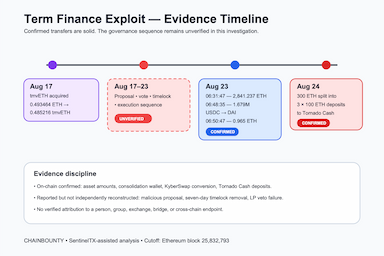
TL;DROn August 23, 2026, Term Finance reported an exploit affecting its Strategy Vaults. Public reporting described a governance attack in which an attacker accumulated voting power, disabled a seven-day delay, and withdrew roughly 2,843 ETH and 1.68 million USDC.Our SentinelTX-assisted review confirms the post-exploit asset flows with transaction-level anchors: 2,841.237 ETH moved into the consolidation wallet 0xD5183d8BfC65a50863C62aF2538198A8288FFc13; 1,679,642.45 USDC was swapped through KyberSwap into 1,679,642.45 DAI; and 300 ETH was later split into three 100 ETH deposits to the sanctioned Tornado Cash router. At the investigation cutoff, the consolidation wallet still held approximately 2,543.15 ETH and 1,679,642.45 DAI.The important caveat: this investigation did not independently identify the proposal, vote, timelock, or execute transactions. Those governance mechanics remain based on public reporting and require separate contract-event reconstruction. The asset movements described below are on-chain confirmed; the governance narrative is not presented as independently proven.INCIDENT BACKGROUNDTerm Finance is an Ethereum-based fixed-rate lending protocol. According to Term Labs' official incident acknowledgement (https://x.com/term_labs/status/2091428394130886740) and contemporary reporting by CoinDesk (https://www.coindesk.com/markets/2026/08/24/ethereum-lending-app-term-finance-loses-usd8-5-million-after-attacker-buys-voting-power), its Strategy Vaults were exploited on August 23.Public accounts describe an attacker buying a small amount of tmvETH governance exposure, submitting a malicious proposal, and using the proposal's first instruction to remove a seven-day timelock before executing the remaining instructions. They also report that the LP veto mechanism did not stop the proposal. Those claims explain the suspected attack path, but the SentinelTX session did not recover the full proposal-to-execution event chain.Visual 1 — Reported governance sequence and confirmed transfer timelineWHAT THE ON-CHAIN EVIDENCE CONFIRMS1. The ETH branchThe principal confirmed ETH transfer occurred at 06:31:47 UTC on August 23, in block 25,816,079. Transaction 0xb3971dcb761ff0044c7d3752e5856af253768a42c32659b857c36250e49fc479 (https://etherscan.io/tx/0xb3971dcb761ff0044c7d3752e5856af253768a42c32659b857c36250e49fc479) moved 2,841.237 ETH from the operational wallet 0xa908b3472d76e7744bab0a5911768a4a6300612b into the consolidation wallet.SentinelTX also observed a preceding WETH path involving 0x64e477800051efb06ae4086f4b258b270668b4df, but the contract was not labeled and was not independently verified as a Term vault. It should be treated as an intermediate contract, not conclusively labeled as the victim contract.2. The stablecoin branchAt 06:48:35 UTC, block 25,816,163, transaction 0x92b2aaf00e28ec2f25128e375fd5e3344e4f69e690b5a7262abab4935fef65ce (https://etherscan.io/tx/0x92b2aaf00e28ec2f25128e375fd5e3344e4f69e690b5a7262abab4935fef65ce) routed 1,679,642.45 USDC through KyberSwap's Meta Aggregation Router v2 at 0x6131b5fae19ea4f9d964eac0408e4408b66337b5, producing 1,679,642.45 DAI.The DAI then moved from 0x686457a7468b9b31c5dba43b1b16077b48520691 to the consolidation wallet in transaction 0xf91371b001a15fb31bbad7090b0af6190b32b3cf1efe77efff4c8fd086436898 (https://etherscan.io/tx/0xf91371b001a15fb31bbad7090b0af6190b32b3cf1efe77efff4c8fd086436898). A separate confirmed transaction, 0x4465052fc702c08cd39cfdcc613bf41a93e3cb54a5c9b7975ce6feeeb338078e (https://etherscan.io/tx/0x4465052fc702c08cd39cfdcc613bf41a93e3cb54a5c9b7975ce6feeeb338078e), moved 0.965 ETH from the same operational wallet to the consolidation address at 06:50:47 UTC.THE FIRST CASH-OUT: 300 ETH INTO TORNADO CASHOn August 24, the consolidation wallet sent 300.05 ETH to the relay address 0xc14007663a5bb9f13d4d2aee8c6fe9075ef1d83e. The relay then deposited 300 ETH into the Tornado Cash router 0xd90e2f925da726b50c4ed8d0fb90ad053324f31b in three equal 100 ETH tranches.This is the clearest laundering endpoint recovered in the investigation. Once funds enter Tornado Cash, deterministic transaction-by-transaction tracing stops. Statistical timing and amount analysis may generate leads, but it cannot by itself establish ownership of any later withdrawal.No bridge or centralized-exchange endpoint was confirmed during this session.Visual 2 — Confirmed post-exploit fund flowCURRENT STATUS OF FUNDSAt the investigation cutoff — Ethereum block 25,832,793 at 2026-08-25 14:24:47 UTC — SentinelTX reported the following balances and completed mixer deposit.Table 1 — Confirmed balances and fund status at the investigation cutoffThe large residual balance makes the consolidation wallet the highest-priority monitoring target. Any transfer to a centralized exchange, bridge, OTC-linked cluster, or fresh intermediary could create a new intervention opportunity.WHY THE TIMELOCK AND LP VETO REPORTEDLY FAILEDPublic reports say the malicious proposal's first action disabled the seven-day timelock, allowing later actions to execute without the intended review window. They also say the attacker accumulated enough governance power to pass the proposal while the LP veto was not exercised in time.This would represent a governance-design failure rather than a classic smart-contract reentrancy or oracle exploit: a privileged process performed exactly what an approved proposal instructed it to do. But this investigation did not recover the underlying propose, vote, or execute transactions. Until those logs are reconstructed and linked to the affected vault contracts, the exact failure mode should be described as reported, not independently proven.WALLET AND ENTITY MAP• 0xD5183d8BfC65a50863C62aF2538198A8288FFc13 — primary consolidation wallet; highest-priority monitor.• 0xa908b3472d76e7744bab0a5911768a4a6300612b — operational wallet associated with tmvETH acquisition and the main ETH transfer.• 0x686457a7468b9b31c5dba43b1b16077b48520691 — operational wallet associated with the USDC-to-DAI swap and onward transfers.• 0xc14007663a5bb9f13d4d2aee8c6fe9075ef1d83e — relay used before Tornado Cash deposits.• 0xd90e2f925da726b50c4ed8d0fb90ad053324f31b — sanctioned Tornado Cash router; confirmed mixer endpoint.• 0x6131b5fae19ea4f9d964eac0408e4408b66337b5 — KyberSwap Meta Aggregation Router v2.• 0x64e477800051efb06ae4086f4b258b270668b4df — unlabeled WETH intermediate contract; victim-vault attribution not confirmed.INVESTIGATOR ACTIONS1. Place real-time alerts on the consolidation wallet, both operational wallets, and the relay address.2. Pre-notify major exchanges, bridges, and stablecoin issuers with the confirmed transaction hashes and addresses.3. Reconstruct Term Finance governance events from August 17–23 and identify the proposal ID, proposer, vote calls, timelock state change, and execution transaction.4. Obtain the affected vault addresses and withdrawal-event logs directly from Term Labs, then match them against the confirmed recipient wallets.5. Monitor Tornado Cash withdrawals using timing and denomination analysis, while treating any matches as leads rather than attribution.Visual 3 — Priority monitoring and response pointsUNKNOWNS AND ATTRIBUTION LIMITSThe session did not independently verify an inbound Tornado Cash funding link to the two operational wallets. It did not identify the affected vault contract, the governance proposal transaction, the vote transaction, or the timelock execution transaction. It also did not establish a real-world identity, threat group, CEX endpoint, bridge endpoint, or cross-chain continuation.These gaps matter. The report establishes a post-exploit asset trail and a confirmed mixer deposit; it does not establish who controlled the wallets or fully prove the governance sequence.CONCLUSIONThe Term Finance incident illustrates why governance controls must be evaluated as part of the protocol's attack surface. A delay is only protective if a proposal cannot remove it before sensitive actions execute, and a veto is only protective if monitoring and participation are reliable during the entire review window.The chain currently preserves a significant intervention window: most of the confirmed proceeds remained in one publicly identified wallet at the cutoff. That makes fast information sharing, exchange coordination, and precise event reconstruction more valuable than speculative attribution.Analytical disclaimer: This report distinguishes transaction-level observations from public reporting and analytical inference. Wallet association does not by itself identify a person or organization. Balances and endpoints can change after the stated cutoff.

 조사관 신청하기