Community
Contribute by sharing insights and tips to strengthen the community.

Category

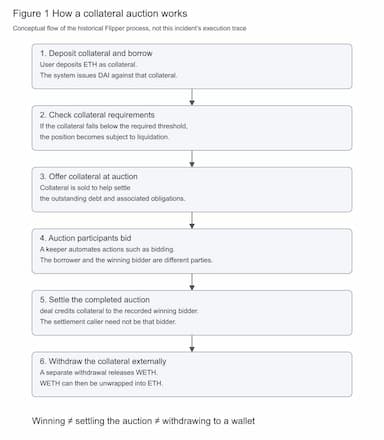
Money moved out of a contract on Ethereum, reached a wallet, and then left that wallet in twenty equal transfers. The last transfer came 15 minutes and 24 seconds after the initial withdrawal.The amount was 200 ETH. ETH, short for ether, is the native asset of Ethereum. At the start of this path, it was held in a token form called WETH, or wrapped ETH. During the withdrawal, 200 WETH was converted into 200 ETH.That change of form matters: we are following the same-sized amount through several stages, not adding a new loss every time it moves.A security alert linked the event to an old auction program. We will first explain what that program did, then follow the recorded transfers, and finally separate what is known from what still needs checking.The route in brief: 200 WETH leaves a collateral contract → it becomes 200 ETH → a wallet receives it → the wallet sends twenty transfers of 10 ETH. The records examined here do not establish where the money went after mixing.Incident: October 6, 2026.Evidence cutoff: October 6, 2026, 21:55 UTC (October 7, 06:55 KST).Reading guide: Follow sections 1–6 for the story. Full transaction references and addresses are in the appendix.1. The auction was selling loan collateral, not NFTsWhy does an auction appear in this story? In MakerDAO, users can leave assets such as ETH as security for a loan. That security is called collateral. They borrow DAI, a token designed to track the value of one US dollar, against it.Think of borrowing against something you own. If its value falls too far, the lender may need to sell it to settle the debt. A liquidation auction performs that role here: it sells crypto collateral. The actual system has its own thresholds, fees, and settlement rules. Background: the official liquidation-system proposal.A keeper is software that automates tasks such as bidding in those auctions. It is not the borrower. The person borrowing against collateral and the participant buying it at auction have different roles. Background: the official Auction Keeper project.The next diagram follows the general process from borrowing to receiving the auctioned asset. Read it from top to bottom, paying particular attention to the final two steps.Figure 1. From borrowing to withdrawing collateralA simplified guide to the historical Flipper auction process, not a trace of this incident. The final two boxes separate settlement from external withdrawal. Detailed bidding rules and the wider current system are outside this diagram.Winning, settling, and withdrawing are separate steps. Winning determines the buyer. Settlement records the outcome. Withdrawal moves the asset out to an external address. Finishing one step does not mean all three have happened.In the published historical auction code, a function called deal settles the auction and credits the recorded winning bidder. The person who calls that function does not become the winner merely by calling it. This is general background, not proof of how the exact incident contract was configured. Source: the published Flipper implementation.With that distinction in mind, we can now follow the actual movement of funds.2. Meet the addresses before following the moneyYou do not need to memorize hexadecimal addresses. The names below describe what each address did in the records; they do not identify a person or prove who controlled it.The collateral adapter — 0x2F0b…042A. This contract is the first sender of WETH in the transfer records. Etherscan, the public transaction explorer, labels it “Sky: MCD Join ETH A.” Here, an adapter means a contract used to move collateral into or out of the system.Two intermediate contracts — 0xF09A…C170 and 0xEc997…1dcF. The WETH passes through these contracts. The first is created during the transaction; the second later sends ETH to the initiating wallet. A contract is a program on the blockchain, not necessarily a person's wallet.The initiating wallet — 0x01EB…A5FA. This address starts the transaction, receives the 200 ETH, and then sends the twenty later transfers. We use the same name throughout so that you can recognize it as the story continues.The WETH contract. This contract releases ETH when WETH is unwrapped. “Unwrapping” is the change from the token form to ETH; it is not a gain of another 200 ETH.One distinction will help when reading the next diagram: starting a transaction is not the same as sending every asset inside it. A wallet can instruct a contract, and that contract can trigger further calls and transfers.3. At 06:13:11, the wallet receives 200 ETHOn October 6 at 06:13:11 UTC, the initiating wallet submitted the withdrawal transaction. Within that one transaction, the collateral adapter sent 200 WETH to the newly created contract. That contract passed 200 WETH to the other intermediate contract.The intermediate contract then unwrapped the WETH. The WETH contract paid it 200 ETH, and it passed 200 ETH to the initiating wallet. These are several movements inside one transaction, not several separate withdrawal transactions. Check the withdrawal transaction.In the diagram below, start with the first blue asset-transfer box. Follow the blue WETH path until it becomes the purple ETH path. The gray strip at the top shows who initiated the call, not an additional payment.Figure 2. Separating WETH transfers from ETH paymentsFollow the numbered asset movements from top to bottom. Blue means WETH; purple means ETH. The gray call strip is not a payment. All stages belong to one transaction. Evidence: token logs 174, 176, and 177, plus internal ETH transfers.The important change is at the end: the initiating wallet now holds ETH that it can send onward. The diagram explains that route. It does not explain why the contracts allowed it or establish a system-wide compromise.You can compare the explanation with the explorer screenshot below. Look for the timestamp, the WETH transfer entries, and the internal ETH payments. “Internal” here means payments made during contract execution inside the transaction.Evidence 1. The withdrawal transaction on EtherscanOriginal explorer evidence: compare the timestamp, WETH transfers, and internal ETH payments. The displayed dollar values are not used as incident-time loss estimates. Open the withdrawal record.Several lines show the number 200 because the amount passes through multiple steps. Keep that in mind as we follow it out of the wallet.4. The same wallet sends twenty transfers of 10 ETHAfter receiving the ETH, the initiating wallet sent twenty transactions to the same Tornado Cash router. A router is an intermediate contract that forwards a request to another contract. Each transaction sent 10 ETH, making 200 ETH in total, excluding transaction fees. Check the wallet's transaction history.Tornado Cash is a mixer designed to make a deposit difficult to link directly to a later withdrawal. That is why observing money enter this route is not the same as knowing who later received it.The next diagram gives every transfer its own tile. Read left to right, then move to the next row. A block number identifies the block containing the transaction; the equal tile spacing does not mean equal time intervals.Figure 3. All twenty transfers in block orderOne tile equals one transfer of 10 ETH. Read left to right, then down. Tile spacing does not represent time. Individual transaction links are in Appendix A.The twenty tiles show repeated transfers to the router, all from the same wallet. You can check each transaction separately in Appendix A without interrupting the story here.The explorer screenshot lists the same type of entries in the opposite direction: newest first. Compare the destination and the 10 ETH amounts, rather than reading its rows as the diagram's order.Evidence 2. Repeated 10 ETH transfers from the same addressOriginal explorer evidence: the newest entries appear first. Compare the Method, To, and Amount columns. Open the wallet history.The final transfer shows one step furtherThe last transaction was recorded at 06:28:35 UTC. Its internal payment record shows the router forwarding 10 ETH to the contract labeled “Tornado.Cash: 10 ETH,” the pool in this final transfer. Check the final transaction.That extra check was made for the final transaction. The twenty outgoing transfers were reviewed, but this article does not claim a complete internal router-to-pool review of all twenty.Evidence 3. The final 10 ETH paymentOriginal explorer evidence: From is the initiating wallet; To is the router. Internal Transactions shows the final 10 ETH payment to the pool. Open the final transfer.We now have two verified endpoints: the withdrawal at 06:13:11 and the final transfer at 06:28:35. The difference is 15 minutes and 24 seconds. The next diagram places those endpoints around the transfers and shows where our evidence stops.Figure 4. The observed time window and the limit of the traceThe bracket spans 06:13:11 to 06:28:35 UTC: 15 minutes and 24 seconds. Intermediate spacing is schematic. Only the final transfer received a detailed internal router-to-pool check; the post-mixer path remains unestablished.The bracket measures withdrawal to final transfer. It is not the duration of the twenty transfers alone or of the entire incident. The separately labeled 2020 history comes from an external alert, which we examine below.The path ends at the checked pool payment because this article has not established a later destination. It does not show an exchange deposit, a cash-out, or the identity of the person controlling the wallet.5. Several movements do not mean several lossesWe have seen 200 WETH move, 200 ETH arrive, and 200 ETH then leave in smaller transfers. These are successive stages of the observed route, not separate amounts to add together.Instead, read the next diagram as a running account of the route: the asset changes form, reaches the wallet, and is sent onward. Each box describes what happens next to the same-sized amount.Figure 5. Following the same amount without counting it twiceRead top to bottom. The amounts describe successive stages, not separate losses to add together. Gas fees are excluded; this diagram makes no incident-time dollar valuation.The observed route is 200 WETH → 200 ETH → twenty transfers totaling 200 ETH. It is not an 800 ETH loss obtained by adding repeated entries inside the transaction, and the onward transfers are not another separate 200 ETH withdrawal.These totals exclude gas fees, the fees paid to execute transactions. Dollar prices displayed in explorer screenshots reflect the display at capture time; this article does not use them to calculate an incident-time dollar loss.The amount and route are now clear. The remaining question is different: what allowed the withdrawal?6. The route is visible; the reported cause still needs checkingDefimon Alerts attributed the event to a permission problem in an old MakerDAO auction keeper. According to its report, the keeper had won four auctions in 2020—numbers 1457 through 1460, each for 50 WETH—but had not settled them. The report says an external caller used an unprotected keeper function to settle and withdraw the collateral. Read the source alert.This explanation connects back to the separate steps in section 1. Settling an auction and deciding who may withdraw its assets are not the same permission question. A publicly callable settlement function is not automatically a flaw.The following comparison puts those two questions side by side. Read the left panel as general auction background and the right panel as the keeper-permission issue that needs verification.Figure 6. Settlement and withdrawal are different permission questionsThis comparison separates the general settlement mechanism from the externally reported keeper-permission issue. The dashed amber panels mark a question and an allegation, not an independently verified exploit path.The allegation concerns someone else being able to invoke a function that sends the keeper's collateral to an external address. To confirm that explanation, we would need the keeper's code and configuration at the time, together with the detailed execution record. The transfer amounts alone cannot answer it.The general Flipper source cited earlier is not assumed to match the exact deployed implementation. Likewise, the adapter's explorer label is not evidence that all of MakerDAO or Sky was compromised.What we can take awayThe records support a specific sequence: 200 WETH moved, it was converted into ETH, the initiating wallet received 200 ETH, and that wallet sent twenty transfers of 10 ETH to a router. The final transfer also has a checked 10 ETH payment from the router to the labeled pool.Use the final diagram to separate that observed route from the external explanation and the unanswered questions. The labels matter as much as the colors: blue is checked evidence, dashed amber is the reported explanation, and gray is unresolved.Figure 7. Verified records and unresolved questionsLabels and border styles distinguish the evidence levels as well as color. The dashed amber box contains the external explanation, not an independently verified cause. No speculative line connects the mixer to an unverified later address.The next investigation has four concrete tasks. Check the keeper's historical permissions and implementation. Verify the creation, bidding, and settlement records for auctions 1457–1460. Review the internal payments in the other nineteen transfers. Look for independent evidence before linking any later withdrawal to these deposits.We can follow the money to the limit of the examined records. We cannot yet turn that route into a proven cause, an identified operator, or a confirmed cash-out.This is the end of the narrative. The appendix below keeps the original records available for readers who want to verify the details.Appendix A. The twenty transaction referencesEach entry represents one outgoing transfer of 10 ETH from the initiating wallet to the router. The full transaction hash is its identifier; follow the link to inspect the original record. The list runs in block order.Order: 1Block: 26131503Amount: 10 ETHOriginal transaction: 0xb8ecff9c129d8d9331c85558eaeddff29a38c4c16b71a40986acbf8f6febefebOrder: 2Block: 26131507Amount: 10 ETHOriginal transaction: 0x01dd51eff5790bf070ae5abefc4a77f3df2b2476feebbe9aaa6ffa1fd48f8429Order: 3Block: 26131509Amount: 10 ETHOriginal transaction: 0x8c5fb4f50aa0f56cc701afdad377e56f53655e48e237f85aef8fe902797a4240Order: 4Block: 26131512Amount: 10 ETHOriginal transaction: 0x9a6ef7cce759e09f1d23115f974eb0707460a6834de0d30a55c3761a9c9dce6cOrder: 5Block: 26131514Amount: 10 ETHOriginal transaction: 0x725cdd6f23f7fc30d6ab43a6cf634aec791e5e2097151a09fc522408786da3ffOrder: 6Block: 26131516Amount: 10 ETHOriginal transaction: 0xaf1fb061f3d3db6cc6107219ea7bc5e0c6f86ba54c997e10bb062e0a3f7f7eedOrder: 7Block: 26131519Amount: 10 ETHOriginal transaction: 0xfd60254ab0a74ae6d51706023394190ca20646264d1da322998afa4682ae18b2Order: 8Block: 26131521Amount: 10 ETHOriginal transaction: 0xcc14212fc5d51d3d5ea7f0de9895264da8c0b5c779ca2947083f665f50f0bfbeOrder: 9Block: 26131523Amount: 10 ETHOriginal transaction: 0x31d6c9cb202306536c9f977a486bd2f5d2a16d0db9c7558ac132442fe58440f5Order: 10Block: 26131525Amount: 10 ETHOriginal transaction: 0x3ef864598198ff4d23f22a35d540e0437ba0ed3af7a77c3d23ae99f59f1bb96eOrder: 11Block: 26131527Amount: 10 ETHOriginal transaction: 0x4c10b56e2f5c37706fdcbe2b1c7da35de68661306971b32e8ea5ed95e7a02a7aOrder: 12Block: 26131529Amount: 10 ETHOriginal transaction: 0xa452e803014458dba087c82bf0a7e9432bf014337b59d34483bbbf232fe39d57Order: 13Block: 26131531Amount: 10 ETHOriginal transaction: 0xaddc6ea108b17f39beca57487fee55f878546c8f233bdb8c0736b03658e890d4Order: 14Block: 26131533Amount: 10 ETHOriginal transaction: 0x61e349fe5ce11d9b3b8f4d9813c3a1f74e6dd898d43f61c0139673540137b3e6Order: 15Block: 26131537Amount: 10 ETHOriginal transaction: 0x7167efdb6740e1c1a38983edd33e3a7446d01abe2fcf63874b80aa8f9f3f7ee6Order: 16Block: 26131539Amount: 10 ETHOriginal transaction: 0xe82b2082edd720801389e75cf2a6158f494f9e8b3ad3a7671bfc18f9e7c07538Order: 17Block: 26131541Amount: 10 ETHOriginal transaction: 0x48303767bec9e216fa06e79dd21f3f3257524dd613c976f3fe60132bcc38af52Order: 18Block: 26131543Amount: 10 ETHOriginal transaction: 0x0ac6195011bfea03360778ce3a05f8ed665a6fe2ce6ac10231c2be3dcbb99210Order: 19Block: 26131546Amount: 10 ETHOriginal transaction: 0x2cd7eb09abe21d07e36aedc5a93f6c6f99b5ab796b2b5632aa14c6278192396cOrder: 20Block: 26131548Amount: 10 ETHOriginal transaction: 0xf1db855a987c2fb5e0ea6184ae8f8ed3271cca98c80e627be4839e4b4ac8dcbfAppendix B. Full addresses and their rolesThese labels describe observed behavior or a role attributed by the source alert. They do not identify people or establish knowing participation in wrongdoing.Role: Transaction initiator and ETH recipientFull address: 0x01eb957e5c7dcddd60f3c875956ccc6fb9bda5faBasis: Withdrawal and subsequent transaction recordsRole: Intermediate contractFull address: 0xec997d2ad033277913d6002277353368e8321dcfBasis: Transaction target and internal paymentRole: Contract created during the transactionFull address: 0xf09a13072ed939b79bc25b66aa3a836ea6dcc170Basis: Creation record and WETH transfersRole: ETH-A collateral adapterFull address: 0x2f0b23f53734252bda2277357e97e1517d6b042aBasis: Explorer label and WETH transferRole: WETH contractFull address: 0xc02aaa39b223fe8d0a0e5c4f27ead9083c756cc2Basis: Token and withdrawal eventsRole: Affected keeper identified in the alertFull address: 0x9c05a05893ada984fc20d0da0c046de5cc0e8273Basis: Role attributed by DefimonRole: Tornado Cash routerFull address: 0xd90e2f925da726b50c4ed8d0fb90ad053324f31bBasis: Explorer label and subsequent transfersRole: 10 ETH pool in the final transferFull address: 0x910cbd523d972eb0a6f4cae4618ad62622b39dbfBasis: Internal payment in the final transactionAppendix C. Source records and review scopeThe review covers the initial withdrawal, the twenty outgoing transfers, and the internal payment in the final transfer. The historical auction story and the alleged permission failure remain externally reported claims rather than independently established findings.Withdrawal transaction, timestamp, token transfers, and internal ETH transfersWithdrawal transaction event logsInitiating address and subsequent transaction historyFinal deposit transactionDefimon Alerts report of the alleged causeOfficial liquidation-system proposal, MIP45Published Flipper source for the general settlement mechanismOfficial Auction Keeper project
ChainBounty · Investigation analysis · October 6, 2026A dormant third-party ETH-A keeper was exploited on Ethereum on October 6, 2026, according to SentinelTX's CASE-ASYNCADB report. The exploit released 200 WETH, which was unwrapped into 200 ETH and delivered to the attacker's externally owned account. That account then sent twenty transfers of 10 ETH each to a Tornado.Cash router between 06:19:35 and 06:28:35 UTC.SentinelTX locates the authorization weakness in the keeper's implementation contract. It classifies the incident as an exploit of a third-party liquidation bot, rather than a breach of the MakerDAO core protocol.Key findingsThe trace follows a 200 ETH native payout through the attack contract to the attacker's account, followed by twenty 10 ETH transfers to the same routerThe keeper proxy delegated selector 0x8804d1de to an unprotected exit path in its implementationThe router is the last recorded recipient on this route. Attacker identity and any exchange-deposit leg remain unestablished1. A funded account deployed two contracts before the drainThe first recorded step was gas funding. At 05:57:23 UTC, account 0x01eb95…bda5fa received 0.09783730488175 ETH from the address labeled Tornado.Cash's 0.1 ETH pool.The account then submitted three control transactions in order. At 06:09:23 UTC, nonce 0 created 0xa5c3a6…1fc552, a staging contract whose purpose remains unconfirmed. At 06:12:11 UTC, nonce 1 created the attack contract, 0xec997d…321dcf. At 06:13:11 UTC, nonce 2 called that contract with selector 0x0e763dd6 in block 26,131,471.The two deployments and the drain occurred within 3 minutes and 48 seconds. The deployment records contain no native value transfer; the 200 ETH payout followed in the drain transaction.The payout route contains two 200 ETH native movements in the same attack transaction. The WETH contract sent 200 ETH to the attack contract, and the attack contract forwarded 200 ETH to the externally owned account. The report interprets the first movement, following selector 0x2e1a7d4d, as the WETH unwrap.Figure 1. The reported native-ETH route. Two 200 ETH movements occur in the attack transaction; twenty later 10 ETH transfers carry 200 ETH from the account to the router. These are successive movements of the same principal, not separate losses. Arrows show direction, not proportional value or elapsed time. Separate gas funding is shown approximately; the exact transfer is 0.09783730488175 ETH.Color key: Slate: native payout hops. Amber: onward router deposits. Sage: separate gas funding.Address key: WETH contract 0xc02aaa…756cc2; attack contract 0xec997d…321dcf; attacker account 0x01eb95…bda5fa; router 0xd90e2f…24f31b. Full identifiers appear below.Source: SentinelTX, CASE-ASYNCADB, October 6, 2026, pp. 4–7 and 10–14. Simplified explanatory figure, not an original SentinelTX graph.2. The drain entered a third-party keeper implementationThe attack contract called keeper proxy 0x9c05a0…0e8273 with selector 0x8804d1de. The proxy then used DELEGATECALL with the same selector to implementation 0x68399e…6a5546. SentinelTX identifies the missing authorization check in this implementation path as the weakness that allowed the drain.The attack calldata includes the keeper proxy, the ETH-A collateral identifier, the WETH contract, the recipient account, and auction IDs 1457, 1458, 1459, and 1460. These identifiers align with the reported account of four legacy auctions holding 50 WETH each. SentinelTX interprets the history as a dormant keeper that had won the auctions but had not completed settlement, leaving collateral available to the unprotected exit path.Later calls pass through the auction and collateral contracts identified as Flipper, Vat, and GemJoin ETH-A, followed by the WETH operation and the 200 ETH payout. The call trace records the selector bytes and execution order. Function names such as GemJoin exit and WETH withdraw are interpretations based on matching signatures and surrounding execution, rather than decoder-confirmed names.The relevant core-contract calls executed without reverting. The report's conclusion that MakerDAO core operated as designed also depends on its interpretation of those contract roles and cited reporting; it did not cross-check the address identities against MakerDAO's public changelog. Its finding is therefore specific to the third-party keeper implementation, rather than a claim that “MakerDAO was hacked.”Diagram 2. The third-party keeper call path. The proxy delegates selector 0x8804d1de to its implementation. Function-name mappings remain interpretations, while the 200 ETH native payout is recorded directly in the call tree. This diagram simplifies the sequence.Color key: Slate: selected keeper call path. Sage: later WETH release/unwrap and native payout section.Address key: Keeper proxy 0x9c05a0…0e8273; implementation 0x68399e…6a5546. Contract roles follow the report's stated basis and qualifications.Source: SentinelTX, CASE-ASYNCADB, October 6, 2026, pp. 4 and 8–9.3. Twenty equal deposits moved the proceeds to the routerThe first 10 ETH transfer to the Tornado.Cash router was recorded at 06:19:35 UTC. The twentieth was recorded at 06:28:35 UTC. The twenty listed transactions each carry 10 ETH, totaling 200 ETH over nine minutes.This sequence started about six minutes after the drain. SentinelTX interprets the equal-size transfers as a structured mixer-deposit pattern.The recipient is labeled Tornado.Cash, Mixer, and Sanctioned. No exchange-deposit leg is recorded. The route ends at the router in the available evidence; that does not establish a final beneficiary or identify a corresponding mixer withdrawal.Figure 3. Cumulative deposits derived from the twenty 10 ETH transfers listed in the PDF. The steps reach 200 ETH at 06:28:35 UTC. Horizontal spacing represents actual time; the chart describes this deposit sequence, not the router's balance or downstream withdrawals.Color key: Slate: cumulative total derived from the twenty listed deposits. Sage: the final 200 ETH total.Source: SentinelTX, CASE-ASYNCADB, October 6, 2026, pp. 6–7 and 11–13. Cumulative totals are an editorial calculation from the listed same-unit transfers.4. Transfer activity is different from the incident amountThe activity summary totals 23 traced value movements involving five addresses and gross movement of 600.097837 ETH. This figure repeats funds at successive hops and is not a loss total. The 200 ETH payout is recorded from the WETH contract to the attack contract, again from the attack contract to the externally owned account, and then across the twenty router transfers. The small gas-funding transfer is separate.The incident quantity is 200 WETH, followed by 200 ETH after unwrapping. The approximately US$538,000 valuation comes from reporting and was not independently priced in the investigation. Native quantities therefore provide the clearest basis for following the funds.The timed movements discussed here run from 05:57:23 to 06:28:35 UTC on October 6. Later paths remain outside this documented route.ConclusionSentinelTX's conclusion is a third-party keeper authorization exploit followed by a 200 ETH payout and twenty mixer-router deposits. The useful boundary is specific: the keeper implementation is the identified weakness, the reported route reaches the router, and the attacker has not been attributed.Useful follow-ups include tracing the keeper and implementation deployers or owners, examining possible correspondence between the timed deposits and later withdrawals, and checking related proxies for similar exposure. These remain investigation leads, rather than established downstream matches.Any proposed downstream match or real-world identity would need its own supporting evidence.Figure 4. The report's conclusion and limits. The route accounts for a 200 ETH payout and twenty 10 ETH router deposits. Attacker identity and corresponding downstream withdrawals are not established; no exchange-deposit leg is recorded.Color key: Slate: keeper weakness. Sage: asset outcome. Amber: stated limits.Source: SentinelTX, CASE-ASYNCADB, October 6, 2026, pp. 4 and 8–10.Continue from the twenty deposit transactionsThe twenty timed deposits provide a concrete starting point for further tracing. The prompt below asks SentinelTX to assess possible later withdrawal correspondence, clearly separating supported links from candidates.Request SentinelTX access · Sign inCopy this starting prompt:Investigate the October 6, 2026 Ethereum route from 0x01eb957e5c7dcddd60f3c875956ccc6fb9bda5fa to Tornado.Cash router 0xd90e2f925da726b50c4ed8d0fb90ad053324f31b. Start with attack transaction 0xbb6940f7c2a1e68cafbae7bb9b94d09af9af06ec3a114f6996f2cab993f3a88c and the twenty 10 ETH deposits recorded from 06:19:35 to 06:28:35 UTC. The first deposit is 0xb8ecff9c129d8d9331c85558eaeddff29a38c4c16b71a40986acbf8f6febefeb; the last is 0xf1db855a987c2fb5e0ea6184ae8f8ed3271cca98c80e627be4839e4b4ac8dcbf. Assess whether available evidence supports any later withdrawal correspondence. Separate directly supported links from timing or amount-based candidates, do not infer common control from correlation alone, and include transaction links, the queried window, and query time. Keep the third-party keeper separate from MakerDAO core, and state when a path cannot be established.Source and address notesThis article adapts SentinelTX's CASE-ASYNCADB — 0x01EB957e…bDa5FA, dated October 6, 2026. The WETH mechanism rests on call-tree evidence; a separate token-event-log check was incomplete. Page references above identify the source of the article and explanatory figures.Attacker account: 0x01eb957e5c7dcddd60f3c875956ccc6fb9bda5faAttack contract: 0xec997d2ad033277913d6002277353368e8321dcfKeeper proxy: 0x9c05a05893ada984fc20d0da0c046de5cc0e8273Keeper implementation: 0x68399ed8aa33c5b43f863ee6782de492006a5546WETH contract: 0xc02aaa39b223fe8d0a0e5c4f27ead9083c756cc2Gas-funding pool: 0x12d66f87a04a9e220743712ce6d9bb1b5616b8fcRouter recipient: 0xd90e2f925da726b50c4ed8d0fb90ad053324f31bThe pool and router descriptions reproduce the report's labels. Account identifiers identify on-chain addresses, not the real-world identity of the attacker.
ChainBounty investigation · USDT token shown for context; no endorsement or attribution to the issuer.What the records show. One address initiated twelve USDT calls that debited nine token-holder addresses. Two collecting addresses later sent 51,000 USDT to a single destination. These are two distinct observations—not two amounts to add together as a loss total.The movements behind the reportBetween 7 and 28 September 2026, twelve USDT calls on TRON debited nine different token-holder addresses for a combined 15,864.609801 USDT. The calls had one feature in common: the same collecting address initiated every transaction. On 30 September, that address and a second collector sent a separate total of 51,000 USDT to one destination, 81 seconds apart.Public allegations concerning Tronify.rent / tron.store prompted the review. To understand what the ledger supports, this report follows three questions: who initiated the twelve calls, what their amounts measure, and where the collectors subsequently sent funds. It then separates those observations from the unresolved questions of authorization, consent and operator identity. The 51,000 USDT consolidation is not a verified loss total, and its provenance has not been fully reconciled with the earlier calls.MeasureResult / scopeReport version1.2 · structural and explanatory revision, 6 October 2026; evidence window unchangedNetworkTRON mainnet; TRC-20 USDTPrimary period1–30 September 2026 UTCFollow-up cutoff6 October 2026, 02:46:45 UTC, as stated by investigation sourceVerified payment subset12 transferFrom calls; 9 distinct token holders; 15,864.609801 USDTVerified consolidation2 transfer calls; 51,000 USDT received in 81 secondsPublic allegationsApproximately $69,651 / 80 victims; not reconciled or independently established────────────────────────────────Timeline — the ledger observations came before the public reportsUTC period / timeEventEvidence level7–28 SeptemberTwelve transferFrom calls in the verified subsetIndependently checked30 September 16:24:54–16:26:15Two collector sweeps into HIndependently checked1–5 OctoberNine additional TRX-seeded addresses reported; subsequent payments not establishedInvestigation source only5 October; exact post times not establishedInitial public allegations and subsequent infrastructure correctionPublic source attribution────────────────────────────────The three addresses followed in this reportC1 and C2 are labels for the two collecting addresses; H labels the destination of their later transfers. C2 has two observed roles: it submitted all twelve calls and received tokens in some of their events. These labels describe activity, not identity or ownership.RoleFull addressEvidence boundaryC2 · caller / collectorTV6n8cCLmX5mRCMMNvcE1K1i87Yo9Ys5rvOwner of every payment call; recipient in some eventsC1 · collectorTLv3iSnZxWghEmadLDzuAK2p5GkAwg7tpJRecipient in other payment eventsH · consolidationTDDfKDDttx6rFkq2YWzge83RZqQgerzs9MReceives the two later sweep transfers1. The address that called the contract was not the holder being debitedA token movement has more than one relevant actor. The transaction owner identifies the address that submitted the call; the From field in the token-transfer event identifies the address whose token balance was debited. Those fields need not name the same address. In all twelve inspected calls, the owner is C2, while the token-event From field names another holder. The calls use transferFrom rather than transfer, and all twelve are recorded as successful and confirmed. The USDT contract is TR7NHqjeKQxGTCi8q8ZY4pL8otSzgjLj6t.The distinction changes how these movements should be described. They were not twelve direct transfers submitted by the holders whose balances decreased: C2 called the contract to move those balances. The transferFrom method is a delegated-transfer mechanism, but the method name does not explain how authorization was obtained. Approval records and wallet interactions are needed to distinguish informed delegation from deceptive authorization; the calls alone do not establish which website, if any, induced it.Figure 1 — Delegated-transfer mechanism. Evidence P1–P12: C2 is the transaction owner; the token-event From field names the debited holder. Approval creation and consent remain unverified.────────────────────────────────2. What the 15,864.609801 USDT total measuresOnce the caller and the debited holders are separated, the next question is how much moved in this examined set. Adding each of the twelve transaction-event amounts once, using the transaction hash to avoid duplicates, gives 15,864.609801 USDT. Nine distinct holder addresses appear because some addresses were debited more than once. Twelve events therefore do not mean twelve victims—and the ownership and victim status of those nine addresses are not established by the count.Figure 2 — Full payment distribution. All twelve amounts use one linear, zero-based USDT scale. P5 dominates the inspected subset; the chart does not estimate total incident loss.Figure 3 — Magnified smaller events. A separate 0–700 USDT axis makes the eleven smaller events readable. P5 is excluded only from this panel, not the aggregate. Do not compare bar lengths between Figures 2 and 3.The largest event, P5, is 13,472 USDT: approximately 84.92% of this subset. Figure 2 shows that concentration on a single zero-based scale. Figure 3 uses a separate 0–700 USDT scale to make the other eleven events readable; it does not remove P5 from the total. No conversion to a contemporaneous USD price is applied. Unpaired inflows, recycled funding and later hops are excluded from the sum. The publicly reported approximately $69,651 and 80 victims describe a different, unreconciled population—not a larger total that this subset independently proves.────────────────────────────────3. Two collectors sent 51,000 USDT to one destinationThe next observed stage is a pair of direct transfers on 30 September. At 16:24:54 UTC, C1 sent 36,000 USDT to H. At 16:26:15 UTC—81 seconds later—C2 sent another 15,000 USDT to the same address. Unlike the earlier delegated calls, both transactions use transfer and are confirmed in the explorer. Together they establish that H received 51,000 USDT from these two collectors. They do not establish that all of those tokens came from the twelve earlier events, or that C1, C2 and H share an owner.UTC / blockMovementFull transaction2026-09-30 16:24:54 · 86704310E1 · C1 → H · 36,000 USDT501b95a1bd13510e495601f2b19e619763a5a73debc85619be2662301b5f48a92026-09-30 16:26:15 · 86704337E2 · C2 → H · 15,000 USDT63e05ce6c8739cdaf6357d3784e4d23d8d51947b6d9d7c0197990e696aee9bc3Figure 4 — Collection and consolidation network. P1–P12 are payment events, not twelve victims. E1 and E2 identify the two verified consolidation transactions below; E3 is a source-only lead. Arrow direction indicates token movement, not ownership.A later 100 USDT movement from H appears in the investigation output at e783e0a7579b27cd49f87c284b22fac22fea1f65e2fe7f415ec2fbe2fb20667d. Subtracting it from 51,000 does not establish a current balance of 50,900: a current balance snapshot and intervening activity are needed.────────────────────────────────4. A shared service is not evidence of a shared operatorThe public source corrected its inclusion of TDii6vao7xyWg2rKPbCPWVRpSmne8xcqYx and identified it as legitimate Tronify infrastructure. The correction is material: service usage must not be treated as proof of operator control or collusion. Public correction.Likewise, exchange labels observed on payer-side funding routes do not establish collector cash-out. Shared service use, timing proximity and a visually dense graph are not identity evidence.────────────────────────────────5. What is established, and where the evidence stopsEvidence classWhat it establishesWhat it does not establishP1–P12 · directly checkedSuccessful transferFrom calls, amounts and transaction ownerApproval origin, consent or victim statusE1–E2 · directly checkedTwo transfers into H; 51,000 USDT in 81 secondsTotal loss, current balance or common ownershipE3 · source-only leadReported later 100 USDT branch; hash retainedIndependent re-verification or remaining balancePublic reportingAttributed incident context and correctionOn-chain domain or human attributionThe records connect the twelve calls through a common transaction owner and connect the two collectors through transfers to H. That is an operational connection between transactions, not an identification of the people behind them. Delegated transfers occur in legitimate workflows as well as deceptive ones, so the method alone does not establish fraud, intent or a stolen private key. Claims about Gemini recommendations, AI videos or search manipulation concern off-chain inducement; transaction records alone cannot confirm them.The reported TRX seeding and short delays are investigative context. The seeding transactions have not all been independently checked in this report, so they are not used to establish a universal causal mechanism. The provider also contains conflicting first-activity dates and broader historical paths; those values are not used to date the operation or aggregate losses.────────────────────────────────6. The next investigation: authorization, inducement and destinationThe remaining questions require different kinds of evidence. Approval records address how C2 could move tokens; victim and service records address the alleged inducement; a timestamped balance and transaction ledger address what happened after consolidation. None can be replaced by the shape of the graph alone.Question to resolveRequired evidencePurposeHow was C2 authorized?USDT approval events, allowance history and wallet interaction recordsSeparate informed delegation from deceptive authorizationWhich domains induced transactions?Victim records, browser history and legitimate service order logsConnect on-chain movement to off-chain inducementWhere are consolidated funds now?Timestamped H balance and subsequent transaction ledgerDetermine actual remaining exposure without assuming a balanceWho owns the affected wallets?Voluntary victim evidence or lawful recordsValidate victim count and loss attributionThe immediate task is to connect the observed calls to their authorization history, test the alleged off-chain inducement, and reconstruct H’s subsequent activity. The table identifies the evidence needed for each question. Until that evidence is available, the report supports a description of delegated transfers and consolidation—not a complete victim census, a current balance, or a finding that funds were frozen, recovered or cashed out at an exchange.────────────────────────────────Evidence appendix — full identifiersEvery payment below was independently checked in the TRONSCAN overview. The method is transferFrom and the transaction owner is C2 in every row. USDT native precision is six decimals. The hash is the deduplication key.Common fields for P1–P12: TRON mainnet USDT; successful and confirmed transferFrom calls; transaction owner TV6n8cCLmX5mRCMMNvcE1K1i87Yo9Ys5rv. The tables separate movement from transaction anchors so full identifiers remain readable. Each P identifier refers to exactly one transaction hash.P1–P4 · token movementsEvidence / USDTToken holder · FromCollector · ToP1 · 100.0TGUfWzCTdYNwVbuzDzfAGKAARkdjCavPq5TLv3iSnZxWghEmadLDzuAK2p5GkAwg7tpJP2 · 485.447918TR1amRA6PTyQCn7p3y9r7NUtjLMWdWDtqhTLv3iSnZxWghEmadLDzuAK2p5GkAwg7tpJP3 · 412.0TCGZTBwNN6HXU9agUpeA49tSsRkGAr6yrdTV6n8cCLmX5mRCMMNvcE1K1i87Yo9Ys5rvP4 · 181.0TUibaVrq1ZYuDuUc8TVDpEbgespvpuTygcTV6n8cCLmX5mRCMMNvcE1K1i87Yo9Ys5rvP1–P4 · transaction anchorsEvidenceUTC / blockFull transaction hashP12026-09-07 19:51:06Z · 860462943c3b8a6fe26b69a760134f1bb3b944baa0ec049c89d3002a426bd3137784d035P22026-09-10 13:25:27Z · 861249036a93656feb2b32058214bc6e8eaebc697f4312132f30e982f4a66325f2e3f84dP32026-09-11 07:00:33Z · 86145999a521b4b148ca8a58b35438981df742a27ee64a988d4c8077384f3e9ceb409304P42026-09-12 15:18:09Z · 86184741b72f7690b7d5d8e92301018de4ac02c516b356b8d7ea9853564d3847b12977e5P5–P8 · token movementsEvidence / USDTToken holder · FromCollector · ToP5 · 13472.0TF3tXoQpgjokBLr6Qpsu3nixTcMgvtNY9nTV6n8cCLmX5mRCMMNvcE1K1i87Yo9Ys5rvP6 · 177.0TTPa48RruBqu2wvbYYskZASj2ox4iPvSXZTV6n8cCLmX5mRCMMNvcE1K1i87Yo9Ys5rvP7 · 61.372883THmHnytNudoV9FDiDdX9rfmq4UatB5TdwvTLv3iSnZxWghEmadLDzuAK2p5GkAwg7tpJP8 · 659.0TJBt8osXN8utgApfAfYdNBR4K5fHrmK9yzTLv3iSnZxWghEmadLDzuAK2p5GkAwg7tpJP5–P8 · transaction anchorsEvidenceUTC / blockFull transaction hashP52026-09-13 08:04:39Z · 862048658b003bd469b45956b430df31ad67b0c8d668a114808775e9897787b6e20ccbf6P62026-09-14 02:10:24Z · 86226573e1bbcbac8dd49284e9745757f555dc663b66da42555544fdf5b9c7e2a0a0119eP72026-09-14 20:14:42Z · 86248253877c9e0cb7ebccf7fe18ce63b0a9f4206aa32993b30c688679ad2f0a2bb83a65P82026-09-14 22:44:30Z · 86251249e6bc783dc6f2f180b576a044f037afe44f4c688b87cd534460f49b19cf145cb5P9–P12 · token movementsEvidence / USDTToken holder · FromCollector · ToP9 · 101.0TJBt8osXN8utgApfAfYdNBR4K5fHrmK9yzTV6n8cCLmX5mRCMMNvcE1K1i87Yo9Ys5rvP10 · 1.789TJBt8osXN8utgApfAfYdNBR4K5fHrmK9yzTLv3iSnZxWghEmadLDzuAK2p5GkAwg7tpJP11 · 210.0TAZ9AaA4qQc6T4WAuwAyMSjWcQgVMJz2HJTV6n8cCLmX5mRCMMNvcE1K1i87Yo9Ys5rvP12 · 4.0TAZ9AaA4qQc6T4WAuwAyMSjWcQgVMJz2HJTV6n8cCLmX5mRCMMNvcE1K1i87Yo9Ys5rvP9–P12 · transaction anchorsEvidenceUTC / blockFull transaction hashP92026-09-15 00:21:57Z · 86253196d52998a2a9f33af5894d50ab95cfa63a73427038ce4e059ffb5a14cba5b97a34P102026-09-15 00:22:33Z · 862532083a9d82c197147bfba3d89fe0a3541fed23bf722e51302d690a5c83a94878e4b6P112026-09-28 15:20:33Z · 86645460c0325bd4daa2c1c88668b8b9fbc7a670d1fec73c53a0ef63eb3c3cdc6b6837beP122026-09-28 15:33:48Z · 86645725c4d870bc9b0dc20802324b25641c721bca0a16840284b60d0915476f15f39e33────────────────────────────────Sources and methodologyPrimary public sources: initial disclosure, infrastructure correction, off-chain follow-up. Transaction claims are anchored beside the relevant findings and in the appendix. Public allegations are not independently established totals.The investigation output supplied candidate identifiers and contextual paths. This report independently compared all twelve payment calls and both consolidation transfers against visible explorer results, checked the aggregate and distinct-holder count, and corrected the direct-transfer interpretation. It does not claim a complete approval-history review, complete wallet balance audit or complete incident census.Revision note — 6 October 2026. Version 1.2 reorganizes the narrative around the observed sequence, explains address roles before the mechanism, and connects each finding to its limits and next verification step. Existing transaction identifiers, quantities, figures and source links are retained. This is an editorial revision, not a new on-chain verification; the evidence set and investigation cutoff are unchanged.
ChainBounty · Report analysis · CASE-10DA91A7Ethereum mainnet · Activity: September 30, 2026 · Source: SentinelTX report generated October 5, 2026SentinelTX’s MUSystem report follows four Ethereum transactions that combine supplied capital, repeated deposit-and-return cycles, and repaid flash loans. It reports a 5.335155071161390070 ETH reduction at the affected contract and a 3.190655071161390070 ETH increase at the initiating account before fees. A third address received 2.1445 ETH. The distinction between those amounts is central to the report: receipts, account changes, and an incident-wide loss answer different questions.Report status matters here. The exported PDF says its automated integrity gate downgraded six claims and flagged one finding. Its chronology and conclusion carry an “unverified (auto-downgraded)” label, and page 83 flags a time-inverted path. This article presents the report’s findings with those qualifications. The figures below adapt its bounded transaction narrative; they do not reproduce the flagged onward path or certify the report’s findings. (SentinelTX, pp. 4, 10, 17, 21, 83)The scope of the reportAll four transactions fall in Ethereum block 26,087,602, timestamped September 30, 2026, at 03:27:35 UTC. SentinelTX calls the first transaction the Run and the following three Sample 1, Sample 2, and Sample 3. The report’s accounting covers those four operations. It does not establish that they comprise the entire campaign or all activity involving the affected contract.The principal roles are the initiating and receiving externally owned account, or EOA; the contract it created and used to coordinate the operations; the affected MUSystem contract; and newly created helper contracts. The report calls the coordinating contract the attack contract. This article uses “orchestration contract” to make its execution role clear without suggesting a separately identified operator. The third recipient’s role and control remain unresolved.The report sets an observation cutoff of October 5, 2026, at 10:00 UTC. It separately identifies address-history, token, and balance observations retrieved around 10:11–10:15 UTC that day as later observations. That distinction matters when reading its statements about activity after the four transactions. (SentinelTX, pp. 4, 8, 18)The Run belongs in the calculationThe last three transactions produced receipts of approximately 5.9475 ETH, 5.0703 ETH, and 2.8368 ETH for the EOA. Together, those receipts total 13.854604425661360100 ETH. Looking only at that part of the sequence omits the EOA’s earlier contribution in the Run.In the Run, the EOA sent 10.7 ETH to the orchestration contract and received 0.036050645500029970 ETH back. Its net change for that transaction was therefore −10.663949354499970030 ETH before fees. The Run also contained the same repeated-cycle pattern seen later; it was more than a preliminary funding transfer.SentinelTX breaks the Run into a priming deposit and sixteen helper cycles. The orchestration contract first paid 44.101139073399812544 ETH to the affected contract. During that call, the affected contract sent 26.460683444039887526 ETH back to the orchestration contract and 2.1445 ETH to the unresolved third address. The report gives the affected contract’s net increase on this leg as 15.495955629359925018 ETH.The sixteen subsequent cycles reduced the affected contract’s ETH by 6.976506274859954988 ETH. Combining those two parts leaves the affected contract with a reported Run increase of 8.519449354499970030 ETH. The later sample transactions then reduce that amount. Including the Run is essential to understanding the four-transaction result. (SentinelTX, pp. 6, 10–11)Figure 1. The report’s four-transaction sequence in one Ethereum block. It records 16 helper contracts in the Run, 16 in Sample 1, 16 in Sample 2, and 11 in Sample 3, for 59 in total. These counts describe contracts, not independent people. All four transactions share the block timestamp; spacing shows sequence rather than elapsed time.Color key: Slate identifies sequence markers and the directly labeled helper counts.Source: SentinelTX, CASE-10DA91A7, pp. 4, 8, 10, 13–15. The chronology is marked unverified by the report’s automated gate. Transaction links appear in the source register below.One deposit, two returnsThe first helper cycle in Sample 1 provides a compact example of the pattern SentinelTX describes. The proxy at 0x8b0856e9b0787d09f9abded66bccc85feb5561d4 calls the affected contract with 53.355703172210117028 ETH. It receives an initial payment of 32.253522567601017211 ETH. After a second call, it receives another 21.502348378400678141 ETH.The two payments total 53.755870946001695352 ETH. The proxy then forwards that amount to the orchestration contract. The excess over the original deposit is 0.400167773791578324 ETH for this cycle. Repeated deposits and forwarding create much larger gross movement volumes, so adding every leg would obscure the net result. The report explicitly excludes gross helper forwarding and large graph aggregates from its economic totals. (SentinelTX, pp. 12, 15)Diagram 1. The ETH legs in Sample 1’s first helper cycle, as described in the report. The same proxy sends 53.355703172210117028 ETH and receives two payments totaling 53.755870946001695352 ETH, an excess of 0.400167773791578324 ETH. Artwork values are rounded. Equal-width arrows show the direction of each leg, not its relative size.Color key: Slate outlines the same proxy P in each row; sage outlines the affected contract. Slate amount text labels the deposit and sage amount text labels the two returns.Address key: Proxy = 0x8b0856e9…561d4; affected contract = 0x9bdf81e6…d9364. The proxy appearing in each row is the same account. MUS token movements are outside this native-ETH calculation.Source: SentinelTX, CASE-10DA91A7, pp. 12, 17–18; Sample 1 transaction. The report marks the cycle-pattern observation unverified and treats the root-cause explanation as attributed analysis.The proposed explanation comes from external research cited in the PDF. SentinelTX attributes to SlowMist a first-deposit bonus that was credited both in an immediate ETH refund and in the user’s MUS allocation, with same-transaction redemption allowing total ETH returned to exceed the deposit. It also cites the DeFiHackLabs reproduction. SentinelTX did not execute that reproduction, and it does not present the root cause as independently verified from the affected contract’s source code.The report distinguishes that explanation from its interpretation of the calls. It says the first selector matches the common deposit() signature, while the second selector’s ABI meaning remains undecoded. It treats the use of fresh proxies as consistent with a per-address first-deposit condition, rather than as decoded proof of that condition. In the example, the first and second payments are approximately 60.45 percent and 40.30 percent of the deposit. Those proportions describe this example; they are not a constant return promised for every cycle. (SentinelTX, pp. 17–18)Borrowed WETH supplied working capitalSentinelTX reports a Balancer Vault WETH loan in each transaction, with the principal returned in the same transaction. It also says the corresponding native-ETH unwrap and rewrap amounts match. These movements explain how substantial capital passes through the execution sequence without turning the entire principal into a reported loss.WETH principal borrowed and repaidRun: 70.940455629359925017 WETHSample 1: 53.355703172210117028 WETHSample 2: 45.486053167691556828 WETHSample 3: 38.777129899239648888 WETHThe report attributes a zero FlashLoan fee to the analyst’s receipt parsing, citing log indexes 276, 345, 414, and 463. It also notes a conflict with a comment in the public reproduction about attacker-owned capital and says it prefers the receipt evidence. These are the report’s stated source choices; this article does not claim to have rerun the reproduction or independently re-established the loans. (SentinelTX, pp. 7, 17)MUS remains a separate token record. The PDF describes a 49.75309010988246 MUS transfer, at display precision, from the affected contract to the orchestration contract in the Run. It calls this a transfer or allocation because the source is the affected contract rather than the zero address. It leaves token decimals, raw values, and log-level completeness unresolved in its anchored evidence. Neither that displayed quantity nor the WETH principal is added to native ETH when calculating the four-transaction changes. (SentinelTX, pp. 7–8, 21–22)From receipts to the net changeThe EOA’s three sample receipts exceed 13.85 ETH, but the preceding Run produces a negative EOA change of more than 10.66 ETH. SentinelTX’s four-transaction total incorporates both sides.EOA native-ETH change before feesRun: −10.663949354499970030 ETHSample 1: +5.947512945688151244 ETHSample 2: +5.070290034224630664 ETHSample 3: +2.836801445748578192 ETHFour-transaction change: +3.190655071161390070 ETHThe report separately attributes 0.005781774786752720 ETH in fees to these four transactions. Deducting those fees gives its stated EOA change of +3.184873296374637350 ETH. That number excludes other costs and any value associated with residual MUS. It is not an account balance or a campaign-wide profit figure. (SentinelTX, pp. 6–7, 21–22)Figure 2. The report’s native-ETH changes for the EOA across the four transactions, before fees. The negative Run and three positive sample receipts produce a reported total increase of 3.190655071161390070 ETH. Values in the artwork are rounded; the table preserves the PDF’s precision. The scope is a change across selected transactions, not the wallet’s starting or ending balance.Color key: Slate is the Run; sage is Samples 1–3. Explicit signs and the zero axis distinguish decreases from increases.Source: SentinelTX, CASE-10DA91A7, pp. 6–7, 21–22. The report’s conclusion marks these findings unverified (auto-downgraded). Full transaction links and hashes are listed below.At the account level, SentinelTX reports a reduction of 5.335155071161390070 ETH at the affected contract, an increase of 3.190655071161390070 ETH at the EOA before fees, and a 2.1445 ETH receipt at the third address. Its reconciliation assigns zero net ETH to the orchestration contract and the 59 helpers within each transaction. These net changes are an accounting summary; they do not identify the third recipient’s owner or purpose.The approximately $36,900 headline remains a separate, attributed claim. SentinelTX credits it to SlowMist and explicitly declines to reconcile it to the native-asset figures. The article therefore does not convert the report’s ETH changes into a new dollar-loss estimate. (SentinelTX, pp. 6, 8, 18, 21–22)The third recipient and the limits of the traceThe third address, 0xA30911099156608A32e35c11aCf2956258E0F645, receives its 2.1445 ETH during the Run’s priming-deposit call. SentinelTX does not establish whether the recipient is controlled by the attacker, unrelated to the attacker, a fee or referral recipient, or an existing participant. Its appearance in the sequence supports a reported payment, not one of those explanations.The PDF’s post-incident observations are also bounded. It says no outbound movement from the EOA was observed in the queried datasets through the later retrieval period around 10:11–10:15 UTC on October 5. It identifies no exchange deposit on the examined outbound paths of the EOA or orchestration contract. The report expressly says those observations do not prove unspent proceeds, recovery, a freeze, or current balances. Later blocks, other chains, and off-chain disposition fall outside those conclusions. (SentinelTX, pp. 8, 18, 22)Earlier funding history should be read in its own time. The report places the RAILGUN Relay Adapt receipt and LiFi departure before the incident, and it leaves the origin of the later Relay.link payout unresolved. It excludes that earlier history from incident proceeds and cash-out totals. The service labels do not establish who controlled the EOA or what anyone intended. These earlier routes are not drawn as an onward path in this article. (SentinelTX, pp. 10, 18)What the report concludesThe useful distinction in this case is between capital that passed through the contracts and the net changes the report assigns to the selected transactions. SentinelTX describes a repeated two-payment cycle and reports a positive EOA change after including the Run’s contribution. It keeps the repaid WETH principal, native-ETH account changes, and MUS transfer record separate.Its unresolved questions remain material: the third recipient’s role, activity outside the four transactions and outside Ethereum, the origin of the Relay.link payout, token-level details, and an additional orchestration-contract nonce increment. The PDF’s own proposed next steps include source and ABI decoding, a fuller log-level token ledger, and a dated valuation with an agreed incident scope. None of these is presented as completed work. (SentinelTX, pp. 18, 21–22)Figure 3. The conclusion and its limits, adapted from SentinelTX. The reported four-transaction amounts do not establish total campaign loss, real-world control of the third recipient, current holdings, recovery, or completed cash-out. The source PDF retains an automated integrity warning and labels the conclusion unverified.Color key: Slate labels the unresolved section; amber frames the directly stated report-integrity warning. Color does not indicate attribution or independently verified status.Source: SentinelTX, CASE-10DA91A7, pp. 21–22 and 83. The INV-5 warning concerns a time-inverted path in the report; that path is not included in these figures.Source register and report noteThis article adapts SentinelTX’s “MUSystem: Four-Transaction Ethereum Investigation — 30 September 2026,” case CASE-10DA91A7, an 85-page PDF generated on October 5, 2026, at 11:25:40 UTC. Page references above refer to that export. The source is the exported report, including its attributed claims and integrity qualifications; the article is not an independent on-chain audit or a certification of the report’s signature or custody claims.The four transaction identifiers in the PDF are:Run: 0xc6116f5ffa7935f3b06f71fc13e3ab0bf5e09a2b1091a134c79619447ce456f2Sample 1: 0xfe28118e48c64b275b587c90da472fc13b8c3dbed9d3cded1e18c1e7a7fc0392Sample 2: 0xaa172fcaa4800b14826daed1a78c9d6dcd8f26ae45ce5f31786d55768b709ec6Sample 3: 0x905af4e8cdaf32c183605358c97181e9ad57393bd4ed1d945baf6d6eebe983feExternal analysis cited by the report:SlowMist’s MUS disclosure, for the attributed mechanism and approximately $36,900 headlineDeFiHackLabs’ MUS reproduction, which the report cites but did not executeAddress key, using the roles in this article:Initiating / receiving EOA: 0x1a083ADf234a8f67ad65A9B9B616853ACf5998E5Orchestration contract, called the attack contract in the PDF: 0xD1a7A2A3c27962E80E9B6B46D54094F93267e988Affected contract: 0x9bdf81e6066d32764b7e75a1b5577237e06d9364Third recipient, role and control unresolved: 0xA30911099156608A32e35c11aCf2956258E0F645Sample 1’s first proxy: 0x8b0856e9b0787d09f9abded66bccc85feb5561d4Balancer Vault: 0xBA12222222228d8Ba445958a75a0704d566BF2C8WETH contract: 0xC02aaA39b223FE8D0A0e5C4F27eAD9083C756Cc2
ChainBounty · Investigation analysisBase mainnet · Activity: October 4, 2026 · Reviewed: October 5, 2026Six transactions moved 1,783.067 aBaswstETH from a Base vault to an intermediate contract on October 4. The selected records then show receipt-token forwarding, a withdrawal of the underlying wstETH, and two Base-side bridge initiations totaling 1,001 wstETH. This reconstruction follows those movements through 20 transaction records, separating the token route from the reported exploit mechanism and the still-unverified destination-chain receipts.Key findingsSix vault outflows transferred exactly 1,783.067 aBaswstETH to a contract deployed by the same address that submitted the outflow transactions.Eight forwarding transfers preceded a pool withdrawal that released approximately 1,783.067 wstETH.Two Base bridge initiations burned 1 and 1,000 wstETH. The events identify an intended recipient; this review has not established receipt on Ethereum.The review covers one contract deployment and 19 token-movement transactions. All times below are UTC. Approximate figures are marked in the text. The linked receipts retain full addresses and native token precision, and all 20 records are listed below.Figure 1. The observed route from vault receipt tokens to two Base-side bridge initiations. Circular nodes identify roles; equal-width arrows show the token route without encoding quantities or elapsed time. Six vault transfers moved exactly 1,783.067 aBaswstETH; eight forwards moved approximately 1,783.067 aBaswstETH to Address A. At 09:23:13 UTC, a pool withdrawal burned aBaswstETH and released approximately 1,783.067 wstETH to that same address. Address A then made two transfers to Address B, which initiated bridge withdrawals of 1 and 1,000 wstETH. These are successive stages, not amounts to add together. This schematic groups the route by role; Figure 4 shows the interleaved downstream transaction order. ≈ marks rounding to three decimals. Ethereum receipt has not been verified.Address key: Vault 0xd1895f…cfcabc; intermediate contract 0xcdfe91…1f569d; Address A 0x0b5126…edb034; Address B 0xc73448…297f8d. Base burn denotes the token Transfer to the zero address in each bridge initiation, not a transfer to the bridge contract.Source: Basescan transaction receipts linked under Sources and method.The reported incident and the two assetsBlockaid’s October 4 public alert described an exploit of an unnamed vault involving a newly whitelisted contract and estimated about US$2.02 million across approximately four transactions. PeckShield’s alert separately suggested that about 1,783 wstETH, valued at roughly US$6 million, had been drained. These are attributed alert estimates. This review does not assign a revised dollar loss.The distinction between the two assets is central to the trace. aBaswstETH is an Aave receipt token representing supplied assets and accrued yield. wstETH is the underlying asset released in the later pool withdrawal. Aave’s tokenization documentation explains that a withdrawal burns aTokens and releases the underlying asset. Adding the receipt-token transfers, the withdrawal, and the bridge burns would count successive stages of the same position repeatedly.Contract deployment and vault outflowsAddress 0x0b5126…edb034 deployed the intermediate contract, 0xcdfe91…1f569d, at 07:28:57. It later submitted the six transactions that moved aBaswstETH from vault 0xd1895f…cfcabc to that contract.The first outflow, for 1 aBaswstETH, occurred at 08:55:01, 86 minutes and four seconds after deployment. Five more transfers followed: 100, 500, 500, 500, and 182.067 aBaswstETH. The last outflow occurred at 09:12:37. Together, the six transfers moved exactly 1,783.067 aBaswstETH over 17 minutes and 36 seconds.Figure 2. Six vault-to-contract outflows of aBaswstETH on October 4, 2026, in UTC transaction order. The exact amounts are 1, 100, 500, 500, 500, and 182.067, totaling 1,783.067 aBaswstETH over 17 minutes and 36 seconds. Bar length starts at zero and encodes token quantity. Rows are equally spaced for comparison, not elapsed time; the 1-token outflow is less than one pixel long at the 720-pixel image width, so its exact value is labeled.Source: the six vault-outflow receipts linked under Sources and method.The route in Figure 1 follows the token Transfer events; Figure 2 compares the six vault outflow amounts. The transaction sender is a separate field: 0x0b5126…edb034 submitted calls to the intermediate contract, while the token Transfer events name the vault as the source of aBaswstETH. That distinction connects the calls to the observed movements without claiming that the vault itself signed a transaction.Receipt-token forwardingEight transactions moved aBaswstETH from the intermediate contract to 0x0b5126…edb034. The first forward, for 1 aBaswstETH, occurred at 08:56:25, 84 seconds after the first vault outflow. The forwarding sequence ended at 09:15:09.Figure 3. Six vault outflows and eight receipt-token forwards through an intermediate contract. The outflows total exactly 1,783.067 aBaswstETH over 17 minutes and 36 seconds. Forwarding overlaps the outflows; ≈ marks its rounded total. Rows are evenly spaced, not an elapsed-time scale. The receiving address deployed the contract at 07:28:57 UTC.Address key: Vault 0xd1895f…cfcabc; Intermediate contract 0xcdfe91…1f569d; Receiving address 0x0b5126…edb034.Source: Basescan transaction receipts linked under Sources and method.The repeated calls have two distinct selectors: 0x9a39f8dd in the transactions containing vault outflows and 0xcb984317 in the forwarding transactions. Their timing supports a description of staged transfer-and-forward execution. A small first movement followed by larger transfers does not, by itself, establish whether the first movement was a deliberate test.The observed forwarding total is approximately 1,783.067 aBaswstETH. At full precision it differs slightly from the vault-outflow total, and the receipts also include small zero-address mint transfers. These are separate recorded totals; their small difference should not be treated as an additional loss.Withdrawal of the underlying wstETHAt 09:23:13, 0x0b5126…edb034 called a contract labeled “Aave: Pool Proxy Base” by Basescan. Its decoded Withdraw event identifies wstETH as the reserve asset and the same address as the recipient.The transaction burned approximately 1,783.067 aBaswstETH and released approximately 1,783.067 wstETH. Those are related sides of one pool withdrawal. The underlying asset moves out of the pool to the recipient, supporting the description of a withdrawal or redemption rather than a debt repayment.Diagram 1. Two accounting legs of one Aave pool withdrawal on Base at 09:23:13 UTC on October 4, 2026. The selected receipt records a Transfer of exactly 1,783.067000109162566728 aBaswstETH to the zero address (a receipt-token burn) and the release of exactly 1,783.067000294435092335 wstETH to the same holder, Address A. The displayed amounts are rounded to three decimals. The upper arrow represents the receipt-token burn within the pool operation; it is not an additional transfer to a new address. The diagram describes the recorded withdrawal and does not establish an exploit mechanism.Address key: Holder / same holder is Address A, 0x0b5126…edb034. Pool operation is a process label; reserve denotes the underlying-wstETH reserve in the selected receipt.Source: Pool-withdrawal receipt and logs.This is the point where the reviewed route changes from receipt-token transfers to movement of the underlying asset. The pool interaction provides no evidence of a vulnerability in Aave’s contracts. The separate question is how the vault’s receipt tokens became available to the transaction-sending address.Two Base bridge initiationsAt 09:24:15, the withdrawing address sent 1 wstETH to 0xc73448…297f8d. At 09:27:29, that second address initiated a withdrawal through 0xac9d11…4287ab. Lido’s official contract list identifies the call target as its Base L2 ERC20 Token Bridge.The bridge receipt records a 1-wstETH Transfer to the zero address and a WithdrawalInitiated event. The call went to the bridge contract; the token movement was a burn on Base.The larger transfer to the second address came at 10:47:23, for approximately 1,782.067 wstETH. Using their full precision, the two selected transfers sum exactly to the wstETH received in the pool withdrawal.At 12:10:59, the second address initiated a further withdrawal of 1,000 wstETH through the same bridge. Both WithdrawalInitiated events specify 0xc73448…297f8d as the intended destination-side recipient.Figure 4. Five downstream transactions in order: pool withdrawal; transfer; bridge-withdrawal burn; transfer; bridge-withdrawal burn. The 1-wstETH bridge initiation precedes the larger transfer between addresses. Both bridge branches end at Base-side burns; Ethereum receipt has not been verified. Rows are evenly spaced, not an elapsed-time scale.Address key: Token contract 0x99cbc4…42ef0d; First address 0x0b5126…edb034 (the upstream receiving address); Second address 0xc73448…297f8d; Base-side burn is the zero address.Source: Basescan transaction receipts linked under Sources and method.The two initiations total exactly 1,001 wstETH. Their order matters: the first bridge initiation happened before the second address received the larger transfer. Grouping both transfers ahead of both burns would misrepresent that sequence.Where the trace stopsThe vault’s permission path remains unresolved. Blockaid reported a newly whitelisted contract, but the reviewed transfers do not independently establish that change or show how it was authorized. The relevant vault implementation, administrative history, and execution traces are needed to test that explanation. The transaction records also do not identify a person or establish common beneficial control of both addresses.The two Base events specify an intended recipient, but this review has not matched either initiation to an Ethereum finalization transaction. A destination-chain continuation needs the corresponding withdrawal message, token amount, receiving address, and confirmed receipt before it can follow any onward movement.Finally, subtracting the two bridge burns from the two selected inflows to 0xc73448…297f8d leaves approximately 782.067 wstETH. This is an arithmetic difference, not a verified current balance. A balance finding needs a query at a specified block or a complete reconciliation through a stated cutoff, including any other transfers.Figure 5. Where the verified trace stops. The selected Base receipts show two bridge-withdrawal initiations of 1 and 1,000 wstETH, totaling exactly 1,001 wstETH. Ethereum receipt has not been verified. Vault permission, destination finalization, and current balance remain to be established from the evidence listed here. A difference between selected transfer amounts is not a verified balance.Source: 1 wstETH initiation; 1,000 wstETH initiation.Sources and methodThis reconstruction uses 20 successful Base transaction records inspected on Basescan on October 5, 2026, including relevant decoded events. It is a selected-record review, not a complete account-history reconciliation or a self-hosted chain replay. The public alert estimates are separately attributed above.Chart 1. Composition of the 20 distinct successful Base transaction records reviewed for this article. Receipt-token movements: 14 (70%), comprising six vault outflows and eight forwards. Underlying-asset records: five (25%), comprising one pool withdrawal, two transfers between addresses, and two Base bridge initiations. Contract deployment: one (5%). Each transaction is assigned once by its role; the withdrawal is counted once with the underlying-asset records despite including both a receipt-token burn and underlying release. The percentages describe the selected evidence, not token quantities, losses, account balances, or coverage of all chain activity.Source: the 20 distinct transaction receipts in the source list below; reviewed October 5, 2026.Contract deployment: 07:28:57Vault outflows: 08:55:01, 09:08:13, 09:09:21, 09:10:19, 09:11:11, 09:12:37Receipt-token forwards: 08:56:25, 09:08:53, 09:09:43, 09:10:45, 09:11:49, 09:13:27, 09:14:15, 09:15:09Pool withdrawal: 09:23:13Transfers between addresses: 09:24:15, 10:47:23Base bridge initiations: 09:27:29, 12:10:59
Investigation FindingsExecutive SummaryOn 1 October 2026, a third-party FlashLoopAdapter enabled execution from two Safe accounts. The exploit transaction delivered 114.096151469674448809 ETH to the initiating EOA. The evidence points to delegated module authority, not an exploit of Aave V3 core. SlowMist primary analysis and clarification.The strongest downstream finding is an exact fee split: 114.030726169100264326 ETH was wrapped, 113.745649353677513666 WETH entered the RAILGUN privacy-system proxy, and 0.285076815422750660 WETH went to the protocol treasury. The visible route ends at that privacy boundary; it does not identify a hidden recipient or prove an exchange cash-out.Measure / scopeVerified resultExploit proceeds received114.096151469674448809 ETH; counted oncePrivate-pool transfer113.745649353677513666 WETHTreasury fee0.285076815422750660 WETHScopeEthereum; focused funding and outbound routeInvestigation cutoff4 October 2026, 23:32:47 UTC; block 26122303Evidence basisSentinelTX call traces and receipts, independently checked Etherscan anchors, SlowMist primary analysisCore findingWhat establishes itDelegated authorityVictim-emitted module success logs 1023 and 1030Exact extraction accountingReceipt logs separate collateral, repaid debt, returned loan and ETH proceedsPrivacy boundaryShield receipt separates private-pool transfer and protocol feeFinding 1 — How Did the Safe Accounts Execute Without Owner Signatures?The question is not whether a wallet signed the initiating transaction—it did—but whether the victims’ owners signed the Safe executions that removed assets. The traced exploit used module executions. No owner-signed Safe execution was observed in the inspected call tree.Observed call relationshipEvidence / interpretationAdapter → victim Safe 1Module execution targeting weETH transferAdapter → victim Safe 2Module execution targeting lending-pool withdrawalAdapter → execution helperAdditional module execution frames naming the helper as the SafeCoverage boundary259 frames reported; 134 returned by the trace tool—not a complete replaySlowMist reports that open()/close() checked ISafe(msg.sender).isModuleEnabled(address(this)), allowing a fake caller to answer its own authentication check. It then describes attacker-controlled router.call data targeting genuine victim Safes through execTransactionFromModule. This source-level explanation is attributed research; our call-trace evidence supports the module-execution route, but we did not independently compile or replay the adapter. SlowMist primary analysis and clarification. 0x75328f916b1a0878724d364da5eb12b255160b894cb36c63ed5d718efc616fc4.Receipt corroboration — two victim-emitted success eventsBoth victim Safe contracts emitted ExecutionFromModuleSuccess naming the same adapter. Log 1023 follows the first victim’s weETH Transfer; log 1030 follows the second victim’s Aave withdrawal. These events independently corroborate the module route beyond the partial call trace. They establish successful execution by the named module, but do not by themselves reconstruct the caller’s authorization check or the owners’ earlier decision to enable it. Exploit receipt: decoded event logs.The implication is a separate authorization boundary: enabling a module grants executable authority beyond the ordinary owner-signature path. SlowMist explicitly clarified that Aave V3 core was unaffected. The current enabled-module lists and the complete set of exposed Safes were not enumerated; two observed victims are not a total exposure count.Finding 2 — Which Amount Is the Loss, and Which Is Reused Liquidity?The exploit receipt and internal movements show WETH unwrapped into the execution helper and then paid to the attack EOA. Those two legs describe the same 114.096151469674448809 ETH and must be counted once. 0x75328f916b1a0878724d364da5eb12b255160b894cb36c63ed5d718efc616fc4.QuantityClassificationEvidence boundary114.096151469674448809 ETHExploit proceeds receivedExact internal transfer11,537.239738536922710940 WETHMorpho loan and matching returnExact logs 1014–1015 and 1059; returned liquidity1,335.255802777509633370 WETHDebt repaymentExact Repay event for victim Safe 2, log 10211,449.351954247184082179 WETHSwap outputExact WETH transfer to helper, log 1058The large flash loan provides temporary liquidity for repayment and collateral release. It was returned, so counting it as stolen funds would inflate the incident by two orders of magnitude. Proceeds received are also not necessarily each victim’s gross collateral loss: debt repayment changes the net economic calculation. The receipt now establishes each victim’s exact token movements. A single ETH-denominated loss for each victim still requires an explicit weETH valuation basis and account-state reconciliation.Subtracting only exploit-transaction gas gives 114.092231045147641069 ETH. That is an arithmetic subtotal, not an all-in profit claim: deployment costs, forwarding costs and other activity are not completely reconciled.Victim Safe 1 — direct token removalThe first victim transferred 6.426087021311600894 weETH directly to the execution helper in log 1022. Its own module-success event follows in log 1023. This is an exact token outflow; it must not be relabeled as 6.426087 ETH or added to a WETH figure without a conversion basis. Exploit receipt: decoded event logs.Receipt itemExact resultVictimSafe 1; full account address in evidence appendixweETH outflow6.426087021311600894 weETHTransfer evidenceLog 1022; victim → execution helperModule executionLog 1023; adapter named by victimVictim Safe 2 — collateral removal after debt repaymentThe helper paid 1,335.255802777509633370 WETH against Safe 2’s debt. The Pool Repay event identifies both that victim and the helper as repayer. The Pool then records withdrawal of 1,306.482324969756972729 weETH for Safe 2 to the same helper; the token Transfer corroborates it. Gross collateral removed and debt extinguished are economically different legs. Exploit receipt: decoded event logs.Receipt itemExact resultDebt repaid for Safe 21,335.255802777509633370 WETH; logs 1020–1021Collateral delivered to helper1,306.482324969756972729 weETH; logs 1027 and 1029aToken burn value1,306.482262583889567736; log 1026Accrued balance increase0.000062385867404993; log 1026Module executionLog 1030; adapter named by victimThe aToken burn value plus its logged balanceIncrease equals the underlying weETH withdrawal exactly. Counting the burn, Transfer and Withdraw as three losses would triple-count the same collateral leg. The debt-token Burn likewise separates 1,329.536830578102452349 from 5.718972199407181021 of balance increase; together they equal the 1,335.255802777509633370 WETH repayment. These are receipt reconciliations, not independent cash movements.Helper accounting — why the flash loan cancels outHelper WETH legExact amount / receiptMorpho loan in11,537.239738536922710940 WETH; logs 1014–1015WETH debt repayment out1,335.255802777509633370 WETH; logs 1020–1021WETH swap output in1,449.351954247184082179 WETH; log 1058Morpho loan returned11,537.239738536922710940 WETH; log 1059WETH unwrapped114.096151469674448809 WETH; log 1060The matching loan-in and loan-return cancel. Swap output minus debt repayment equals 114.096151469674448809 WETH exactly, matching the withdrawal event and subsequent ETH receipt. This explains the observed extraction without treating temporary liquidity as incident loss. The helper also retained approximately 0.008411991 weETH in the explorer’s rounded token overview; it is excluded from the exact ETH subtotal because that overview is not an exact balance proof. Exploit receipt: decoded event logs.Combined execution and settlement mapThis supplementary overview connects the module-execution boundary with both collateral outflows and helper settlement. The dashed paths represent authority calls; the dotted path is a repayment prerequisite, not a token transfer. Solid paths show selected asset movements. The flash-loan return is shown separately from extracted proceeds.The diagram rounds amounts to six decimals. The native receipt tables preserve exact quantities; it does not convert weETH into ETH one-for-one or claim a complete execution trace.Finding 3 — What Actually Entered the Private Pool?The forwarding transfer is larger than the exploit receipt because the EOA had pre-existing funding. It cannot be treated as an exclusively stolen-funds figure. The next transaction converts the gross ETH input to WETH and divides it between the privacy-system proxy and treasury. 0x3a5663d9a3d32bdea3c3012fd9dbaf490195ed413204c4db8f1097e1e7f753f9. 0xa20636bf3792f705ae51a48afdec336fb0518cd43365a8fc3e596dea23266dc9.Shield receipt legExact WETHLogWrapped input114.030726169100264326262Transfer to privacy-system proxy113.745649353677513666266Transfer to treasury0.285076815422750660267Shield eventSupports the amount / fee split268The allocation chart below uses a shared linear WETH scale. The fee bar is intentionally tiny: enlarging it without a separate scale would misrepresent the 0.25% allocation. Chart labels are rounded to six decimals; the native table above preserves the full values and receipt indices.The two transfers sum exactly to the wrapped input. The treasury fee is 0.25% rounded down at token precision; transaction gas of 0.001793902352363730 ETH is separate. The treasury leg is a protocol fee—not evidence of cash-out, common ownership, or a recovery target. We independently checked these visible Etherscan logs against the SentinelTX follow-up result.Timeline — Funding, Execution and DispositionAll times below are UTC on 1 October 2026. These are selected transaction anchors, not a claim that every intervening transaction has been accounted for.UTC / blockEventAmount14:15:23 / 26098000RAILGUN withdrawal funds attack EOA0.049875 ETH net received15:08:47 / 26098264Exploit helper pays attack EOA114.096151469674448809 ETH16:45:59 / 26098748Attack EOA forwards to intermediate EOA114.130726169100264326 ETH16:46:59 / 26098753Intermediate EOA sends Relay Adapt input114.030726169100264326 ETHFunding to exploitation took 53 minutes 24 seconds. The creation transaction preceded exploitation by six minutes; forwarding followed exploitation by 1 hour 37 minutes 12 seconds, and shielding followed forwarding by 60 seconds. These measured intervals are consistent with a prepared execution sequence, but do not identify a person or prove coordination with any service operator.Helper creation — a direct infrastructure anchorThe creation transaction at block 26098235, 1 October 2026 15:02:47 UTC, was signed by the same initiating EOA and sent to a separate contract; the explorer identifies the helper as created within that transaction. This establishes a transaction-level infrastructure link. It does not justify calling the EOA the direct CREATE caller without inspecting the creation call frame. 0x0c2bbaf2b5ebf1102e0df4acb1bcc2c7bc920896c45da6f85b4e9442506a3884.Creation anchorObserved resultTransaction signer0x42c2633438609881c8fBAb82414eb9A0c45F9353Transaction target0x4a418c7132d452705a2123e95B5b9bFdF3b1f84aCreated helper0xf09168963ac7b31917a02aa82fa9cd667f4b67ffUTC / block2026-10-01 15:02:47 / 26098235Creation transaction0x0c2bbaf2b5ebf1102e0df4acb1bcc2c7bc920896c45da6f85b4e9442506a3884Wallet network — how the public route connectsThe account-level overview below joins the victim collateral legs with the directly observed outbound route. V2 collateral is delivered by the Aave token contract, not by a direct Safe token transfer. The funding origin is a separate earlier privacy-service withdrawal; using the same public infrastructure does not prove a shared hidden owner. Exact transaction anchors remain in the evidence appendix.Diagram nodeFull Ethereum account / contractV1 · Victim Safe 10xe3b23e47df7cd85876ac6cb05bdb9d7cd5b28520V2 · Victim Safe 20xcfedf95a3653a128dfc2e4288758a1a1850d169fH · Execution helper0xf09168963ac7b31917a02aa82fa9cd667f4b67ffA · Attack EOA0x42c2633438609881c8fBAb82414eb9A0c45F9353R · Forwarding EOA0x951ad21b85c1ce165f15d548a7c7d42520a32f1aS · Relay Adapt0xac9f360ae85469b27aeddeafc579ef2d052ad405P · Privacy-system proxy0xfa7093cdd9ee6932b4eb2c9e1cde7ce00b1fa4b9T · Protocol treasury0xe8a8b458bcd1ececc6b6b58f80929b29ccecff40Aave Pool0x87870bca3f3fd6335c3f4ce8392d69350b4fa4e2Morpho flash lender0xbbbbbbbbbb9cc5e90e3b3af64bdaf62c37eeffcbThe role-labelled nodes are verified account or contract anchors, not a common-owner cluster. The 114.130726 ETH forwarding transfer exceeds the exploit receipt because it includes pre-existing balance. Relay Adapt wraps 114.030726 ETH, then the receipt splits WETH between the privacy-system proxy and treasury. The treasury payment is a protocol fee, not attacker cash-out. No verified edge continues from the private pool to a hidden withdrawal or exchange.Connection Evidence — Direct Transfers Are Not Identity EvidenceA same-transaction call chain directly connects the initiating EOA, helper, adapter and victim executions. Two later transaction hashes directly connect the initiating EOA to the forwarding EOA and Relay Adapt. These are transaction relationships, not human attribution.Proposed connectionEvidence levelConclusionAttack EOA → helper → adapter → victimsDirect inspected call traceExecution relationship establishedAttack EOA → forwarding EOA → RAILGUNDirect value transfersVisible disposition route establishedFunding withdrawal and shield use same public serviceShared service patternDoes not establish hidden owner continuitySimilar-looking addressesPotential poisoningDo not merge into attacker clusterPost-shield withdrawal of similar sizeHeuristic onlyAmount / timing alone cannot attribute fundsLimits and Alternative InterpretationsThe traced scope is Ethereum. Two reported Optimism activities were not inspected. The exact exploit receipt and helper creation transaction were checked in this revision. Adapter source code, a complete replay, incident-block module lists, the precise CREATE caller and each victim’s pre/post account valuation remain unestablished. Historical owner/setup claims from the first automated result were withdrawn in the follow-up and are not used here.The RAILGUN funding-transaction signer may be an independent relayer. Shared public infrastructure does not identify an operator. No exchange endpoint was identified in the inspected routes; that is narrower than proving no exchange cash-out occurred. The private-pool transfer cannot be followed to a particular hidden withdrawal using these public records alone.Visible noncustodial EOA balances are not automatically freezeable. We also do not describe the helper’s deployment as the only remaining lead: unexamined histories, module exposure and alternate infrastructure remain separate questions.Incident-Specific Response PointsQuestionPractical investigation actionWhich Safes retain this authority?Enumerate adapter-enabled Safes and incident-block module lists; validate current exposure before remediationHow much did each victim lose net of debt?Use the exact receipt legs established here; reconcile pre/post positions and a documented weETH valuation basisWas infrastructure reused?Inspect the creation call frame and transaction target history; the signing EOA is now directly linked to helper creationCan downstream funds be attributed?Treat pool exit matches as leads; require independent evidence before attribution or exchange requestsFor affected account operators, the relevant control is the specific module’s execution authority. A verified vulnerable-module exposure warrants targeted module revocation and preservation of account state and receipts. This is distinct from a blanket assertion that Safe or Aave core is compromised.Evidence Appendix — Ethereum Account AnchorsRoleFull addressAttack EOA0x42c2633438609881c8fBAb82414eb9A0c45F9353Execution helper0xf09168963ac7b31917a02aa82fa9cd667f4b67ffThird-party adapter0x16bb8b912da187870c23ec6756bb3fad061283d8Victim Safe 10xe3b23e47df7cd85876ac6cb05bdb9d7cd5b28520Victim Safe 20xcfedf95a3653a128dfc2e4288758a1a1850d169fForwarding EOA0x951ad21b85c1ce165f15d548a7c7d42520a32f1aRAILGUN Relay Adapt0xac9f360ae85469b27aeddeafc579ef2d052ad405RAILGUN privacy-system proxy0xfa7093cdd9ee6932b4eb2c9e1cde7ce00b1fa4b9RAILGUN Treasury0xe8a8b458bcd1ececc6b6b58f80929b29ccecff40Evidence Appendix — Contract and Asset AnchorsRoleEthereum addressweETH token0xcd5fe23c85820f7b72d0926fc9b05b43e359b7eeWETH token0xc02aaa39b223fe8d0a0e5c4f27ead9083c756cc2Aave Pool V30x87870bca3f3fd6335c3f4ce8392d69350b4fa4e2aEthweETH token0xbdfa7b7893081b35fb54027489e2bc7a38275129Variable debt WETH token0xea51d7853eefb32b6ee06b1c12e6dcca88be0ffeMorpho flash lender0xbbbbbbbbbb9cc5e90e3b3af64bdaf62c37eeffcbHelper creation transaction target0x4a418c7132d452705a2123e95B5b9bFdF3b1f84aEvidence Appendix — Transaction AnchorsRoleFull transaction hashHelper creation0x0c2bbaf2b5ebf1102e0df4acb1bcc2c7bc920896c45da6f85b4e9442506a3884Funding withdrawal0xc5dc2606e42ebfad29fce601056248b9b3f3571318c9a0de2910ac7c0363852bExploit0x75328f916b1a0878724d364da5eb12b255160b894cb36c63ed5d718efc616fc4Forwarding0x3a5663d9a3d32bdea3c3012fd9dbaf490195ed413204c4db8f1097e1e7f753f9Shield / fee split0xa20636bf3792f705ae51a48afdec336fb0518cd43365a8fc3e596dea23266dc9Source and Method NotesPrimary mechanism and scope clarification: SlowMist primary analysis and clarification. Incident index: SlowMist Hacked. Transaction references above are Etherscan records. SentinelTX was used for the original call-trace and downstream receipt analysis. This revision directly checked the exploit receipt’s decoded events and the helper creation transaction in Etherscan; the shield accounting and exploit anchor were cross-checked against visible explorer records. The report separates directly observed transfers, attributed source-code findings and analytical inference.The central result is a module-authority route yielding a precisely observed ETH receipt, followed by a fee-reconciled privacy-pool entry. A large flash loan is not the loss figure, a protocol fee is not cash-out, and a privacy endpoint is not an identified attacker.Revision note — 5 October 2026: added exact victim-level receipt accounting, helper creation evidence, a measured UTC timeline, a proportional shield-allocation chart and clearer directional diagrams. The original investigation window ends at block 26122303 (4 October 2026 23:32:47 UTC); this revision does not claim a complete scan of later activity.
Executive SummaryPublic research describes an Aquifer Solana venue exploit on 31 August 2026. This investigation separates the reported exploit mechanism from the later transaction-anchored proceeds trail. Ethereum records confirm a transfer of 1,000.795547188808275967 ETH on 1 September to a relay address. Eleven subsequent Arbitrum USDC transfers to a contract labeled Hyperliquid: Deposit Bridge 2 total 2,470,625.249359 USDC.The deposit total does not establish a current Hyperliquid balance, the identity of the operator, or an ability to freeze assets. The Solana provenance of the largest Ethereum arrival remains unresolved. Reported counts of 212 calls and 18 vaults were not independently re-enumerated.The Finding in One ScreenMeasureScope / evidence boundary1,000.795547188808275967 ETHOne Ethereum handoff, 1 September 2026, 20:37:23 UTC2,470,625.249359 USDCGross sum of 11 Arbitrum deposits, 4–6 September 2026; not current holdings1 supported CCTP pairTen other routes remain correlations, not fully established message matchesHistorical evidence windowDeposit ledger ends 6 September 2026, 02:40:26 UTC; not a live balance snapshotSource boundaryRetained investigation and explorer checks from the original report; editorial revision adds no new tracingThree Findings That Matter1. The EVM handoff is anchored to a transaction. The large ETH transfer is directly identified. It does not resolve its complete upstream Solana provenance.2. The destination is a deposit endpoint, not a final location. Eleven transfers establish gross USDC deposits. They do not establish current account holdings, identity or recoverability.3. Cross-chain confidence is uneven. One fee-adjusted burn/mint pair is supported in retained evidence. Matching amount and time alone are insufficient for the other ten routes.When Did the Verified Trail Move?UTC, 2026EventInterpretation31 AugustReported Solana exploitPublic research context, not independently re-executed1 September 20:37:231,000.795547188808275967 ETH handoffEthereum transaction anchor4 September 20:16:47First of 11 USDC depositsStart of the retained Arbitrum deposit window6 September 02:40:26Last deposit: 249,792.579308 USDCEnd of this ledger, not proof activity stoppedWhich Ethereum Transfer Anchors the Trail?A successful Ethereum transfer on 1 September at 20:37:23 UTC forwarded 1,000.795547188808275967 ETH from the explorer-labeled Aquifer Exploiter 1 address to the relay. This is a verified transaction anchor, not proof that every upstream Solana transfer has been matched.FieldVerified valueTransaction0x728294f756bf1f2f35fb32d9c5a18b5f65f9e78cdc2fae72544a64ffb8004800Block / status25,884,871 / SuccessETH transferred1,000.795547188808275967ETH transaction fee0.000022413007617The dashed Solana segment marks unresolved provenance; the deposit endpoint does not imply current holdings.What Do the Eleven Deposits Establish?The retained ledger records eleven successful transfers from the same Arbitrum depositor to the explorer-labeled deposit contract. Their gross sum is 2,470,625.249359 USDC. The full transaction ledger is preserved in Appendix B below.The destination is explorer-labeled Hyperliquid: Deposit Bridge 2. These transactions establish deposits to that contract. They do not establish the subsequent trading-account balance, withdrawals, beneficial ownership, or the availability of a freeze mechanism. Those conclusions require separate evidence.Which Cross-Chain Pair Is Supported?SentinelTX saved evidence supports one Ethereum burn and Arbitrum mint pair using decoded message fields and matching amounts. The other ten routes remain amount-and-time correlations. A message hash and attestation were not established in the retained evidence, so this report does not claim complete cryptographic proof for all routes.StageUSDCEvidenceEthereum burn249,820.128254Decoded source amountExecuted fee27.548946Decoded feeArbitrum mint249,792.579308Burn minus feeFinal deposit249,792.579308Independently checked Arbiscan transferRecordTransactionEthereum burn0xe169519295399ed8d548480c77b1c01d97538bf2de99d3371adfbd2646d67f5aArbitrum mint0xb02754f975a86c91f3ebdfab98723c9e8e431047293beab7dd304a0afdcb7497The fee-adjusted mint equals the last verified deposit. This figure illustrates one supported pair, not a universal proof of every route.Why Must the Privacy Branch Be Kept Separate?A separate relay-funded branch received 1 ETH and interacted with wrapping and shielding infrastructure. Its amounts must not be confused with the much larger Arbitrum deposit route or with total activity in a shared helper contract. The following values come from the saved SentinelTX investigation, not a fresh independent replay of every internal call.StageAsset / amountMeaningRelay funding1 ETHBranch seedWrap-helper input0.999709712414154961 ETHSaved internal-call evidenceShield amount0.9959140645635465 WETHCase-specific branchFee output0.002496025224470041 WETHSaved fee transferUnreconciled difference0.00129962262613842 WETHDo not assign a destination without evidenceThe lower branch is separate from the main Arbitrum deposit route. Its unreconciled remainder is explicitly retained rather than assigned by inference.RoleEthereum address / transactionBranch wallet0xbc8d344b12c728707eb005b123786f3cd22e905cFunding transaction0xd2b4fee82f7322128fe1ffebb9697f6af3ee829ab6d2951419c1c3d0bea73485Shield transaction0x699cb2d44ec16685e6a7ae4f17a08798300beb4378ca66c0a8957a643b931d20The shared helper’s aggregate volume is not Aquifer proceeds. The earlier 54.53 WETH preview is not attributed to this case. A later call from the branch wallet remains unverified; the privacy boundary prevents a supported claim about its final owner or destination.What Remains Unproven?QuestionCurrent evidenceRequired next checkLargest Solana-to-Ethereum arrivalProvenance unresolvedMatch source bridge recordAll CCTP routes paired?One supported; ten correlatedCompare message identifiers and attestationsFunds still on Hyperliquid?Deposits onlyEstablish account-level onward activityWho operated the wallet?No human attributionIndependent attribution evidenceGross deposits equal stolen funds?Not fully establishedReconcile every inbound source and dustWhere Further Investigation Can Change the Conclusion?The useful next steps are evidence-specific, not generic wallet advice. Each would resolve a different boundary in this case.Evidence gapNext actionWhat it could establishSolana provenanceMatch source bridge execution to the Ethereum arrivalWhether the large arrival is attributable to the reported exploitTen correlated CCTP routesCompare decoded message identifiers and attestationsWhich cross-chain pairs are directly supportedAfter the deposit endpointObtain attributable account-level onward activitySubsequent movement or holdings; not implied by depositsPrivacy branch remainderReconcile internal calls and feesWhether the unassigned difference has a supported destinationThese are proposed verification actions, not claims that a service can freeze funds or that recovery has occurred.ConclusionThe strongest result is a transaction-anchored EVM trail: one large ETH handoff and eleven independently verified Arbitrum USDC deposits. The key analytical distinction is between seeing a deposit endpoint and proving where the money is now. Upstream provenance, complete cross-chain message matching, and onward account activity remain separate questions. Neither a service label nor a matching amount establishes an operator’s identity.Appendix A — Full Incident AddressesRoleAddress / networkEvidence boundaryReported exploit wallet7fTe9pvrwXJRBHq9MaSyVPR4PgEuhqLiA93Dxf4gRk7JSolanaPublic incident anchor; selected transfers tracedEthereum arrival0x2Dfe9e969796e2797278b02761dd9Ad6aE922746Forwarded 1,000.795547188808275967 ETHRelay / depositor0x200e52350fbc579c96bad87b6ef782c1f962dffdArbitrum; same address also used on EthereumSender of all 11 verified depositsDeposit destination0x2df1c51e09aecf9cacb7bc98cb1742757f163df7ArbitrumExplorer label: Hyperliquid: Deposit Bridge 2; onward balances not establishedAppendix B — Full Arbitrum Deposit LedgerAll eleven transactions below were checked against visible Arbiscan records: successful status, the same sender and destination, and native Arbitrum USDC. Times are UTC in 2026. The total is gross deposited USDC, not a current account balance or independently proven total stolen proceeds.UTC / sequenceUSDCTransaction1 · 09-04 20:16:472,453.9642340x5ca132222846c1e54b7ff42cd57869cb9734b23e34c1309ba7920e88c4ccea002 · 09-04 20:24:12243,041.1311030x2841ebcd439b5a22d1874d16a34c35e1aabada620bc54e2e93c2b796b421f4323 · 09-05 00:28:49245,361.5044680xfebdb16f6dd1ece48e0321da5acf80adc6a110a62ae8bd070936de4808d136734 · 09-05 02:41:46244,958.4719630x2e87862888319a4c1adcdab04d80f45a06172bd2e150156c80f26d0013ca4b275 · 09-05 04:47:32244,776.9320260xd37f8c85728d2539dca14f5c4ec54084c0270fe871f891f76910137569130a446 · 09-05 17:15:46247,930.4844880x44b89b44235aa3990a8c6fe12ce948a5e301b6bf9ba3dc1c48d3e87d718290c47 · 09-05 20:11:06247,586.8793160x4fa683c1804963b151fbbf36cd33420f0b0b24900d8837db9472069cbf9a742d8 · 09-05 22:15:04248,624.1728560x1af9d9423bb06d4002616c928ffbbc6637a36a6f4e6f817873750366bc4e78339 · 09-05 23:18:24247,966.9649290xdd1b18847b4dc17419fc0af0b30df967773f852eb934d7d6b972da963938ea8610 · 09-06 00:16:16248,132.1646680x0832c6bd5077ee6230bbbe1f4882d37d8fe03676b6c48d050bc8b4e9681f8b4311 · 09-06 02:40:26249,792.5793080x3933bb6d2e80de8365e92ec226df853a19f408206ead21589e96fb4b7e43fcf8Total · 11 deposits2,470,625.249359Nonces 0–10Sources and Revision ScopeThe report combines the saved SentinelTX investigation with visible Etherscan and Arbiscan transaction checks. Public incident context: Bitquery Aquifer investigation. Reported exploit counts and mechanism are public research, not an independent re-execution performed for this report. The full transaction links above identify the directly checked transfer evidence.Editorial revision: 6 October 2026. The structure and explanations were revised; no new on-chain observations or current-balance claims were added.
Executive SummaryOn 24 September 2026, Payy Network’s Ethereum RollupV1 bridge paid 1,918,792.198148 USDC to the same recipient across two verifyRollup batches. Both calls were submitted by Payy’s usual batch-posting address. The first payment was rapidly moved to a second contract, converted through UniswapX into approximately 683.38 ETH, and split across four wallets.By 26 September, three relay paths had deposited a transaction-anchored total of 682.3 ETH into the Tornado Cash Router. A fourth branch retained 1 ETH. The later 90,202.820016 USDC payout remained at the primary recipient; its verified genuine-USDC balance was 90,202.821244 USDC at the 28 September cutoff.Payy’s initial root-cause update ruled out a compromised key, social engineering, and an exploit of its off-chain infrastructure. The company has not yet published the validated technical cause. The call path proves that verifyRollup processed the payouts; it does not by itself prove which verification or authorization invariant failed.Incident AnchorsItemValueEvidenceNetworkEthereumOn-chainBridge / rollup contract0x367C1eAF14AA06b78ce76bd0243297de79d85270Contract historyBatch poster0x5343B904Bf837Befb2f5A256B0CD5fbF30503D38tx.from in both batchesPrimary recipient0xAa4985dBDaBfACa344237D40F7E06C4a0BB57E70USDC Transfer logsSwap / distribution contract0xb483B1742aaD0a60a9FC91bb36C5a42dbE3F3D38USDC and ETH flowFirst drain block26,044,909On-chainFirst observed time2026-09-24 04:21:23 UTCOn-chainPrimary-recipient total1,918,792.198148 USDCTwo verified transfersTwo verifyRollup BatchesTime (UTC)BlockTransactionAmount to primary recipient2026-09-24 04:21:2326,044,9090xf43abdac5422087f645d77923eb1c825178bff3eb86d17d40fa18d89701e18141,828,589.378132 USDC2026-09-24 09:30:3526,046,4390xda88fb9273c703a4d2647c744362f58b6db4e104d7a203a75d4b67e3d54858c890,202.820016 USDCThe first batch included ordinary-looking withdrawals to other addresses as well as the dominant transfer to the primary recipient. The second batch used the same function, bridge, submitter, and recipient.Conversion and Initial ETH SplitAt 04:22:59 UTC, the primary recipient transferred 1,828,594.895417 USDC to 0xb483B1742aaD0a60a9FC91bb36C5a42dbE3F3D38 in transaction 0xb2fd99c115ad98162149fa1e0e8243050d3009719910e00bff16808a12ca10e7. Public reporting identifies the conversion venue as UniswapX. The subsequent ETH distributions sum to approximately 683.38205 ETH.DestinationAmount receivedFirst-hop transactionStatus0xa3dD31d9aD9A7eCAC68c2d2cF6063DfEa7bA3cAe1.000000 ETH0xd68af00a8693f154f1daf576e6a91a966c6b0909617a412d0471cb15678b6ca0Retained0xe8d566E2f914dbd8309625e1792ed21fD0431956282.382139990140 ETH0x7987458cae1d4424b5555c4a50cda01a31a5b08469cd6ab4c35d9b32acf09b95Forwarded0x888A21c48cF442e312bddd7c24B678f0C7132a2a200.000000 ETH0xd2ef52f0497a693bf3fe25b3584c5ec1b85d901c9ca8c4e0997f5e1a61074f1aForwarded0x3d092740936dA4C5693DaE3633c7207A37F40104199.999911680412 ETH0x0b41b66d5e4158a82b5ca8adacf87a1b96fe79bd9e8da5b38b8c9551f4289a9eForwardedTornado Cash Deposit PathsOn 26 September, three relay wallets deposited 682.3 ETH into the Tornado Cash Router at 0xd90e2f925DA726b50C4Ed8D0Fb90Ad053324F31b. The transactions used the router’s deposit method. The total is calculated from transaction values, not an estimated USD conversion.Source branchRelay walletDeposit window (UTC)CountTotal0xe8d566E2f914dbd8309625e1792ed21fD04319560xF46e1e8Ca9a032f1C84b1451890ad0aedb5E0BeD06:09:35–06:19:599180.0 ETH0x888A21c48cF442e312bddd7c24B678f0C7132a2a0x2072f325f0Bb7e06c1D7C933a10886f794D4CC9906:46:11–07:11:118302.3 ETH0x3d092740936dA4C5693DaE3633c7207A37F401040x21D4A32a357c77e72dCe79810d54C7FCf5A1996907:16:23–07:17:112200.0 ETHTotal3 relays06:09:35–07:17:1119682.3 ETHRelayFirst Tornado deposit transactionLast Tornado deposit transaction0xF46e1e8Ca9a032f1C84b1451890ad0aedb5E0BeD0x7de4955568c12e82d0cea9bc08d18715414c45b612ec270b5fa171ae74775db30x1cfb681a5bb2567ca6c68facbf65f9decc239eedd73248de27193103705a9cf60x2072f325f0Bb7e06c1D7C933a10886f794D4CC990xe5dfd95a2710f45d1749d99c941200f0b5831b25ec92239ff3e9800e60b6dbf20xb9958c2a8828865936c53cac3967434381584e6753d0a09da579972ead8a9de60x21D4A32a357c77e72dCe79810d54C7FCf5A199690x2097d151c2efe641673d3a6e772817c5baefcfbb550d5e0ade1cb49cbd91611a0x0415dc1ff16cc17c6862b9ee27c1ebfbb2e30705d8f5e6157989e7618ecf64f4No centralized-exchange deposit was identified before the mixer deposits. The router entry breaks deterministic forward tracing; it does not identify the controller of any eventual withdrawal.Verified Balances and StatusAddressAsset / balance at 28 Sep cutoffStatus0xAa4985dBDaBfACa344237D40F7E06C4a0BB57E7090,202.821244 genuine USDCLater payout remains visible0xa3dD31d9aD9A7eCAC68c2d2cF6063DfEa7bA3cAe1.000000 ETHRetained branch0xe8d566E2f914dbd8309625e1792ed21fD0431956~0 ETHForwarded to relay0x888A21c48cF442e312bddd7c24B678f0C7132a2a~0 ETHForwarded to relay0x3d092740936dA4C5693DaE3633c7207A37F40104~0 ETHForwarded to relay0x21D4A32a357c77e72dCe79810d54C7FCf5A199690.028009 ETHResidual after depositsThe primary recipient also displays a separate token using the symbol “USDC” at another contract. This report excludes that token and counts only Circle’s Ethereum USDC contract, 0xA0b86991c6218b36c1d19D4a2e9Eb0cE3606eB48.Evidence AssessmentStatementAssessmentBasisTwo bridge batches paid the same recipientConfirmedReceipts and USDC logsBoth calls used verifyRollup and the usual batch posterConfirmedCall data and tx.fromRoughly 683.38 ETH was produced and splitConfirmed at distribution layerETH transfers from 0xb483…3D38682.3 ETH entered Tornado Cash RouterConfirmed19 direct deposit transactionsCompromised key or social engineering caused the incidentNot supported; Payy says initial RCA ruled these outOfficial Payy updateA specific proof-validation or authorization bug caused the incidentUnresolvedNo validated post-mortemA named person or organization controls the walletsUnresolvedNo identity evidenceResponse PrioritiesPriorityActionReason1Preserve both verifyRollup transactions, calldata and validator/prover artifactsNeeded for root-cause reconstruction2Monitor 0xAa49…7E70 and genuine USDC balance90,202.821244 USDC remains visible3Monitor 0xa3dD…3cAe1 ETH remains outside the mixer path4Provide the 19 Tornado deposit hashes to investigatorsPreserves precise entry amounts and times5Publish the validated post-mortem and user-remediation planFailure mode and reimbursement status remain unresolvedConclusionThe strongest forensic conclusion is not merely that Payy’s bridge lost about $1.92 million. The value followed two distinct post-drain states: 90,202.821244 genuine USDC remained at the primary recipient, while nearly all ETH created from the first tranche was split, relayed, and deposited into Tornado Cash less than three days later.The transaction history supports a deliberate laundering sequence. It does not establish the technical root cause or the identity of the operator. Those questions require Payy’s validated post-mortem, preserved rollup artifacts, and any later mixer-withdrawal correlation.SourcesPayy incident noticePayy root-cause updateUnchainedThe Crypto TimesiTokenly incident registryEthereum records: Etherscan and BlockscoutSentinelTX case: b92968a7-ee47-4f17-a260-1e5ebfc16a09
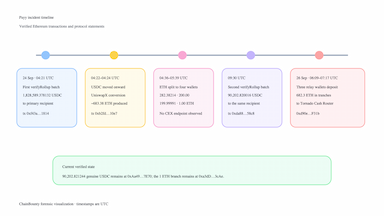
On September 24, 2026, crypto casino Duelbits reported a security incident affecting operational hot wallets across multiple blockchains.Public reporting cited in the investigation estimated the total loss at approximately $7 million, involving Ethereum, Solana, BNB Chain, Bitcoin, and Tron.ChainBounty analyzed the Ethereum leg of the incident, beginning with a confirmed withdrawal from a Duelbits-labeled hot wallet and tracing subsequent ETH movements through newly created intermediary wallets.The investigation identified 20 deposits totaling 1,370 ETH into the Tornado Cash Router between September 26 and September 28.However, the full 1,370 ETH cannot be attributed to the Duelbits incident with equal confidence. Based on transaction-level value paths currently anchored on-chain, up to 1,360 ETH of the Tornado Cash deposits can be explained by the tracked incident flow.No outbound exchange deposit was identified within the investigated path.Executive SummaryFinding Result Incident dateSeptember 24, 2026Blockchain analyzedEthereumConfirmed initial withdrawal836 ETH + 593,430.319285 USDTFirst receiving wallet0xA77e24Fe29d16E051e487ef4Ea7b056cb05aef76Reported consolidation wallet0x8dB9D7f0a03d212c566Ca80c66e294CeCC20C306Observed outbound movement from consolidation wallet1,914.1 ETHReturned to consolidation wallet540.0 ETHTornado Cash deposits observed1,370 ETH across 20 transactionsMaximum explained by tracked incident path1,360 ETHConfirmed exchange deposits in traced outbound flow0Consolidation-wallet balance at investigation snapshot973.536981 ETHInitial receiving-wallet balance at snapshot25.566884 ETHEvidence ClassificationClassification Meaning ConfirmedDirectly supported by transaction-level or address-attribution evidenceObservedTransaction path is directly anchored, but its attribution to the incident may depend on additional contextAnalytical assessmentInterpretation of observed behavior rather than independently proven intentUnverified leadPotentially relevant connection requiring additional evidenceThis distinction is critical throughout the investigation.An address interaction can establish that two entities touched the same infrastructure. It does not, by itself, establish that the investigated funds moved between them.1. Initial Withdrawal From the Duelbits Hot WalletThe Ethereum investigation begins with:0x014435B1E39945CF4f5F0c3cbb5833195A95CC9BThe address was attributed to Duelbits in the attribution data used during the investigation.Its first recorded activity occurred on February 14, 2024.At approximately 09:02 UTC on September 24, two major transfers left the wallet only 36 seconds apart.Time (UTC) Block Asset Amount Destination Transaction 09:02:1126046298USDT593,430.3192850xA77e24...aef760x4f2bc2a8...9bb73909:02:4726046301ETH836 ETH0xA77e24...aef760xcdc0b6dfac...3182dFull transaction hashesAsset Transaction hash USDT0x4f2bc2a8bc5040788c71e712546deec6d0f61529518b8114b0334ffd3e9bb739ETH0xcdc0b6dfacbefe4aef640be1538c9081bbf401ca9ad9784e1b0cfc044523182dThe receiving wallet,0xA77e24Fe29d16E051e487ef4Ea7b056cb05aef76was a previously unseen EOA whose first activity occurred on September 24.At the investigation snapshot, it retained 25.566884 ETH.What the blockchain proves — and what it does notBoth transactions were signed by the Duelbits hot wallet itself.That matters.From Ethereum transaction data alone, an investigator cannot distinguish an authorized withdrawal from a withdrawal executed by someone who obtained legitimate signing authority.The classification of these transactions as part of the reported compromise therefore relies on the incident disclosure and associated public reporting.The Ethereum transactions themselves show ordinary signed transfers rather than direct exploitation of a smart contract.2. The Missing Link to the Consolidation WalletPublic reporting identified the following address as the primary ETH consolidation wallet:0x8dB9D7f0a03d212c566Ca80c66e294CeCC20C306The wallet first became active on September 24.However, the investigation did not identify a direct value transfer from the initial receiver 0xA77e24... to the consolidation wallet 0x8dB9....Instead, two common counterparties were found.Address Activity Sent transactions Snapshot balance Label 0x181a638038a4bd75c207d080de83e217f8e8a1d7September 24 only60.000031 ETHNone0x4293b5dc11b250078da7359d7d57c15eecfcf70aJan. 2018 – Sep. 20263800.000547 ETHNone0x4293... is particularly notable because it sent funds to both the initial receiving wallet and the consolidation wallet.That creates a meaningful investigative lead.It does not yet create a verified value path.The transaction amounts and transaction hashes required to demonstrate that the investigated value moved through these common counterparties were not anchored in the current evidence set.ChainBounty therefore classifies:Connection Status Duelbits hot wallet → 0xA77e...Confirmed0xA77e... → 0x8dB9...Unverified value path0x8dB9... → downstream intermediary walletsObserved and transaction-anchoredDownstream intermediaries → Tornado CashObserved and transaction-anchoredThis gap prevents the entire Ethereum path from being presented as one uninterrupted forensic chain.3. A 0.1 ETH Route TestOn September 24, the consolidation wallet performed a small round-trip transfer involving another address.Direction Amount Transaction Consolidation wallet → 0x922adc...8cd230.1 ETH0x0edf6e07...bfe52b0x922adc...8cd23 → consolidation wallet0.1 ETH0x5eaf7ef1...a3f1aFull hashes:0x0edf6e07817a6d2eafd3f42c3d40c7dcab4756d4375286d48f26654dc9bfe52b0x5eaf7ef13016fd76a822f046935ca7b78f76bc66095249f8a8d8fec2d79a3f1aA 0.1 ETH round trip alone does not prove intent.Placed alongside the substantially larger transactions that followed, however, it is consistent with route validation before larger fund movements.That interpretation remains an analytical assessment rather than a directly provable fact.4. First Laundering Branch: 110 ETHBetween September 26 and September 27, the consolidation wallet began distributing ETH through newly activated intermediary wallets.The first branch started with:0xa31bb1fdf3409ce863bf646b69e6013ca74c38e3Consolidation Wallet → First IntermediaryDate Amount Transaction Sep. 2611 ETH0x2fa0bf95...12fac6Sep. 261 ETH0x928dccb8...286260Sep. 26650 ETH0xd9186462...62d801Total662 ETHMost of that ETH did not continue toward the mixer.First Intermediary → Consolidation WalletDate Returned amount Transaction Sep. 261 ETH0x98d87960...c0d83Sep. 26480 ETH0x391989db...03c1Sep. 2758.9 ETH0x29436031...0c8Total539.9 ETHAnother 111.1 ETH was forwarded to:0xadb82eef7baa2feaebe64f88577c06f803a2c578Date Amount Transaction Sep. 2610.1 ETH0xe4e83e46...896a5Sep. 27101 ETH0xaa3ff3bc...75ff6Total111.1 ETHThat wallet then deposited 110 ETH into the Tornado Cash Router:0xd90e2f925da726b50c4ed8d0fb90ad053324f31bDeposit Amount Transaction 110 ETH0xf12cf53b...d86af2100 ETH0xccaf6baa...5349Total110 ETHThe remaining 1.094278 ETH was returned upstream.This 110 ETH branch is fully explainable using the tracked transaction path.5. Second Laundering Branch: 1,260 ETHThe second and significantly larger movement occurred on September 28.The consolidation wallet transferred 1,252 ETH into a newly active address:0x6495afaeb766e59f3b725e6ef6e5622b44b272c3Consolidation Wallet → 0x6495...Amount Transaction 1 ETH0x2fb2fc01...709e3650 ETH0x72c887a4...b265e601 ETH0x425b31b4...e8a61,252 ETHThat wallet subsequently transferred 1,250 ETH into:0x56644f6a348a142d38fb7dde2e942c9ef03d09fcAmount Transaction 1 ETH0x5b6d00a9...ba07c500 ETH0xe8384b80...cff6f500 ETH0xb9424aa...bdc58249 ETH0x8471f89d...e6b5a1,250 ETHThe final intermediary then executed 18 Tornado Cash deposits.Tornado Cash Deposit StructureDenomination Transactions Total 100 ETH121,200 ETH10 ETH660 ETHTotal181,260 ETHIt also returned 1.905145 ETH upstream.This creates an important accounting issue.Observed activity at 0x56644f... ETH Tracked incident-path inflow1,250Tornado Cash deposits1,260Returned upstream1.905145Total observed outflow1,261.905145Outflow exceeding tracked inflow11.905145The intermediary therefore spent approximately 11.905145 ETH more than it received from the tracked upstream address.The origin of that additional ETH falls outside the investigated outbound path.As a result, ChainBounty does not attribute the full 1,260 ETH from this wallet to the incident.The maximum amount supported by the tracked inflow is 1,250 ETH.6. Why 1,370 ETH Does Not Equal 1,370 ETH of Attributed Incident FundsThe distinction can be summarized as follows.Branch Gross Tornado deposits Maximum explained by tracked incident path First branch110 ETH110 ETHSecond branch1,260 ETH1,250 ETHTotal1,370 ETHUp to 1,360 ETHThis is one of the most important findings in the investigation.The observed wallets deposited 1,370 ETH into Tornado Cash.But evidence-backed attribution should stop at 1,360 ETH unless the additional funding source at 0x56644f... can also be tied to the incident.A clean transaction graph is not the same thing as a proven provenance graph.7. Consolidation-Wallet Flow SummaryThe observed movements from the consolidation wallet can be summarized without double-counting as follows.Flow Amount 0.1 ETH test transfer0.1 ETHFirst intermediary branch662 ETHSecond intermediary branch1,252 ETHGross value sent from consolidation wallet1,914.1 ETHReturned to consolidation wallet540.0 ETHGross Tornado deposits from downstream wallets1,370 ETHConsolidation-wallet balance at snapshot973.536981 ETHThe wallet's complete inbound history was not reconstructed as part of this outbound tracing exercise.The 973.536981 ETH balance should therefore not automatically be treated as entirely stolen Duelbits funds.It is a monitored balance associated with the reported consolidation wallet, not a fully attributed recovery amount.8. The Laundering TypologyThe downstream activity shows several notable behavioral characteristics.Pattern Observation Assessment Small route test0.1 ETH sent and returnedConsistent with route validationDisposable EOAsFour intermediaries became active on the day they were usedConsistent with single-purpose routing infrastructureProgressive scaling110 ETH mixed before a later 1,260 ETH batchConsistent with testing before larger deploymentFixed denominations12 × 100 ETH and 6 × 10 ETH depositsConsistent with denomination-based mixer structuringBalance cleanupResidual ETH returned upstreamSuggests temporary wallets were cleaned after routingShort wallet lifespanIntermediaries showed only a small number of outgoing transactionsConsistent with operational compartmentalizationThe pattern is more structured than simply forwarding stolen ETH directly into a mixer.The sequence suggests an operator using temporary addresses, validating routes, scaling transaction size, and cleaning residual balances after use.This is a behavioral assessment. It does not, by itself, identify the operator.9. Address Poisoning Was Removed From the GraphDuring transaction review, ChainBounty identified 32 transactions consistent with address-poisoning activity.These transactions involved addresses deliberately resembling wallets in the investigation, often sharing similar starting and ending characters.Some also transferred fake assets named similarly to ETH rather than native ETH.Poisoning SummaryImitation address Target address Events Economic relevance 0x922a86...6cd230x922adc...8cd231Fake ETH-, no native ETH0xa31bb2...138e30xa31bb1...c38e313Fake ETH-, no native ETH0x6495e2...972c30x6495af...272c32Fake ETH-0xadb80c...1c5780xadb82e...2c5787Fake ETH-0x8db9cb...ec3060x8dB9D7...0C3067Zero-value native transfers0x5664cf...c09fc0x56644f...d09fc2Fake ETH-Total32ExcludedThese transactions were excluded because they showed no meaningful economic value flow and matched common address-poisoning characteristics.Including them would create false graph edges and potentially corrupt attribution.This is an important reminder that transaction-history proximity is not equivalent to financial linkage.10. No Exchange Cash-Out Was IdentifiedWithin the investigated outbound Ethereum flow:Destination category Confirmed deposits Centralized exchanges0Tornado Cash Router20 transactions / 1,370 ETH grossPublic reporting referenced Kraken and ChangeHero in connection with activity involving the consolidation wallet.Those references concerned claimed inbound flows into the wallet, rather than confirmed cash-out destinations in the outbound path analyzed here.ChainBounty therefore does not identify Kraken or ChangeHero as laundering destinations based on the present evidence.11. What the Ethereum Transactions Suggest About the Initial CompromiseThe initial ETH and USDT withdrawals were ordinary signed transactions.Observation Implication ETH moved via a standard native transferNo obvious Ethereum contract exploit in the transaction itselfUSDT moved through a standard token transferConsistent with valid signing authority being usedETH and USDT transfers occurred 36 seconds apartIndicates coordinated executionPublic reporting describes multiple chains affected in a narrow time windowBroader signing or withdrawal infrastructure compromise is plausibleThe available evidence is therefore more consistent with compromise of withdrawal signing authority than with a vulnerability in an Ethereum smart contract.Possible mechanisms could include exposure of private keys or compromise of infrastructure authorized to sign withdrawals.The blockchain cannot determine which mechanism occurred.That question requires off-chain evidence such as key-management records, signing-service logs, server telemetry, access logs, or other internal forensic material.12. The Most Interesting Unresolved AddressOne address differs significantly from the disposable infrastructure surrounding the incident:0x4293b5dc11b250078da7359d7d57c15eecfcf70aCharacteristic Observation First activityJanuary 5, 2018Activity lifespanMore than eight yearsOutgoing transactions380Interaction with initial receiverYesInteraction with consolidation walletYesAttributionUnknownThere are two materially different explanations.Hypothesis Investigative significance Operator-controlled gas or funding infrastructureCould expose older transactions, KYC-linked services, or reused infrastructureBridge solver, relayer, or other shared serviceMay have little or no attribution valueCurrent evidence cannot distinguish between them.The wallet should therefore be treated as a high-priority lead rather than evidence of attacker ownership.13. Remaining Investigative OpportunitiesPriority Investigative target Why it matters 10x4293...Could connect short-lived incident wallets to long-lived infrastructure20x8dB9... balanceFuture transfers may reach a bridge, exchange, or additional mixer3593,430.319285 USDT pathUSDT may remain technically freezeable depending on downstream disposition40xA77e... → 0x8dB9... gapClosing this gap would strengthen end-to-end provenance5Tornado Cash exitsPotential exit candidates can be evaluated against later exchange deposits6Non-Ethereum chainsSolana, BNB Chain, Bitcoin, and Tron remain outside this Ethereum-focused investigationAt the investigation snapshot, the two monitored wallets held:Wallet Balance 0x8dB9D7...0C306973.536981 ETH0xA77e24...aef7625.566884 ETHThe original 593,430.319285 USDT transfer also remains a significant unresolved asset path.If USDT remains in token form at an identifiable downstream address, issuer-level intervention may still be relevant.14. Fund-Flow Timeline15. ChainBounty AssessDate Event Amount Sep. 24Duelbits-labeled wallet → 0xA77e...593,430.319285 USDTSep. 24Duelbits-labeled wallet → 0xA77e...836 ETHSep. 24Consolidation wallet route test0.1 ETHSep. 26Consolidation wallet → first intermediary12 ETHSep. 26Consolidation wallet → first intermediary650 ETHSep. 26–27First intermediary → consolidation wallet539.9 ETH returnedSep. 26–27First laundering branch → Tornado Cash110 ETHSep. 28Consolidation wallet → second intermediary1,252 ETHSep. 28Second intermediary → final intermediary1,250 ETHSep. 28Final intermediary → Tornado Cash1,260 ETH gross15. ChainBounty AssessmentThe Ethereum evidence supports a clear downstream laundering pattern:short-lived EOAs → staged routing → fixed-denomination mixer deposits → residual-balance cleanup.It also supports a confirmed initial withdrawal of 836 ETH and 593,430.319285 USDT from a Duelbits-attributed wallet.What the evidence does not yet support is equally important.The value path between the first receiving wallet 0xA77e... and the reported consolidation wallet 0x8dB9... remains unanchored.And while downstream wallets deposited 1,370 ETH into Tornado Cash, the transaction-level incident path explains up to 1,360 ETH, not necessarily the full amount.That is the line ChainBounty draws between observation and attribution.ConclusionThe Ethereum portion of the Duelbits incident shows a structured laundering operation built around temporary wallets and Tornado Cash.A Duelbits-labeled hot wallet transferred 836 ETH and 593,430.319285 USDT to a newly activated address on September 24.Separately, ETH leaving the publicly reported consolidation wallet can be followed through four short-lived intermediary EOAs into the Tornado Cash Router.Those wallets deposited:Metric Amount Gross Tornado Cash deposits1,370 ETHNumber of deposits20Maximum explained by tracked incident path1,360 ETHConfirmed exchange cash-out0The distinction between 1,370 ETH observed and 1,360 ETH attributable is not a technicality.It is the difference between describing what appeared in a wallet's transaction history and demonstrating where investigated value actually came from.The investigation also remains incomplete at a critical point: the first recipient and the reported consolidation wallet have shared counterparties, but the value path connecting them has not yet been transaction-anchored.For that reason, ChainBounty does not present the case as a fully closed end-to-end flow.The next breakthroughs are more likely to come from closing that missing link, tracing the USDT path, analyzing the long-lived 0x4293... address, and monitoring the remaining ETH for interaction with identifiable services.Because in on-chain investigations, the goal is not to draw the cleanest graph.It is to know exactly which edges can be proven.Investigation MetadataField Value Case IDCASE-7907CC26NetworkEthereum — Chain ID 1Incident dateSeptember 24, 2026Investigation windowAugust 23 – September 28, 2026Gross Tornado deposits observed1,370 ETHIncident-path attributionUp to 1,360 ETHExchange deposits identified0This report is based on observable on-chain transaction data and address-attribution information available during the investigation. Statements describing behavior, intent, compromise mechanism, or operator infrastructure are analytical assessments unless explicitly identified as transaction-level facts.
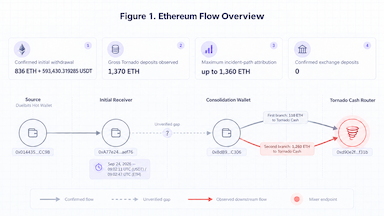
Executive SummaryBitget confirmed unauthorized transfers from hot wallets at 18:31 UTC on 24 September 2026. The exchange stated that cold wallets were not affected and that its protection fund exceeded $464 million. Public reporting placed the loss at approximately $351.6 million.SentinelTX expanded the investigation to 289 addresses and 41 evidence items across Ethereum, Arbitrum, Avalanche and BNB Chain. The pattern is consistent with a hot-wallet signing or key compromise: one consolidation EOA appeared across chains, stablecoins were rapidly swapped into ETH, funds crossed bridges, and Ethereum proceeds were split into fixed-size tranches.The clearest recovery lead is 20,763,612.55 USDC routed from Avalanche and Arbitrum through a common receiver into a Circle-labeled address. No centralized-exchange deposit or mixer exposure was confirmed in the reviewed scope.Incident AnchorsItemValueStatusEvidenceOfficial confirmation24 Sep 2026, 18:31 UTCConfirmedBitget statementPublic loss estimate$351.6MReportedCEO / mediaSentinelTX scope289 addresses; 41 evidence itemsConfirmedCase outputCEX or mixer exposureNone confirmedOpenReviewed scopeCore Wallet MatrixRoleAddressChainEvidencePrimary consolidation0x770b10b273fC44Fe9197D6bF20F145c2e98463EeMulti-chainHighUSDT0-to-ETH swap0xe410a2e5710ee787bcaa63f52a3943ff71f0d946ArbitrumHighStablecoin receiver0xb3fa262d0fb521cc93be83d87b322b8a23daf3f0Arbitrum / AvalancheHighCircle-labeled route0xfd78ee919681417d192449715b2594ab58f5d002Multi-chainHigh label; destination openEthereum source0x469Ac1406dE92f82C0563477240a3627057425DCEthereumHighEthereum hub0xa6dd3f218b65e32ccc37be30f74884133c655545EthereumHigh inbound; mixed outflowAvalanche downstream0x5085b3d52b5587c18ef456fcbcde9a11d48340f8AvalancheHighBNB downstream0x7c96279ec1e888aa56b9b836e0db26ca48573e1cBNB ChainHighWhat the Cross-Chain Flow ShowsThe primary consolidation address was active on Ethereum as early as 7 February 2026, contradicting descriptions of it as newly created. TRDB labels on two upstream addresses are useful leads, but do not independently prove Bitget ownership.Confirmed Chain-Level MovementsChainConfirmed movementActionConfidenceEthereum1,541.51 ETHSource to distribution hubHighArbitrum19,668,851.77 USDT0 → 7,111.344304 ETHSwap and splitHighAvalanche821,000 AVAX + 8,204,678.8 USDCTwo downstream routesHighBNB Chain12,719.45 BNBRouter-linked downstreamHigh; partial pathArbitrum: Swap, Split and Partial Stablecoin RecoveryOn Arbitrum, 19,668,851.77 USDT0 reached a dedicated swap wallet and was converted through UniswapX and 1inch intents into 7,111.344304 ETH. One branch converted 2,513 ETH into 6,561,140.178933 USDC; another 26,830.363654 USDC joined the same receiver before the route reached a Circle-labeled address.Key TransactionsChainTransactionMovementStatusEthereum0xbb7f4d68c339f44e048b45bcee466bc75a086fc02d89cda8242b5031639bf8b41,541.51 ETH → hubIncident-anchoredEthereum0x872dd53e25e071ae7ae6b653a44ff18cfc041e8fdea4ac0da72c6ef97ba4ede110,000 ETHGross hub outflow onlyEthereum0xd955a11839263c24e49ddb850b17663d0122904cee1fb9c436e04203a88ec28810,000 ETHGross hub outflow onlyEthereum: Anchored Inflow vs. Gross Hub ActivityA confirmed transaction moved 1,541.51 ETH from the Ethereum source to the hub. The hub later sent several much larger tranches. Those gross outflows cannot all be attributed to this incident because only the 1,541.51 ETH inbound is directly anchored to the investigated path.Bridges, Routers and Recovery LeadsInteraction with a router or bridge does not mean that service controlled the attacker.PriorityAddress / serviceObserved amountAction10xfd78ee919681417d192449715b2594ab58f5d002 / Circle20,763,612.55 USDCPreserve and freeze route20xe35e9842fceaca96570b734083f4a58e8f7c5f2a / Across1,600 ETHTrace destinations30xef4fb24ad0916217251f553c0596f8edc630eb66 / deBridge1.001213 ETHPreserve destination tx40x2bca667d37afe8d065ca46e3261e9442e77cbeae~1,997 ETH residualMonitor and trace50x5085b3d52b5587c18ef456fcbcde9a11d48340f8~620,999.99991 AVAXMonitor and traceWhat Remains UnprovenNo threat actor has been identified. No evidence confirms a CEX deposit or mixer. The direct link from the multi-chain consolidation address to 0x469Ac1406dE92f82C0563477240a3627057425DC was not independently confirmed; it remains a third-party Bubblemaps claim. Zero-value and tiny lookalike transfers were excluded as address-poisoning noise.Untraced RemainderChainUnresolved amount / pathNext stepEthereumMuch of 34.75M USDT/USDC; hub downstreamSeparate incident funds from prior activityArbitrum~1,997 ETH + ~990 ETH; Across destinationsTrace destination chainsAvalanche~620,999.99991 AVAX; router outputResolve router recipientsBNB Chain~9,719.45 BNBTrace beyond shared routersConclusionThe evidence confirms coordinated cross-chain dispersal and a high-priority Circle recovery route, while leaving substantial balances and several bridge destinations unresolved. The urgent action is preservation and freeze outreach for the Circle-labeled path, followed by destination tracing for Across and deBridge.Evidence note: wallet balances and labels reflect the SentinelTX investigation cutoff. Public statements, third-party labels and analytical inference are separated from transaction-confirmed facts.
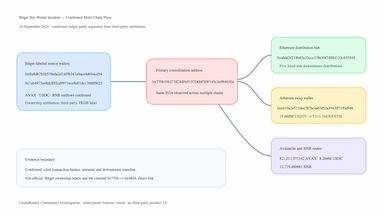

 Become an Investigator